
The Last Colonnade Oldsmobile 4-4-2 Traded Its Rocket 455 For Corners
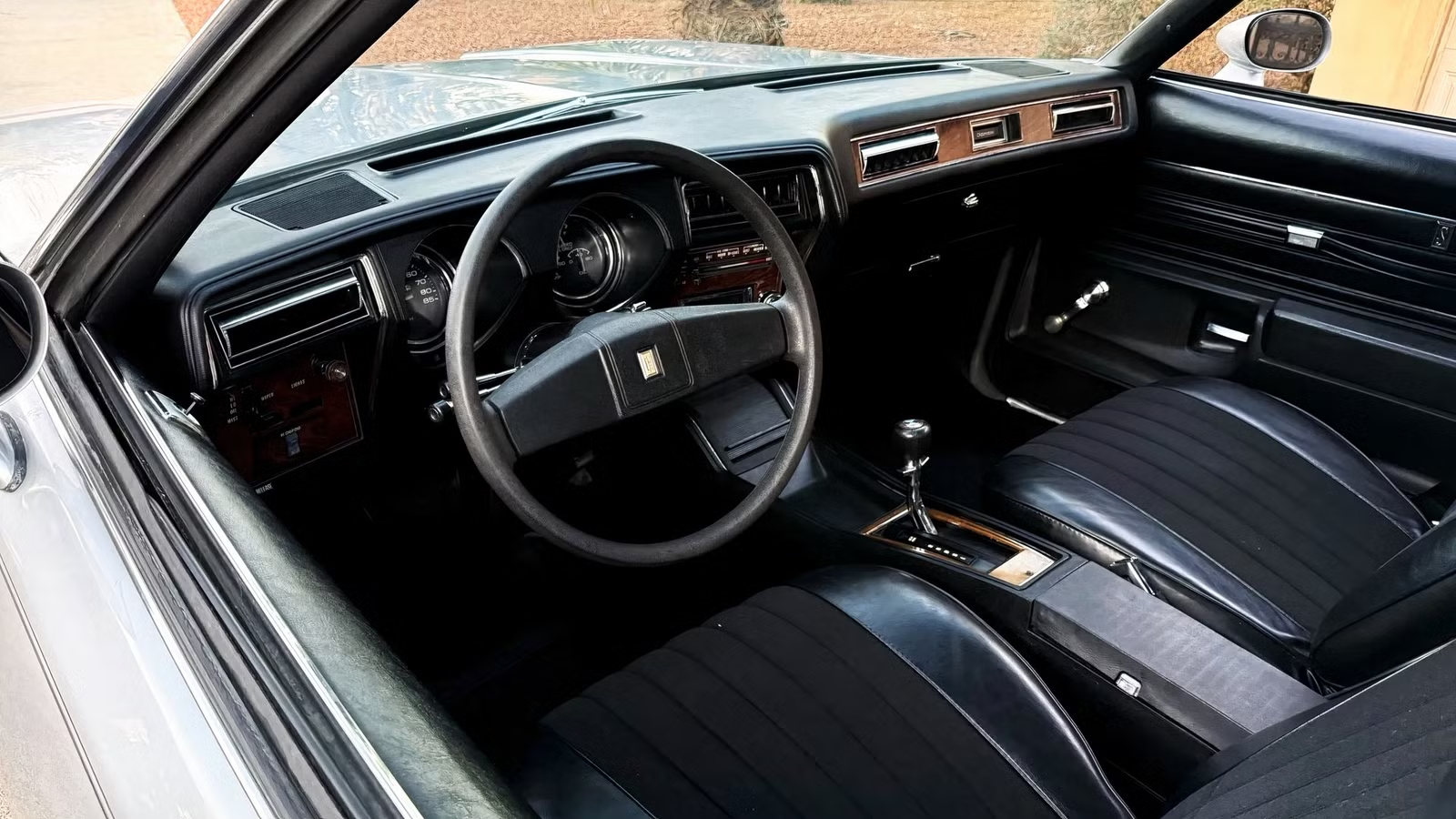
Oldsmobile had spent years building a nameplate into one of America’s most recognizable muscle-car names, but by the late 1970s, the recipe was getting harder to sell. Big-block engines were disappearing, horsepower was falling, and emissions regulations were changing what performance cars could do. Yet Oldsmobile wasn’t ready to let its sporting image go quietly. Its answer looked aggressive, handled better than its numbers suggested, and carried one of the most famous badges in American performance. It just didn’t have the engine most people would expect.
Oldsmobile Was Running Out of Muscle

Give an Oldsmobile midsize car a serious V8, a stout drivetrain, and enough performance hardware to make it interesting, then let the thing loose on American roads. That formula worked remarkably well through the muscle-car era. By the middle of the 1970s, though, the rules had changed.
Emissions regulations had started taking a serious bite out of engine output. The introduction of catalytic converters in 1975 also ended the availability of dual exhaust on Oldsmobile’s V8s, while changing rear axle ratios and engine calibrations put more emphasis on fuel economy. Horsepower and torque figures that once seemed perfectly normal for a performance Oldsmobile were suddenly looking much less impressive.

Oldsmobile wasn’t alone in feeling the squeeze. Pontiac had already let the GTO nameplate disappear after 1974, and Chevrolet’s Chevelle SS was gone a year before that, folded into the milder Laguna S-3. Most of the muscle-car names that had defined the 1960s were already dead or reduced to stripe-and-scoop packages on family sedans. Oldsmobile could have let its own nameplate quietly join them. It didn’t.

The biggest engines were disappearing, too. Oldsmobile’s 455-cubic-inch V8 hung on a bit longer, but it was already a shadow of the engine that had powered the most celebrated versions of the car earlier in the decade. Within another year, it too was gone. That left Oldsmobile with a problem. The nameplate still carried plenty of weight, but the mechanical recipe behind it was changing fast. The company could have treated the badge as little more than a styling exercise. Instead, it found another way to give the car some sporting character.
Oldsmobile Started Making the Chassis Matter More

With engine output falling across the industry, there was less point in pretending that every performance car needed to be a quarter-mile weapon. A car could still be fun if it responded well to the driver, and Oldsmobile was paying more attention to that side of the equation.
The suspension became an important part of the answer. Firmer springs, bigger sway bars, and a more controlled ride started doing the work that a big engine used to handle on its own, and that was a meaningful shift from simply bolting on stripes and calling something sporty. It also meant Oldsmobile’s engineers had to think about the car differently, tuning it to feel quick through a corner rather than just quick in a straight line.

Styling did its part too. The regular Cutlass received a squared-off front end around this time, while the performance version kept a more aggressive, slanted nose with a revised grille. That gave it a more purposeful face than the ordinary cars parked beside it at the dealership. Some of the changes were cost-cutting rather than performance philosophy. These cars also swapped some of the earlier chrome trim for plastic, a small but telling sign of where Detroit’s priorities were headed.
This was becoming a different interpretation of American performance. There was still an aggressive-looking car, still a tuned suspension, and still a V8 available, but the enormous engine that once defined the package was disappearing. The question was what Oldsmobile had actually built when the old muscle-car formula finally ran out.
The 1977 Oldsmobile 4-4-2 Was the Last Colonnade Car to Wear the Badge

The answer was the 1977 Oldsmobile 4-4-2, offered as the W29 Appearance and Handling Package on the Cutlass S. It was the final year for the Colonnade body style, and by then the 4-4-2 had become much more about its suspension and appearance than outright power. The engine lineup makes the change almost comical when compared with the cars that made the name famous.
A 231-cubic-inch (3.8-liter) Buick V6 producing 105 hp was standard. Buyers could step up to a 260-cubic-inch (4.3-liter) V8 making 110 hp, a 350-cubic-inch (5.7-liter) four-barrel making 170 hp, or the new 403-cubic-inch (6.6-liter) four-barrel, which produced 185 hp. The 403 was as good as it got in 1977. The 455 was gone after 1976, so there was no 455-powered 1977 4-4-2. A 4-4-2-equipped Cutlass S started around $4,520 that year, which bought a lot more attitude than it did outright speed. That may sound like a pretty miserable ending for a muscle-car name, but it misses what Oldsmobile was actually doing.

The W29 package included the FE2 Rallye suspension, the special body-side treatment, 4-4-2 graphics, bright trim, and that distinctive slanted front-end panel and grille. It wasn’t a 455 replacement. It was an attempt to keep the 4-4-2 feeling like a performance car after the engine that once defined it had disappeared.
Whichever engine buyers chose, the W29 hardware came along for the ride, so a 4-4-2 badge and a base V6 could just as easily end up on the same window sticker. And there were still plenty of them on American roads. Oldsmobile put the W29 package on 11,649 Cutlass S coupes for 1977, up from 9,576 the year before, proof that plenty of buyers still wanted the badge even without the big engine behind it.
The 403 Wasn’t a Muscle-Car Monster, But the 4-4-2 Still Had Something To Prove

Nobody should confuse 185 hp with the numbers attached to the legendary 4-4-2s of the muscle-car era. The 1977 car wasn’t hiding some giant engine waiting to embarrass a W-30. It was a product of a completely different automotive world. The 403 did at least bring some proper V8 character to the package. It produced 320 lb-ft of torque at 2,200 rpm, giving the car considerably more low-speed shove than its horsepower figure suggests.
The 403 came paired with a three-speed automatic, while buyers who wanted three pedals had to step down to the 260 V8, which could be ordered with a five-speed manual. Period road tests put a 403-powered 4-4-2 through the quarter mile in 17.3 seconds at just over 79 mph, respectable for a car built around emissions compliance rather than straight-line speed.

More importantly, the chassis wasn’t an afterthought. The FE2 suspension gave the car firmer springs and shocks, larger sway bars and wider wheels, and contemporary coverage found the handling to be one of the car’s strongest qualities. That combination meant the 1977 4-4-2 could work a corner in a way the window sticker never hinted at. It wasn’t winning a stoplight drag race against anything from a decade earlier, but point it down a two-lane road and the chassis did most of the talking.
That matters because the 1977 4-4-2 doesn’t need to win a horsepower argument to be interesting. Its appeal comes from the fact that Oldsmobile was trying to preserve some of the character of a performance car after horsepower had stopped being the whole story. That’s a different kind of interesting than a big block posting huge numbers, but it counts for something all the same. It was a very late-1970s solution to a very late-1970s problem.
The Last Colonnade 4-4-2 Is Still Worth a Look

The 1977 4-4-2 won’t command the money of the famous early cars, and that’s part of its appeal. The Hagerty valuation tool puts a 403-powered example in Good condition at $23,233. That’s a guide value rather than a guaranteed selling price, and a clean, well-documented car with the right options will bring more.
That dip isn’t really about the 1977 car losing appeal so much as the whole hobby recalibrating. As prices for the famous muscle-car years keep climbing out of reach for a lot of buyers, more collectors are turning toward the awkward middle chapters of the story instead: the cars nobody wanted back when insurance companies and emissions mandates were calling the shots instead of the engineers.

That still puts the 1977 4-4-2 in a very different financial universe from the collectible W-30s. Production was never huge to begin with, and it gives enthusiasts a genuine shot at owning one of the strangest endpoints of Oldsmobile’s muscle-car story without buying into the mythology and prices surrounding the best-known cars. A manual transmission was technically available, but the overwhelming majority of 4-4-2s left the factory with an automatic, which makes a documented stick-shift car a rare find today. The 1977 4-4-2 wasn’t the last 4-4-2 ever, but it was the last version built on the larger Colonnade body before GM downsized its A-body lineup for 1978. The badge would return on the rear-wheel-drive G-body Cutlass in the mid-1980s and again briefly around 1990, but never on a Colonnade car again.
And that’s exactly why it deserves more attention. The W-30 crowd gets the glory days, and the invoices to match. The 1977 car gets the ending, and that’s a story the W-30 money can’t buy. This is the final Colonnade 4-4-2, carrying the badge into an era when big engines were disappearing and chassis tuning had to do more of the talking. It isn’t the 4-4-2 that proves how powerful Oldsmobile could be. It’s the one that shows how long Oldsmobile was willing to keep the name alive after that kind of power was gone.
Sources: Bring A Trailer, Classic.com, Hagerty Valuation Tools

Related posts


Latest Post


No Comments