
Nissan’s Electric GT-R Prototype Died After One Nürburgring Lap, So The R36 Stays Hybrid
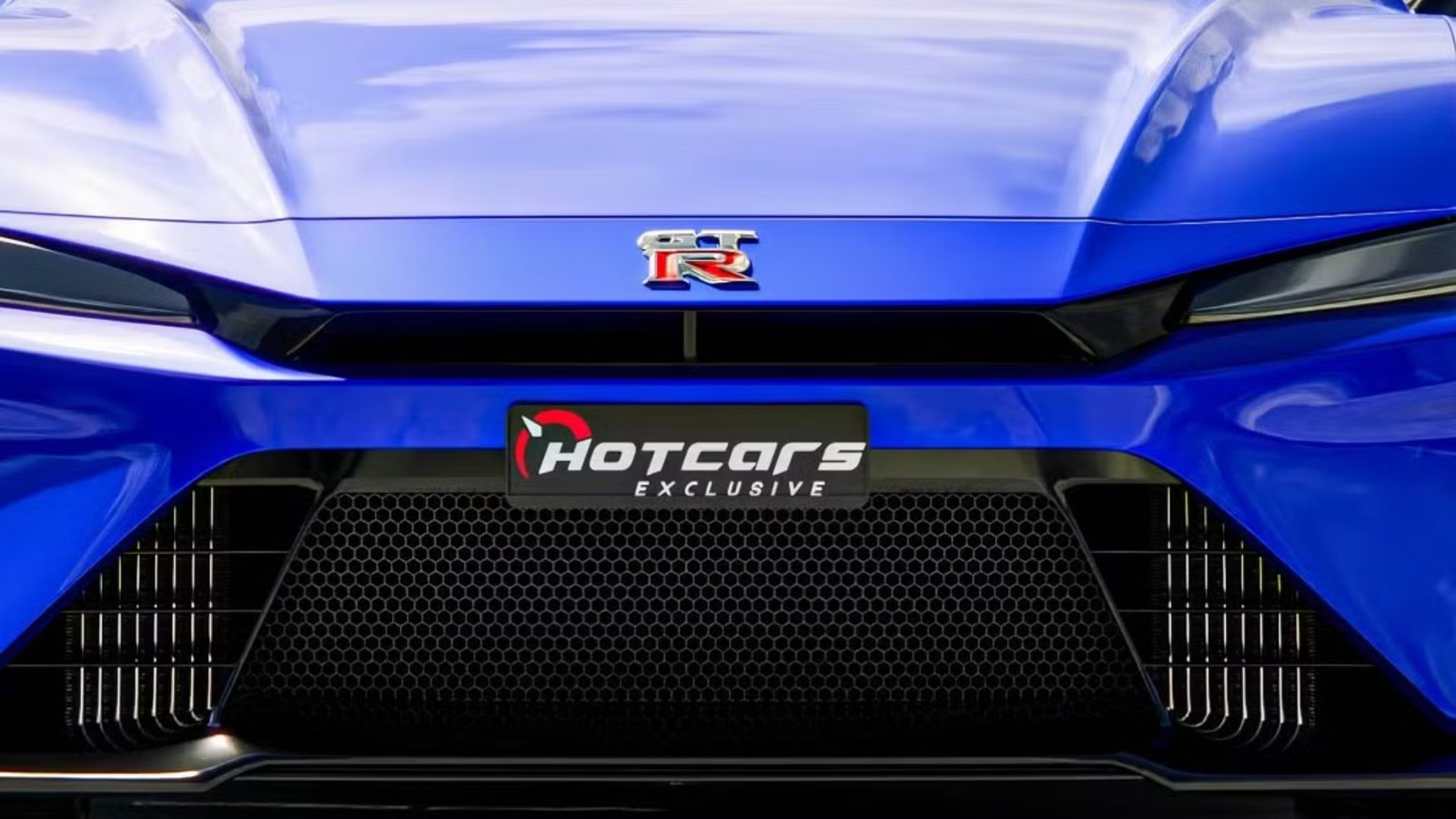
The development of the next generation of the Nissan GT-R has to be one of the most scrutinized development stages of any car in recent years. Pretty much every gearhead is waiting anxiously to see how it turns out. It has now been confirmed this year that what will become the R36 GT-R is already in development. While it looks like it’s set to become an all-new car, with a whole range of new technology for the GT-R in it, there is one crucial part of the GT-R experience that looks like it’s not going to change. That’s the fact that, for the time being, the GT-R will stay as an internal combustion engine vehicle.
Nissan Developed Electric GT-R Prototypes, But They Had Serious Issues With On-Track Performance

The GT-R staying as a combustion-powered supercar isn’t a choice that Nissan‘s made lightly. It’s known that the Japanese automotive giant did experiment with building fully-electric prototypes for what could have gone on to become the R36 GT-R. But according to Nissan’s management, those fully-electric prototype cars had a really big problem. Ponz Pandikuthira (Nissan North America’s Senior Vice President and Chief Planning Officer) told automotive media that these prototypes “would complete one lap at the Nürburgring, and then you have to recharge.”
Pandikuthira’s statement confirms a lot of what we already know about fully-electric Sports Cars and Supercars. While their performance may be incredibly impressive, trying to run them flat-out for an extended period of time really shows that they’re not quite ready for full-on, traditional track day use. They just don’t have the range to go around a track at full speed for more than short bursts, and after that they need an extensive amount of time to recharge.
Nissan Has Decided To Preserve The GT-R’s Mechanical Soul, With A Hybrid Powertrain


Because of these issues with a fully-electric version of the GT-R, Nissan has decided to preserve the mechanical soul of prior GT-Rs. It’ll have a hybrid setup, integrating the experience Nissan already has with hybrid cars into its next-generation halo model. The ICE in the R36 GT-R’s new powertrain could also end up being a development of the twin-turbocharged V6 from the R35.
This new hybrid setup could be incredibly powerful. Estimates so far have put the output for the regular R36 GT-R at 800-900 PS (789-888 horsepower). A Nismo version could have as much as 1,000 PS (986 horsepower). That would make the Nismo version as powerful as the original Bugatti Veyron, or the Ferrari SF90 Stradale.
Why is the GT-R going to become electrified? It’s because global emissions requirements are demanding it. Nissan’s Global Head of Product Strategy Richard Candler said earlier in the year that the next GT-R “will have to be electrified because of emissions regulations at some level, of course.” He followed that up by saying that “it’s just common sense that you would have a sense of electrification” about how the R36 GT-R’s powertrain will turn out.
There Are Worries That A Hybrid Powertrain Could Come With A Significant Weight Penalty

While the choice to make the R36 Nissan GT-R into a hybrid as a way of keeping the ICE part of the car intact is music to the ears of many enthusiasts, they are worried about a potential problem it could bring. Hybrid performance cars have often ended up carrying a significant weight penalty, compared to the pure ICE cars that came before them. There’s no better example of this than the latest version of the BMW M5. The G90 M5 ended up being 1,020 pounds heavier than the old F90 generation. This had the slightly embarrassing effect of making the G90 slower than the F90 in a lot of metrics, even though it has around 100 more horsepower and nearly 200 more lb-ft of torque. A lot of die-hard enthusiasts will be hoping Nissan doesn’t make the same mistake with the GT-R that BMW made with the M5, and turn what was once a deft combustion-engined supercar into a bloated mess.
There Are Other Reasons Why Nissan Won’t Make The R36 GT-R Fully Electric
The issues with on-track performance that we’ve been told about are the prime reason why Nissan has, for now, held off on making the GT-R fully-electric. But, the full reasons why run deeper than just that. There are some genuine technical hurdles that can’t quite be overcome yet that explain why Nissan is going for a hybrid setup instead of fully committing to an electric future for its halo model. There are also some parts of the fundamental GT-R experience that a fully-electric car would either struggle to replicate or not be able to replicate at all.
Nissan Is Worried About Battery Problems With Fully-Electric Supercars

Nissan has expressed concerns with the limits of battery technology as part of their explanation as to why the R36 GT-R won’t be fully electric. A big part of those worries are due to the issues that are inherent with current EV batteries. “I think what we’ve seen so far is that electric sports cars haven’t been hugely popular,” Richard Candler said when talking about the idea of a fully-electric GT-R. “I think they’ll come as better battery technology takes its next leap, but the current lithium chemistries are not capable of producing a GT-R-type product.”
As we’ve already seen with the issues the electric prototypes had at completing laps at the Nürburgring, the range is a factor. But thermal management is a problem too. Batteries require thermal management, too, and they struggle much more with that in continuous use than pure ICE cars and hybrids do. That’s especially the case in hotter climates. On hot track days in the Middle East where temperatures can push over 40 degrees Celsius (and even towards 50 degrees Celsius), current battery and battery cooling tech just can’t keep up with the standards that GT-R customers would demand of it.
It Wouldn’t Be An “Authentic” GT-R Experience

One of the other major reasons why the R36 GT-R won’t be going fully electric is more psychological than technical. But they are important to the overall experience of the car. Ponz Pandikuthira has remarked that a fully-electric GT-R is “just not authentic.” That’s something a lot of enthusiasts would absolutely agree with. The GT-R is very much thought of as a traditional ICE performance car. To go straight from pure internal combustion to pure electric would be an incredibly jarring transition. It would result in a car that wouldn’t have anywhere near the same kind of visceral noise as an R35 GT-R. As a result, many gearheads would reject it, and it would be a disaster for Nissan’s plan to keep sports cars alive in its model lineup.
The R36 GT-R Could Be With Us Sooner Than We Think

The details on exactly when the R36 Nissan GT-R will show up are currently up in the air. Even Nissan itself doesn’t seem to quite know. It has said that we could see the car and learn all the details about it by 2028. That date, though, depends on what happens with US emissions laws. If Nissan does know what’s going on with that by 2028, we could see the first R36 GT-Rs roll off the production line in 2030. That’s still a few years away. But, considering the R35 GT-R’s production only completely finished in 2025, that’s sooner than we might have thought.
Sources: BMW, Bugatti, Driven Car Guide, Ferrari, Motor1, Nissan,

Related posts



Latest Post


No Comments