
Five Rarest Cars at Mecum Nashville 2026 Auction
Mecum Nashville 2026 opens its doors September 22, and somewhere inside a catalog of more than 1,700 lots are five cars that most collectors will never encounter anywhere else. Hagerty combed through the full listing and flagged a handful of genuinely obscure machines — a one-off Chrysler prototype, a microvan barely larger than a riding mower, a German amphibious SUV that crossed the Atlantic exactly once, a Japanese-market retro oddity rarer than most hypercars, and a SEMA show car that’s been sitting in Roush’s own collection for two decades.

The sale runs through September 26 in Nashville. For anyone who follows rare iron, this is the watch list.
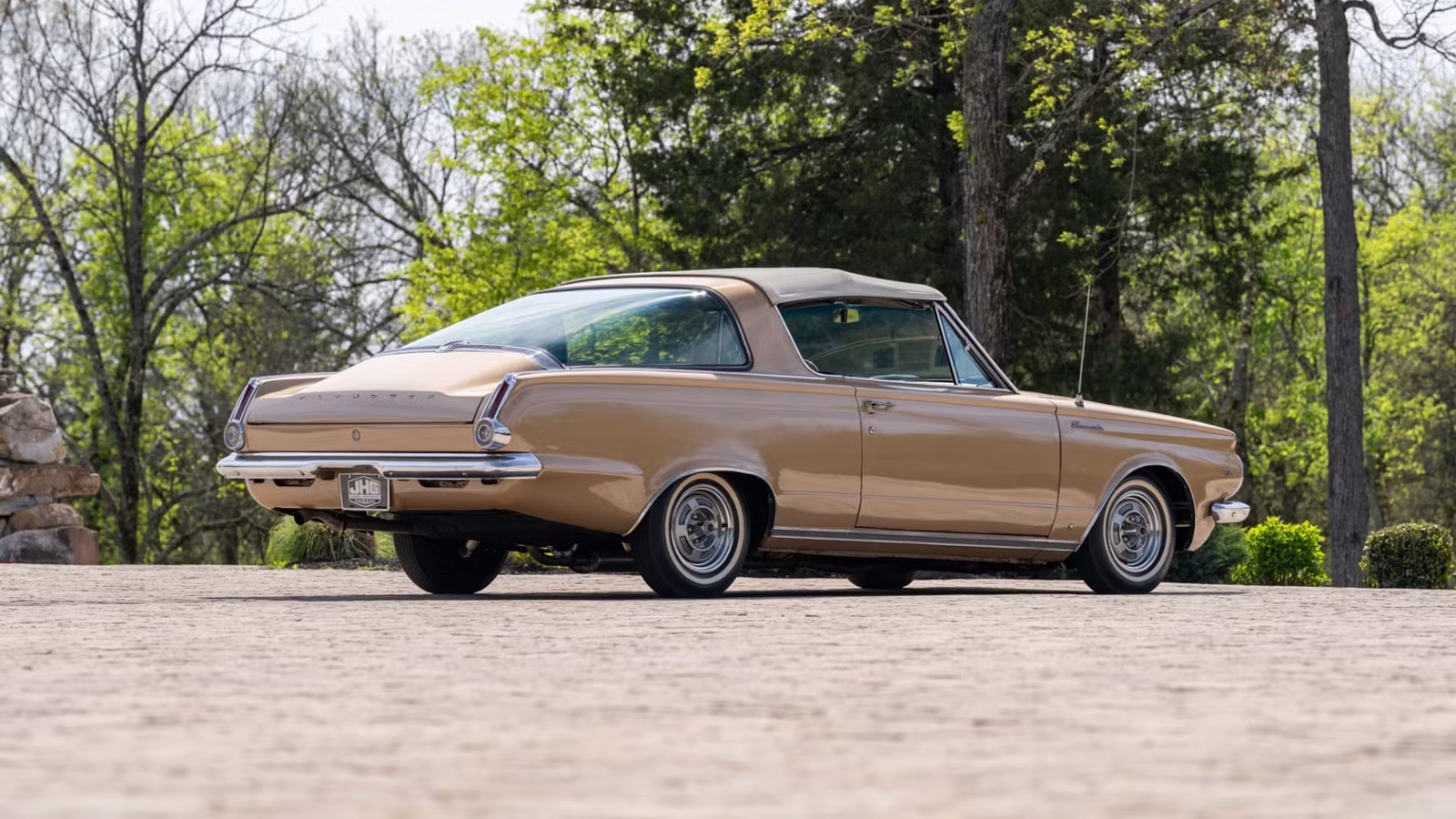
A 1964 Plymouth Barracuda Prototype With a Targa Roof Nobody Knew About
The first-generation Barracuda launched in 1964 as a fastback only — no convertible until the second generation arrived. This Landau Prototype, built by Chrysler designers, was an internal proof-of-concept to show that an open-air Barracuda could work. Rather than a full folding roof, it used a removable targa-style panel, the same basic idea Chevrolet has used on the Corvette for years. Structural rigidity and simplicity were almost certainly the reasoning.

Finished in gold over gold, the car is powered by a 273-cubic-inch V-8 paired with a push-button automatic. The odometer reads approximately 52,500 miles, which means this prototype actually got driven — it didn’t spend 60 years in a warehouse. Equipment includes an AM radio and a three-spoke steering wheel. One-off factory prototypes from this era rarely surface at public auction, and a first-gen Barracuda variant that never reached production is exactly the kind of lot that stops serious collectors cold.
A 1978 Willam Fourgonnette, the Microvan That Runs on Scooter Power

The Willam brand was founded in 1967 by Henri Willame, who previously ran Lambretta, the Italian scooter maker. Willame partnered with industrialist Carlo Lavezzari and set up production near Brescia to build vehicles aimed at the French market — machines so small and slow that a scooter license was all you needed to drive one legally.
The Fourgonnette was the commercial van variant in Willam’s lineup, which also included a Jeep-like open model called the Farmer and a city car simply called the City. The Nashville example is a 1978 model powered by a 125-cc, 5.6-horsepower single-cylinder engine mated to a four-speed manual. It’s painted yellow with a black bench seat and no rear seating — which, given the dimensions, probably counts as generous cargo space. This is one of the rarest microcars ever built, and the Willam name barely registers even among dedicated microcar collectors.
The Only RMA Amphi-Ranger in the United States Is Going Up for Bid

Germany’s Amphicar gets most of the attention when amphibious civilian vehicles come up, but the RMA Amphi-Ranger is a different animal entirely. RMA — short for Rheinhauer Maschinen und Armaturenbau — was a pipeline equipment manufacturer that needed a vehicle capable of reaching pipelines across water. When nothing on the market fit the bill, the company built its own.
The Amphi-Ranger debuted in 1985 with a galvanized steel chassis and aluminum body. Engine options included Ford-sourced V-6s, and locking differentials made it genuinely capable on land. On water, a dashboard switch lowers a rear-mounted propeller and you keep moving. RMA eventually sold the vehicle to the public; the German police used it to patrol the Rhine River. Production ended in 1995 after roughly 66 units were built — low demand made it impossible to justify continuing. The Nashville lot is one of those 66, powered by a Ford 2.9-liter V-6 with a five-speed manual, and it is believed to be the only example currently in the United States.
The Mitsubishi Pajero Junior Flying Pug Sold Just 139 Units Worldwide

Mitsubishi planned to build 1,000 examples of the Pajero Junior Flying Pug between September 1997 and June 1998. It sold 139. That production shortfall makes this Japanese-market retro SUV rarer than virtually any Ferrari or Lamborghini limited edition you could name.
The Flying Pug wore a full body kit designed in-house by Mitsubishi, drawing on 1950s British car styling: upright front end, round headlights, a bright grille, a hood ornament, round rear lights, and pronounced wheel arch flares. The result was a small SUV that turned heads in a market already accustomed to quirky kei-adjacent vehicles. The Nashville example is powered by a 1.0-liter four-cylinder making 79 horsepower, paired with a three-speed automatic and four-wheel drive. Most enthusiasts have seen photos of the Flying Pug; very few have seen one in person.
A One-Off Roush Signature G6 From SEMA 2004 Rounds Out the List

The fifth car Hagerty flagged is a one-of-a-kind Roush Signature Pontiac G6, built for the 2004 SEMA show and currently part of Roush’s own collection. The G6 is not a car that typically earns collector attention, but this particular example is different. Roush fitted it with a 3.5-liter V-6 with a cold-air intake and a GM Performance dual exhaust, then wrapped the whole package in a body kit that includes a deeper front bumper, sculpted side skirts, and a trunk spoiler. It rides lower than stock on Eibach springs and rolls on black-finished 19-inch alloys finished in a color called Merles Opus Orange Yellow.
Inside, Sparco front seats upholstered in black and yellow, Sparco-inspired rear seats, and a pair of auxiliary gauges on the driver-side A-pillar complete the SEMA-era build. The car won the GM Design Award at the show. It’s a time capsule of early-2000s tuner culture, and the fact that it’s coming directly out of Roush’s collection gives it a provenance most show cars never carry.
Five cars, five genuinely different reasons to set a calendar alert for Nashville. The Mecum sale runs September 22–26, and lots like these don’t surface twice.

Related posts





Latest Post


No Comments