
10 Vehicles With The Worst Names Of All Time
In the early 1960s, Plymouth was developing a new model that it intended to call the “Panda,” but luckily one brave soul stood up to corporate and said that’s an absolutely stupid name for a car. Luckily, that voice was listened to and the car became the “Barracuda,” which would go on to be the baddest ride of the Golden Age of American Muscle, something that would have never happened if it had been named after a cuddly, bamboo-eating bear. A car’s name is as important as its design or function in attracting buyers, but for some reason automakers consistently saddle their models with ridiculous nameplates that often doom their appeal. Here are the worst car names of all time that beg the question: “What the hell were they thinking?”
10
Volkswagen Golf
Unintentional Golf Cart

Volkswagen introduced the subcompact Golf as a replacement for the Beetle in 1974 for the European market, but wisely figured that name wouldn’t fly in the U.S., so the cars were sold as Rabbits here, which isn’t much of an improvement. Eventually, in 1985, they brought the Golf name to the Americas, and it’s one of the silliest names for a car ever. It doesn’t help that the Golf is basically a glorified golf cart in size and power, but it’s also a name that doesn’t make a lot of sense. It’s like if they named it the VW Badminton or the VW Skee Ball. VW got into this weird groove of naming its cars after winds like the Scirocco, which is a Mediterranean wind, and there are rumors that the Golf was named after the Gulf Stream, but that doesn’t make things better. On the other hand, the dorky Golf name fits the dorky Golf design, so at least it’s model appropriate.
9
Isuzu Amigo
Surprisingly Unfriendly

Amigo is the Spanish word for “friend” and there’s nothing inherently wrong with that. As a car name, however, it’s preposterous, and yet in 1989 Isuzu unleashed the compact SUV Amigo on the North American market. It was meant to compete with the Suzuki Samurai, which, by the way, is a killer name for a vehicle, but saddled with the lame Amigo moniker, it didn’t have quite the impact. An off-road vehicle needs a rugged name like Durango or Denali, so calling it the Isuzu Amigo made it seem wimpy and incapable. It’s like if it was the Isuzu Ami or Isuzu Freund, plus it’s gendered, referring only to male friends. In a crazy M. Night Shyamalan twist, this vehicle was named the Isuzu MU in Japan, which is a substantially worse nameplate.

8
Mercury Villager
Angry Peasants

In the 1931 Frankenstein film, villagers armed with torches and pitchforks chase the monster to a windmill after he had killed a young girl and burned it down. While that’s an awesome moment in classic cinema, it’s not necessarily an awesome name for a vehicle. Mercury disagrees and called their minivan, which debuted in 1993, the “Villager.” That name conjures up images of medieval peasants or angry monster hunting mobs, neither of which jive with the family demographic of the minivan segment. It’s possible that Mercury was trying to steal some thunder from the Plymouth Voyager, which was part of Chrysler’s incredibly successful minivan lineup, but just because the names sound similar doesn’t mean they have anything in common. The completely nuts thing about this ride, which has nothing to do with its name, is that two Villagers, the least collectible rides of all time, have been sold on Bring a Trailer, including the one pictured above which went for $1,759 in 2026.
7
Saturn Outlook
Magic 8-Ball Says Outlook Doesn’t Look Good

In 2007, Saturn tried to break free from its cheap compact persona with a three-row full-size SUV it unfortunately named the “Outlook.” We can’t even think of a less inspired or more inappropriate name for a real SUV than Outlook. Microsoft Outlook is a decent name for a personal organizer program, but Saturn Outlook is bizarre. Again, SUVs need names of outdoorsy places or off-road events, not lofty aspirations and personal opinions. Nobody would buy a Saturn Perspective and, as it turns out, not a lot of them wanted an Outlook either. After a decent 34,700 unit run in 2007, the Outlook was down to 3,637 sales in 2010 before being discontinued. The kicker here is that Saturn as an automaker, was also discontinued in 2010. Coincidence? I think not.
6
Dodge Rampage
No Ram, No Rage, Just P

To be clear, the name “Rampage” is not awful, but it belongs on a vehicle that kicks all the ass and not something wimpy and timid. The Dodge Rampage, introduced in 1984, was a front-wheel-drive, 84-horsepower four-cylinder compact pickup/car that was the least rampaging thing that ever existed. This was an Omni with a truck bed and, as you can see from the picture, that’s as terrible as it sounds. Dodge actually flirted with a rampaging Rampage full-size concept vehicle that was Hemi-powered and then built a much less sucky compact Rampage for the South American market, that will hit U.S. shores possibly in 2028. If you’re going to talk the talk, you gotta walk the walk, and the original Rampage was completely incapable of backing up its boastful name.
5
Pontiac Aztek
Mesoamerican Misery

The original concept for the Pontiac Aztek was to combine the Chevy Camaro and Blazer into a kind of hotrod small SUV, which would actually have been cool. Instead, GM made Pontiac build it on a minivan platform, which resulted in the tall, awkward abomination that it became. The name Aztek was chosen because they felt it would evoke ideas of strength, adventure, and ruggedness, which it most certainly did not. It seems weird that this needs to be pointed out, but naming a car after an ancient race of people is never a good idea, even if you purposefully misspell it. A Hyundai Hittite or an Oldsmobile Ostrogoth would never fly and, as it turns out, neither did the Aztek. GM, for some reason, thought it was going to sell 75,000 units a year with this vehicle, but it fell far short in its 2001 debut, selling around 27,000. It went downhill from there to just 5,500 units in 2005 before going extinct.
4
Buick Rendezvous
Infidelity Innuendo

The Rendezvous was Buick’s answer to the Pontiac Aztek, with slightly less hideousness but an equal amount of bad naming. Rendezvous is the French word for a meeting or gathering, but is mostly used in the context of an extramarital sexual tryst. It connotes cheating on your spouse, which makes it easily the worst name for a family SUV anyone could come up with. Buick is reported to have chosen this name because it was “lifestyle-oriented,” which it may be, but that lifestyle is one of infidelity and not a good fit for the family market. If they had some kind of midlife crisis turbocharged convertible sports car named the Rendezvous, that would actually work, but for a wholesome family unit, it’s completely wrong. Since we’re coming up with fictional equivalencies to demonstrate how bad these names are, this is akin to the Chevy Concubine, Mercury Mistress, and Saturn Side Piece.
3
Nissan Murano
It’s Italian For Moron

Automakers have long given their models European-sounding names because they think it projects a level of class or sportiness. While the Cadillac Eldorado and Chevy Chevelle worked out just fine, the Nissan Murano was an epic fail. Having a dopey-looking crossover that already suggests you made a poor purchasing decision, combined with a name that sounds like the Italian word for “moron,” is one of the biggest self-inflicted blunders in automotive history. Spellcheck reprimanded this editor for using the word “moron,” and we can’t help but think that might have been a more appropriate name for this vehicle. It turns out Murano is an island near Venice, famous for glassmaking, which isn’t exactly a great vehicle name for a variety of reasons, including the fact that it comes off like idiota or stupido.
2
Chevrolet Citation
Moving Violation

Chevrolet has long favored alliteration with models like the Corvette, Chevelle, and Camaro, all of which are genuinely iconic names. However, the brand has produced some unfortunate entries among its “C” cars, like the Celebrity, Chevette, and Cruze, but none is worse than the Citation. Introduced in 1980, the Chevy Citation was a compact front-wheel-drive hatchback that is actually one of the worst cars ever built. With so many recalls, the car became synonymous with crap, so in 1984 Chevy began calling it the Citation II to distract people. A citation is a mild award or commendation, but for most people it’s a traffic ticket, which is certainly an odd thing to name a car after. The good news is that with the base 90-horsepower 2.5-liter four-cylinder and three-speed automatic, the Citation took 14.6 seconds to go from 0-60, so there was little chance any owners ever got a speeding ticket in one.
1
Ford Probe
For the Alien Abduction Demographic

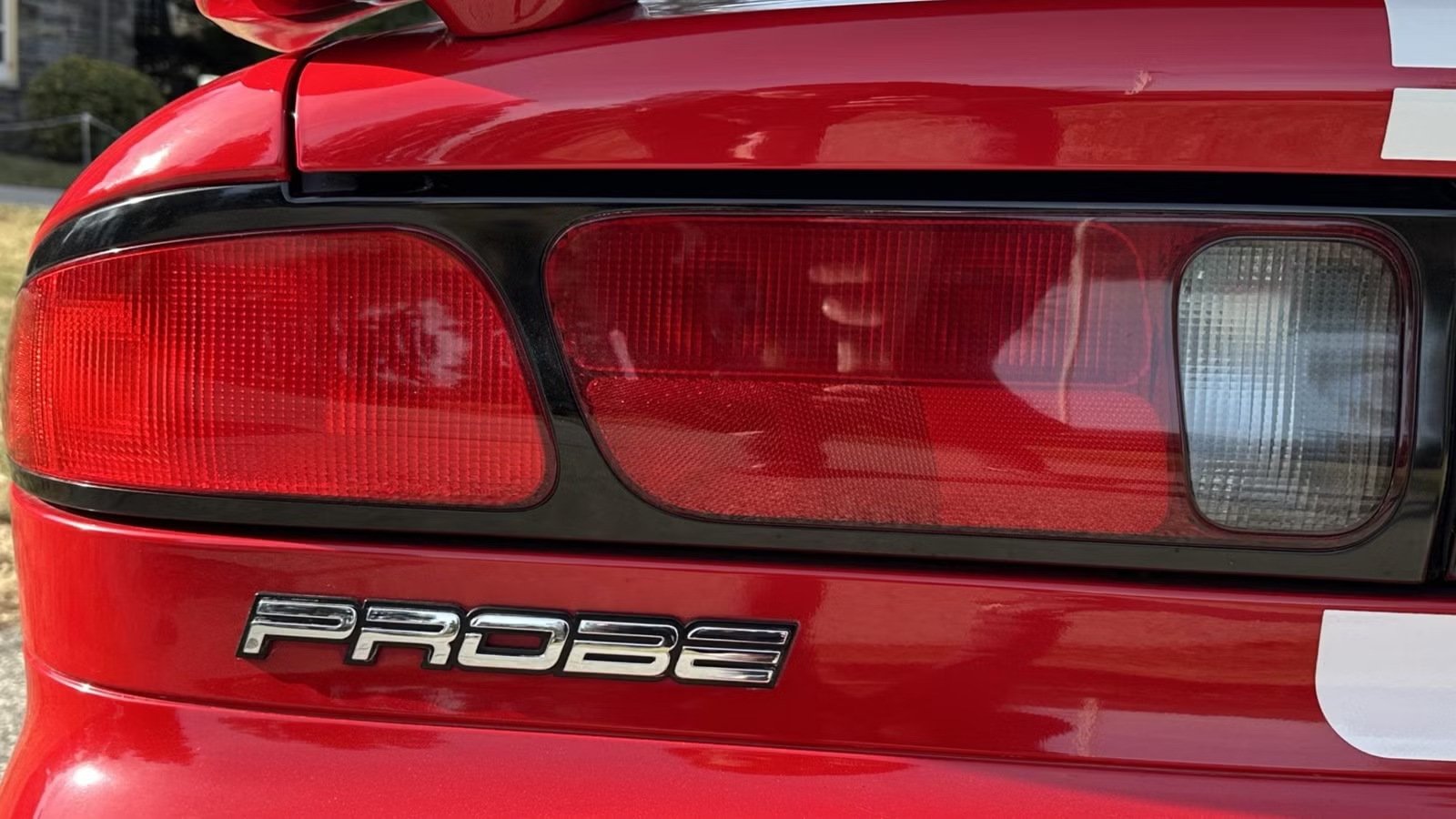
As one of the biggest automakers in the world, Ford clearly has dozens of departments that conduct market research on the viability of prospective models, and yet nobody put the kibosh on a car name most associated with prostate exams and colonoscopies. The Ford Probe, which hit the streets in 1989, was actually supposed to replace the Mustang. That’s no joke as Ford literally considered axing the legendary pony car in favor of a generic ’80s sports car named after a rectal examination. Luckily, cooler heads prevailed and the Fox Body ‘Stang continued, giving way to future generations that continue kicking ass to this day. Still, Ford did actually release a car called the Probe, and there is no logical explanation as to why it went with that moniker. A probe can be a police inquiry, a deep space satellite, or all of the aforementioned rear-end examinations, none of which screams cool sports car name.
Sources: Bring a Trailer

Related posts

Latest Post


No Comments