
The 500-Unit Kawasaki Superbike Homologation Special Hiding Behind A Common ZX-7R Badge
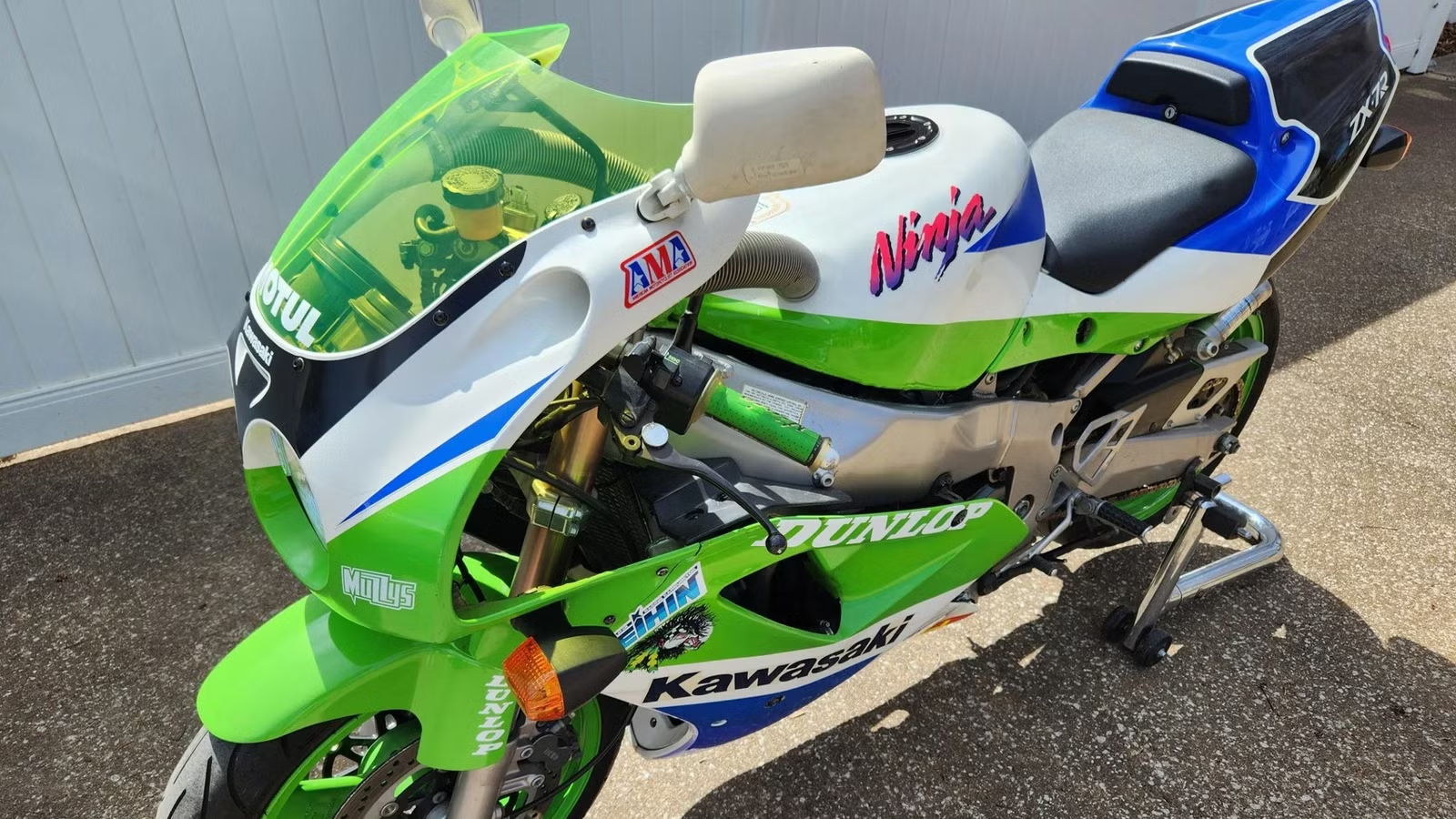
Brands are usually exceedingly keen to shout about their performance models, especially homologation specials. These are the super serious bikes — those for people who don’t simply want what everyone else has, but who want to taste what they see in the racing series of the world. But while these bikes are usually outstandingly clear in their intentions to be above everything else, Kawasaki hid this bike in normal bodywork and left two small clues as to the real power that lay beneath.
The Japanese Superbike Arms Race Was Getting Serious

To stand still in the automotive world is to fall backwards, and this was especially true of the early 1990s superbike market. Japanese brands in particular were releasing increasingly quick, increasingly sharp motorcycles that represented the cutting edge of technology, and which often took inspiration from their brand’s racing exploits. And for America, the AMA Superbike series was particularly important.
AMA required manufacturers to build homologated versions of their racing bikes, offering brands the opportunity (or the necessity, depending on how you see it) to create bikes that far outreached what normal street riders actually needed. It’s a way for manufacturers to keep teams in check, ensuring they don’t blow the budget knowing that there has to be some commercial implication to their designs. But that’s not to say that the resultant machines are boring.
Homologation specials were, and still remain, exciting. They cost more than you want to spend, sure, but you get things normal bikes don’t. It could be more power, or better handling, or lighter parts, but there’s just something about a homologation special (whether it’s a bike or a car) that gives it that extra layer of credibility. And part of that is their rarity.

Racing Rules Created Some Of The Craziest Street Bikes

Homologation specials are, in some ways, machines that nobody actually wants to make. By their definition, they’re cars or bikes that have to be created as a cost of entry into a series and, with this in mind, they’re not made in especially large numbers. Some manufacturers will make more than they’re strictly required to if there’s an overwhelming demand — the Honda RC30 being perhaps the best example of this — but, for the most part, the minimum required is the maximum made.
This forced rarity is partly due to cost. Homologation specials allow manufacturers to experiment with small batches of lighter, faster, more technologically-advanced machinery which is more capable but vastly more expensive — often meaning that each bike is sold at a loss. Yamaha reportedly lost money on every single mid-1990s YZF-R7 OW-02 that was sold due to the bike’s development cost, which was a necessary finance line in the racing department’s budget. This can mean that manufacturers want to do little more to these unwanted children, born from a want of championship glory, than slap a license plate and some headlights on, make it road legal, and call it a day. And, in 1991, Kawasaki essentially did just that.
The Kawasaki ZX-7R K1/K2 Was A 158 MPH Homologation Unicorn

On paper, the Kawasaki ZX-7R K1/K2 (K1 and K2 were fundamentally the same bike, with the K1 released in 1991 and the K2 in 1992) was a road version of Kawasaki’s AMA Superbike race bike. It also had some of the same visual cues as the more familiar ZX-7R that sat in showrooms rather than paddocks. But while the looks might have been similar, the homologation version was considerably more exciting.
To start: the regular bike was a mass-imported, mass-produced sportbike for the populace. There were just 500 examples made of the K1/K2, though, with only 142 of those being exported to the US. Told you it was rare. The engine in both bikes was the same 749cc liquid-cooled inline four, but the homologation bike’s was race-tuned to extract that bit more power. Compression and cams were also increased, with the redline bumping up another 500 rpm for good measure. This all helped the K1/K2 to get an extra bump in power over the non-special-edition bike, going from 100 HP to 120 HP. This was no small number back in the early 1990s, and put it right in with bikes like the Suzuki GSX-R750. Period testing gave the K1/K2 a top speed of 158.5 MPH.
All this extra power didn’t come at the expense of weight, though. Steel was swapped for aluminum on the tank, while a fiberglass tail section and lighter subframe contributed to a roughly 10 pound weight loss compared to the standard machine. But while Kawasaki had completely revamped the bike, it hid its rarity under very similar bodywork. That was, if you didn’t know where to look.

Enthusiasts keen to spot the difference between a run-of-the-mill bike and a one-of-500 bike have two areas to go to – one of which is the right-side fairing. The K models have a rounded access hole, necessary to provide access to the bike’s 39mm flatside carburetors. The standard bike doesn’t have this, as its 38mm Keihin CV (constant velocity) were set up differently. A more route one approach is to simply look at the bike’s frame code, as anything labeled ZX750J is the standard bike, while ZX750K is the spicy version. But that’s no fun when you’ve got an incredibly niche bit of knowledge you could use instead.
Regardless of whether you knew the differences, what was clear was that the K models were far from just being regular ZX-7Rs with a few fancy bits stuck on and a higher price tag. They were wolves in sheep’s clothing. Or whatever is scarier than a sheep but not quite as scary as a wolf, given the ZX-7R wasn’t exactly slow. Given there were only 500 made, the problem wasn’t in identifying one – it was in spotting one at all.
Why This Kawasaki Is Now A $65,000 Collector’s Secret

The bike that the K models were homologated for actually did achieve a title, winning the AMA Superbike championship with Scott Russell in 1992. But while championship success can sometimes help a bike to achieve larger sales, the K models’ rarity meant that the bike faded into history, falling from consciousness and into obscurity. It had everything collectors love, though: extremely limited production, genuine racing pedigree, unusual specification and, importantly, examples that hadn’t been ridden to hell and put away wet or modified beyond all belief. And that’s important.
In 2022, there still existed a brand new, in-crate 1992 K2 model that was still in that original crate some 30 years after it had been put there. Whether bikes should remain in a crate or be removed and ridden is a topic for another day, but this one was wheeled across the auction block and sold for $69,978.
It’s a remarkable price for a bike that has spent its entire life waiting to be ridden, but perhaps that’s the point. The bike wasn’t a simple rebadged version, and remarkable bikes require remarkable prices.
The ZX-7R K1/K2 Is The Japanese Homologation Special That People Forgot About

While the ZX-7R K models deserve to sit alongside the other homologation bikes of their era, they’ve never really got the recognition they should. Perhaps that’s because it was homologated for the AMA Superbike championship whereas bikes like the GSX-R750 were made for the comparatively more popular World Superbike series, or maybe it’s because there were so few of them that nobody even had the chance to know it existed. But, based on the value achieved at auction, it seems like what flew under the radar at the time is finally getting the attention it should have.
Given the bike’s rarity, it’s exceedingly unlikely that you’ll see one in the wild. Hell, it even seems like there would be, at most, 499 of them on the road, given one is most likely still in its original packaging. But next time you see a ZX-7R roll into the parking lot, take a look at that right-hand-side fairing. You might just spot a unicorn.
Sources: Carole Nash, Motorcycle Specs, Bike-urious, Iconic Motorbike Auctions, RideApart

Related posts

Latest Post


No Comments