
The Muscle Cars Born From Trans-Am Racing’s Golden Era
As gearheads, we all know about how awesome homologation specials can be. While these cars were primarily built for motorsport, they ended up becoming legendary road cars too. The homologation rules of several popular racing series have been the reason these homologation specials were developed. Some of them are still popular (or are at least still fondly remembered) today. The homologation specials we’re going to talk about here, though, come from a racing series that many enthusiasts have since forgotten.
The Trans-Am Series Started Becoming Very Popular In The Late 1960s

Governed by the Sports Car Club Of America (SCCA), the Trans-Am series was America’s attempt at making a proper road racing series that used Sports Cars. Starting in 1966, it didn’t take long before the Trans-Am series became caught up in the golden age of American muscle. Several of the great Muscle Cars that you could buy in showrooms in America back then appeared on the grid in Trans-Am races. This meant that the “win on Sunday, sell on Monday” mentality was very much present in Trans-Am racing. That’s entirely thanks to the way the rules regarding which cars could compete in the Trans-Am series enabled that.
The Series Had Rules That Set The Stage For Crazy Homologation Specials
Like many racing series that have used production cars over the years, back in its golden period of 1966–1972 the Trans-Am series had homologation rules. These were different over the several different classes Trans-Am racing had, but they all consistently required teams to use vehicles that were based on standard production cars that were within certain requirements.

The over 2-liter class (O2L) that made up the top division of the series is the class we’re going to be focusing on here specifically. This class had a displacement limit of 305 cubic inches (5 liters), and before 1970 it had to be exactly the same as an engine that was available to the general public. These rules relaxed slightly from 1970, allowing manufacturers to “destroke” a larger production engine down to the 305 cubic-inch limit. There was also a minimum production requirement for the series. This initially was 1,000 cars over a 12 month period. But as time went on, those minimum production requirements changed. By 1970, the minimum production rules were based on a sliding scale that was calculated against the manufacturer’s total output from the previous year.
The Legendary Homologation Specials That Trans-Am Racing Helped Create

Like with other series that used homologation rules like Trans-Am’s, automakers saw a big opportunity to use them to create crazy homologation specials. These specials often ended up becoming legends of the muscle car world. Some of them have even become some of the most celebrated muscle cars ever made!
Pontiac Firebird Trans Am

It only feels right to start off our dives into Trans-Am homologation specials with the car that’s most associated with “Trans Am” as a brand. The Pontiac Firebird Trans Am is one of the best-known of these homologation specials, and it was one of the first to appear too. The Trans Am package was added to the first-generation Firebird’s model lineup in 1969. Only a tiny number of these original Firebird Trans Ams were built—689 coupes and 8 convertibles. That wasn’t enough to satisfy the homologation rules. But as we’ll see with another car here, the SCCA was known to bend the rules to try and keep major manufacturers involved.
In perhaps a cruel irony given its name, the first iteration of the Pontiac Firebird Trans Am wasn’t legally allowed to race with its factory engine. The production cars used a 400-cubic-inch V8, because Pontiac’s race-legal 303-cubic-inch V8 never actually ended up going into production. A creative solution was thought up by T/G Racing, an outfit that was co-founded by a Canadian businessman called Terry Godsall. Using the Canadian connection, T/G Racing was able to use a 302-cubic-inch Chevrolet V8 (we’ll be coming back to this engine a bit later) that Canadian market Firebirds used. As this V8 was completely legal under SCCA regulations and was used in production Firebirds in Canada, the SCCA had absolutely no problem with the race-spec Firebird Trans Ams using that engine.
While its origins were very much as a homologation special for a popular racing series, the Trans Am nameplate carried on for a long time after that. In fact, the last Firebirds to carry that branding were produced in the early 2000s. If nothing else, it shows how enduring that brand has been. For better or worse, people now associate it much more with Pontiac’s road cars than they do with that racing series.
Chevrolet Camaro Z/28

The Pontiac Firebird Trans Am wasn’t the only Trans-Am homologation special built on this General Motors sports car platform. The Chevrolet Camaro got one too, and it spawned another brand that’s survived beyond this homologation special period. The Chevrolet Camaro Z/28 also first appeared during the mid-late ’60s, and it’s very similar to the Pontiac Firebird Trans Am. Unlike the Firebird Trans Am, it actually got a legal engine straight out of the gate—the 302 V8 that we’ve already mentioned. This V8 was created by combining the wider bore of the 327 V8 with the shorter stroke of the 283 V8. This resulted in a “best of both worlds” design that fit well within the SCCA’s requirements, and could be dropped into production cars exactly as it was.
Like its Pontiac Firebird Trans Am cousin, the Chevrolet Camaro Z/28 technically didn’t meet the SCCA’s homologation rules. Only 602 were produced in its first year of production (1967). But, because Chevrolet was such a huge brand and the SCCA wanted Chevy in the series, it was allowed to compete anyway. Chevrolet later more than made up the numbers, producing 7,199 in 1968 and 20,302 in 1969.
Like the Trans Am branding on the Pontiac Firebird, the Z/28 branding lasted on the Chevrolet Camaro for a long time. It actually survived right up to the end of Camaro production as we currently know it, with the final Z/28-branded Camaros rolling off the production line in 2023 (they were sold as 2024 model year cars). If the Camaro does return in the future, you can absolutely bet that the Z/28 branding will return with it.
Ford Mustang Boss 302

When you think of Ford’s Boss Mustangs, you’ll typically think of the fire-breathing Boss 429. That was a homologation special for NASCAR, and aimed for maximum big-block power for the super speedways. What a lot of enthusiasts may not know is that Ford also built a Trans-Am homologation special using the same platform and the same “Boss” branding.
That car is the Boss 302, and from the outside it looks fairly similar to the Boss 429. But, under the skin, both muscle car specials couldn’t be any more different. Instead of an enormous 429 V8, the Boss 302 had, well, a 302 V8. While this didn’t have the ludicrous speed and power of the Boss 429’s engine, it was much more suitable for the road courses of the Trans-Am series. With time, it also became much more relevant for the Mustang’s development. All high-performance Mustangs now use engines that are a similar size to the Boss 302’s. That even includes the super-powerful Mustang GTD and Mustang Dark Horse SC—the 5.2-liter supercharged Predator V8 is only slightly larger than the Boss 302’s engine.
Plymouth ‘Cuda AAR

People will usually think of the Hemi ‘Cuda when thinking of special, super-powerful versions of the Plymouth Barracuda. The ‘Cuda AAR also existed around the same time, though, and it was a brilliant performance car in a very different way. The AAR in the name comes from Dan Gurney’s All American Racers team, who developed the car in collaboration with Plymouth and ran it in the Trans-Am series. Like the Ford Mustang Boss 302 we’ve just talked about, the Plymouth ‘Cuda AAR eschews big-block power for a small-block that’s much more suitable for the road course races of Trans-Am.
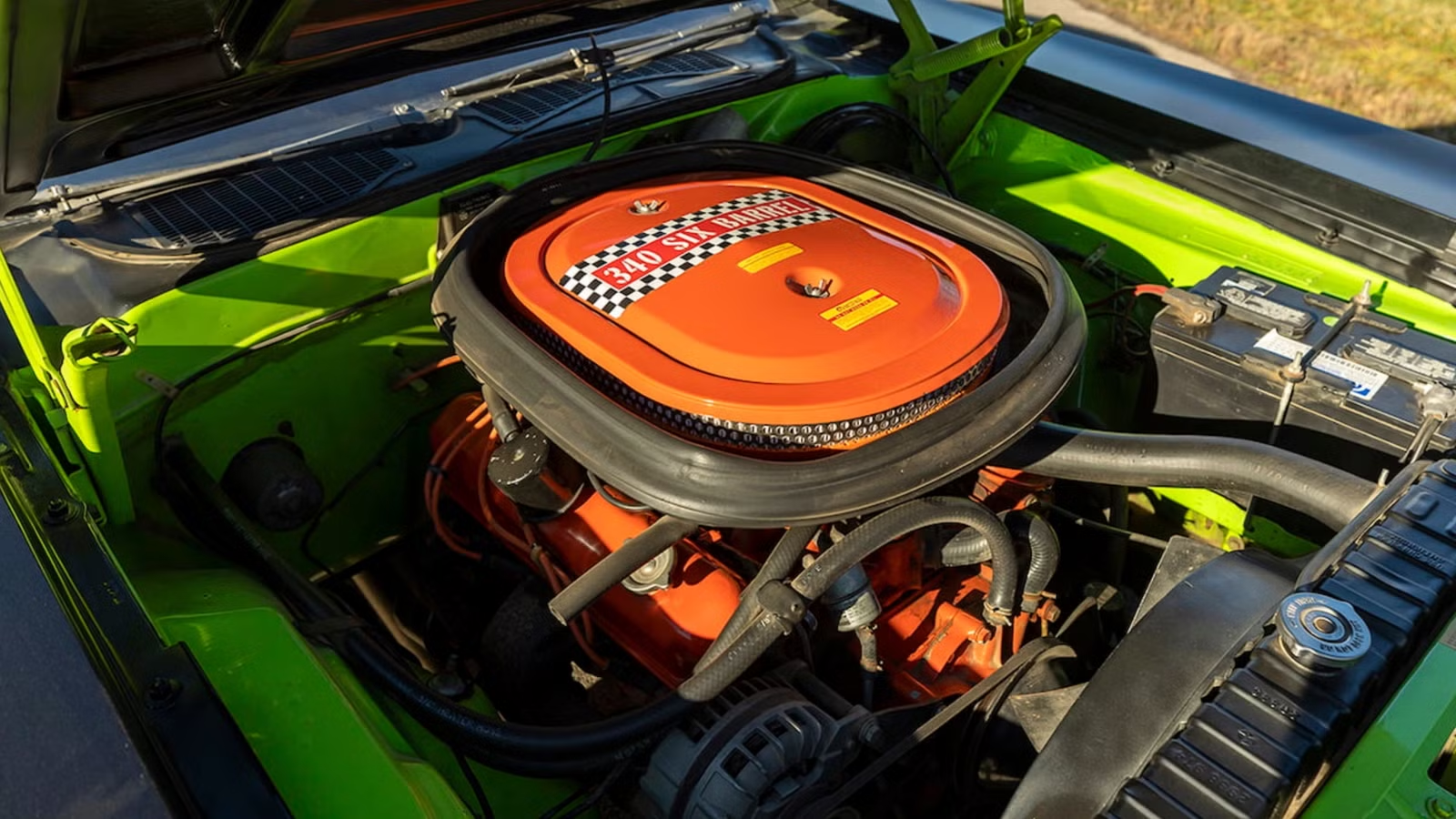
The ‘Cuda AAR was a car that took advantage of the “destroking” rules that were introduced from 1970. While race-spec cars ran a 303 V8 that fit in with the rules, the street versions had a 340 V8 instead. This is the same 340 “Six-Barrel” V8 that you could find in several other Mopar cars of the time, and it was rated at 290 brake horsepower and 345 lb-ft of torque.
The production of the mandated street cars only lasted for 5 weeks. Somehow, Plymouth managed to run the production at breakneck speed, fulfilling the homologation rules by producing 2,724 street-legal ‘Cuda AARs. That makes the production run of the street cars alone a bit of a marvel, and it’s surprising that it’s not talked about so much as an achievement in and of itself.
Dodge Challenger T/A

The Dodge Challenger T/A was only available for the 1970 model year, and it’s a fairly forgotten version of the original Challenger muscle car. It’s also another car that took advantage of the “destroking” rules. Like the Plymouth ‘Cuda AAR, street versions of this car used the 340 “Six-Pack” V8 (rated at the same output as the ‘Cuda AAR’s engine), while race-spec versions used a destroked 303-cubic-inch version of the engine to get its size within the rules. Street versions also got unique graphics, different tires and tire sizes (it was one of the first muscle cars to have different-sized front and rear tires), and heavier-duty suspension. But other than that, it really wasn’t that different from a regular 1970 Challenger.
AMC Javelin Mark Donohue Edition
The AMC Javelin Mark Donohue Edition is a Trans-Am homologation special you might not have ever come across before. Named after famous Trans-Am series driver Mark Donohue (who, before switching to driving the Javelin, had driven the Camaro Z/28 we talked about earlier) and co-developed with Penske, this car appeared in 1970. That meant it could take advantage of the “destroking” rule. Street models had a 360 or 390 V8, with the 390 engine producing as much as 340 horsepower. They also got the ram air hood from the AMC AMX, a fully functional rear ducktail spoiler (one of the main reasons this car was created in the first place—AMC wanted the spoiler to be legal for racing), side stripes that were unique to this car, and Mark Donohue’s signature on the right rear deck lid.
One of the big issues with the Mark Donohue Javelins is that it’s really difficult to authenticate exactly how many of them were really built. AMC didn’t put anything specific in the VIN number that would point out if it was a genuine Mark Donohue Edition, and the ducktail spoiler could be ordered as a factory option on other Javelin variants. To complicate things even further, some dealers actually put together their own Mark Donohue edition cars themselves away from the factory by just ordering the right options and then doing the rest of the work themselves.
The Trans-Am Series Still Exists Today, And Some Classes Still Use Production Cars
While the boom period of the Trans-Am series has long since passed, it didn’t die out. It’s still running today, albeit in a very different form. It’s still a multi-class series, but the top class consists of purpose-built silhouette cars. These cars are designed to look like recognizable sports cars you can buy in North America, but they’re nothing like the production cars their exteriors are modeled after. Some of the lower classes, though, do still rely on homologated production vehicles. The Grand Touring (GT), Super Grand Touring (SGT) and Extreme Grand Touring (XGT) all use those regular production cars, with the TA, TA2 and TA Cup (TAC) using the silhouette cars. These production car classes even include some non-American models – Ford Mustangs, Chevrolet Camaros and Chevrolet Corvettes race alongside GT3 and GT4-spec Ferrari 458s, Porsche 911s and Maserati Gran Turismos.
In that sense, homologated production cars are still integral to the Trans-Am series like they were in the 1960s and 1970s. They’re just more for the classes populated by gentleman racers and people making their way up through the ranks.
Sources: AMC, AMX-perience.com, Camaro Research Group, Chevrolet, Dodge, Firebird Red Book – Pontiac Firebird From 1967, Ford, Plymouth, Pontiac, Sports Car Club Of America

Related posts






Latest Post


No Comments