
The 320-HP Ford Sleeper Sedan Americans Can’t Legally Buy Until 2027
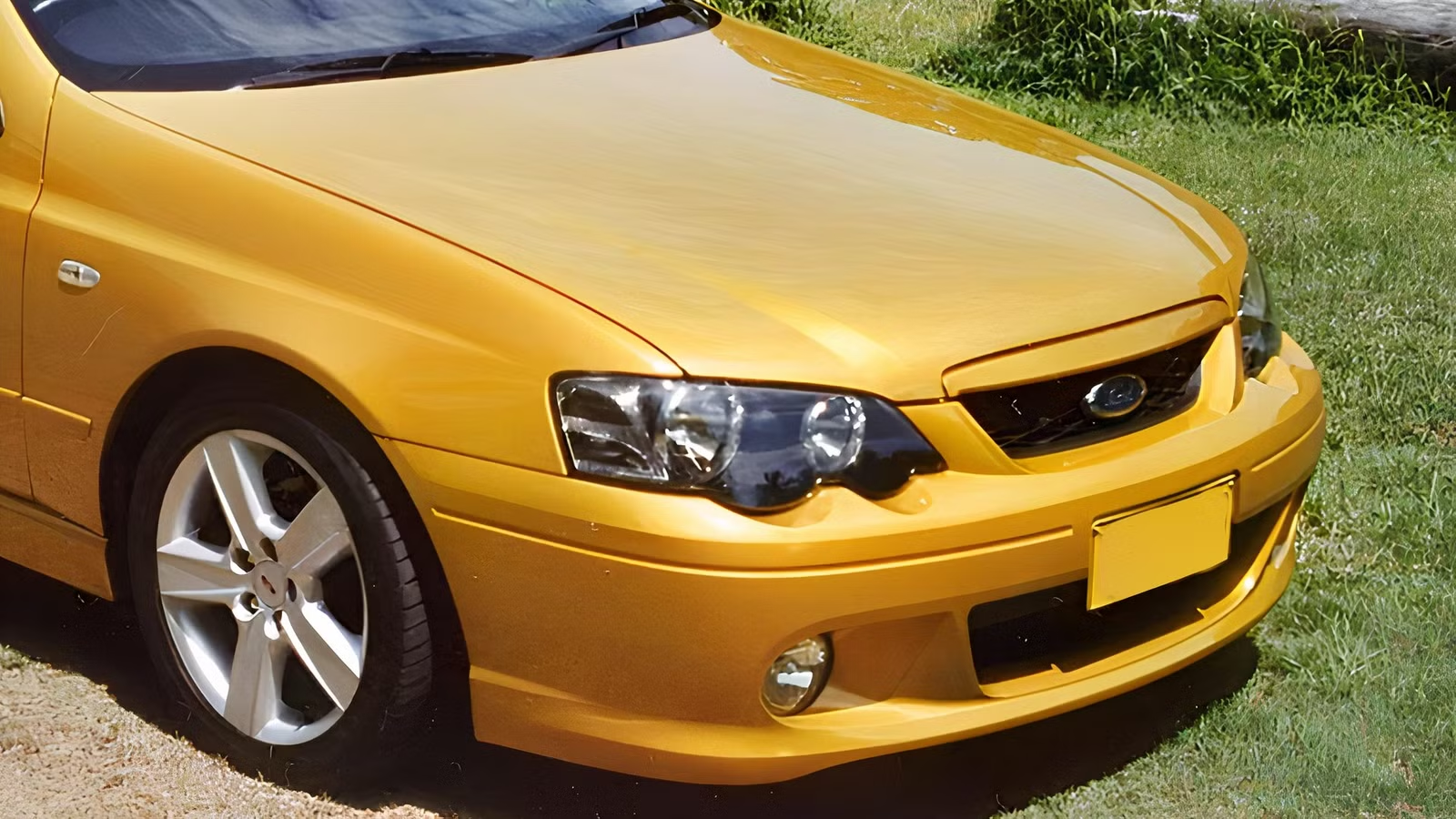
The 25-year import rule: we know it, we hate it, and it feels totally arbitrary. Ostensibly, it’s in place to protect American dealerships from the nothing burger that was the gray-market foreign car sector. In reality, dealership interest groups just love bellyaching about very little, and safety and emissions concerns were a convenient scapegoat. Typically, the rule stops British, German, Italian, and Japanese imports from entering the country before 25 years. Yet, perhaps the biggest thing we’re missing comes from Ford of Australia. At least, for now, it is.
Ford in Australia: An Operation Defined by Rivalry

To properly explain the relationship Australians had with Ford for the better half of a century, it’s best to sum it up like a sports rivalry between two bitter enemies, just more intense. On the track, at the dealership, and on the streets, Ford’s eternal beef with GM’s Holden brand has its origins in the 1930s. At that time, GM acquired the independent Holden’s Motor Body Builders Ltd (HMBB) group that fabricated the body shells for the company’s Australian vehicle lineup. Before then, HMBB ironically built body shells for Ford, and even Dodge for a time. Yet, the formal founding of Holden as GM’s team in Australia made the group perpetually adversarial to team Ford.
Holden began building entire cars from scratch in 1948, not just bolting bodies onto pre-existing American frames. Meanwhile, Ford had been assembling cars in the country since it opened a plant in Geelong, Victoria, in 1925, establishing itself as the only game in town with a fully-fledged automotive production operation in the country for two decades before Holden entered the fray. It was there, only after the end of World War II, where the Ford versus Holden rivalry became a markedly all-Australian affair—one where large groups of domestic engineers and designers competed to win the favor of their countrymen with refinement, horsepower, and national prestige.

The relentless brutality of Australian roads, often unpaved and bumpy before the National Highway System spread, meant imported American chassis often weren’t strong enough to last in Australia. By the 1960s, Holden had almost entirely transitioned to bespoke, in-house-designed frames and bodies. Only the powertrains were commonly imported from America — even the Australians knew the best part of an American car is almost always the engine. Meanwhile, Ford took just a little bit longer to reach the same standard, and that allowed it to fashion its flagship Australian product from distinctly American underpinnings.
The Definitive Australian Ford

In America, the Ford Falcon was an enigma. It wasn’t a gigantic barge of a runabout like the Galaxie or Fairlane. It wasn’t a darling of the newly-formed personal luxury car scene like the Thunderbird, and it wasn’t a comfortable cruiser like a Mercury. The most notable attribute of the Falcon in North America during these years was having its underpinnings championing the first Mustangs. Put simply, the Falcon didn’t fit the tastes of the American automotive palate.
Yet, in Australia, the exact opposite was true. When the Falcon hit Oceania in 1960, it was effectively the exact same car as it was in the states, just with the steering wheel on the right-hand side instead of the left, and Australians absolutely adored it. Domestic dealerships did do novel things to the car, like add heavy-duty rear suspension and chunkier tires to compensate for the roads. Otherwise, there really wasn’t much difference between the hemispheres as far as the Gen-I Falcon was concerned. The point of differentiation only occurred after the Falcon left American production in 1972. From there, Australian designers were free to style the car in a way that appealed to its native audience.

Over the generations, the Falcon shed its American roots, forgoing the transition from rear-wheel drive to front-wheel drive, and straight-sixes to V6s. When Ford considered cutting the Falcon entirely for a front-wheel-drive platform developed with Mazda in the ’80s, the resulting sales bonanza killed that plan in a real hurry. Over time, the Falcon was forced to modernize just a bit, getting more aerodynamic with a model refresh in the late ‘80s, and it even took on styling cues reminiscent of the American Ford Taurus. Paired with the bulletproof I6, these were some of the most dependable Australian cars ever built. It was a sentiment carried over by the Gen-V Falcon, which sported the modernized overhead-cam I6. Still, the best was yet to come.
Ford Falcon BA XR6 Turbo: The Gen-VI Falcon’s Highest Peak

By this stage, the Falcon was firmly Australia’s Ford, but the good times couldn’t last forever. The cost of manufacturing cars in Oceania was rapidly outweighing the profits of selling them, be they Fords or Holdens. And yet, the Falcon had one more trick up its sleeve. It came in the form of the BA-series, complete with an engine that ultimately retroactively defined the entire Falcon lineage by virtue of how darn amazing it was. Enter the Barra straight-six: 4.0 liters of closed-deck iron-block engineering with 24-valve aluminum heads and dual independent variable cam timing.
Like Toyota’s 2JZ or Nissan’s RB26, the 4.0 Barra engine was practically tailor-made to accept forced induction boost pressures that’d make other engines leak oil just thinking about it. Sporting a Garrett turbocharger under the hood of the Falcon XR6 Turbo, the Barra 240T variant ran a leisurely six psi of boost pressure. That doesn’t sound like a lot, but it was enough to help the big 320 horsepower sedan sprint to 60 mph in under six seconds, while the American Taurus SHO V8 took more than seven. It was absolutely amazing speed for a Ford sedan, nearly on par with out-and-out sports sedans like the Audi S4 or BMW 540i. With such a conservative tune, that overbuilt block was perennially understressed, making it a prime platform for 2J-style twin-turbo setups and nitrous hookups that routinely push the engine past 1,000 hp.

Otherwise, the BA Falcon was a fairly ordinary Ford sedan, complete with cloth seats and plasticky interiors. It was clear that the majority of its $43,965 AUD base MSRP was invested in the powertrain. And yet, we hardly hear anyone complain about it. It wasn’t a Lincoln, and it was never expected to be fancy. In a way, that only made the BA Falcon more quintessentially Aussie. It was all motor, no fluff, and nothing you didn’t need. If only more American Fords were built this way.
A Quarter Century in Waiting: It’s Almost Over

The sixth-generation Falcon left production for good in 2010, with a comprehensive facelift and refresh in the middle. The whole line was only given one more cycle before it was discontinued in 2016, and Ford stopped building vehicles in Australia entirely that same year. As a result, Americans started to gaze upon Aussie Falcons with a particular interest in the Barra-engined BAs. Given that maddening 25-year wait time, it’s fair to say Americans are ready to foam at the mouth for a taste of that Barra goodness.
Currently, a used Falcon XR6 Turbo in reasonable condition with a manual gearbox and mid-range mileage sells for anywhere between $15,000 and $25,000 AUD. That works out to between roughly $10,750 and $18,000, give or take a few dollars here and there. Factor in import fees that can easily top $5,000 USD, plus taxes and brokerage fees of another few thousand dollars at least, and you’re in for a bill of $20,000 to $25,000 USD at the minimum before an XR6 Turbo is safe in your driveway. Still, don’t be surprised if the final cost is considerably more. Remember what it was like when the R34 Nissan GT-R became import-legal? Well, some things never change.
Sources: Ford, carsales.com.au

Related posts



Latest Post


No Comments