
Pontiac Built Only 16 Of This 405-HP Luxury Coupe Before Inventing The Muscle Car
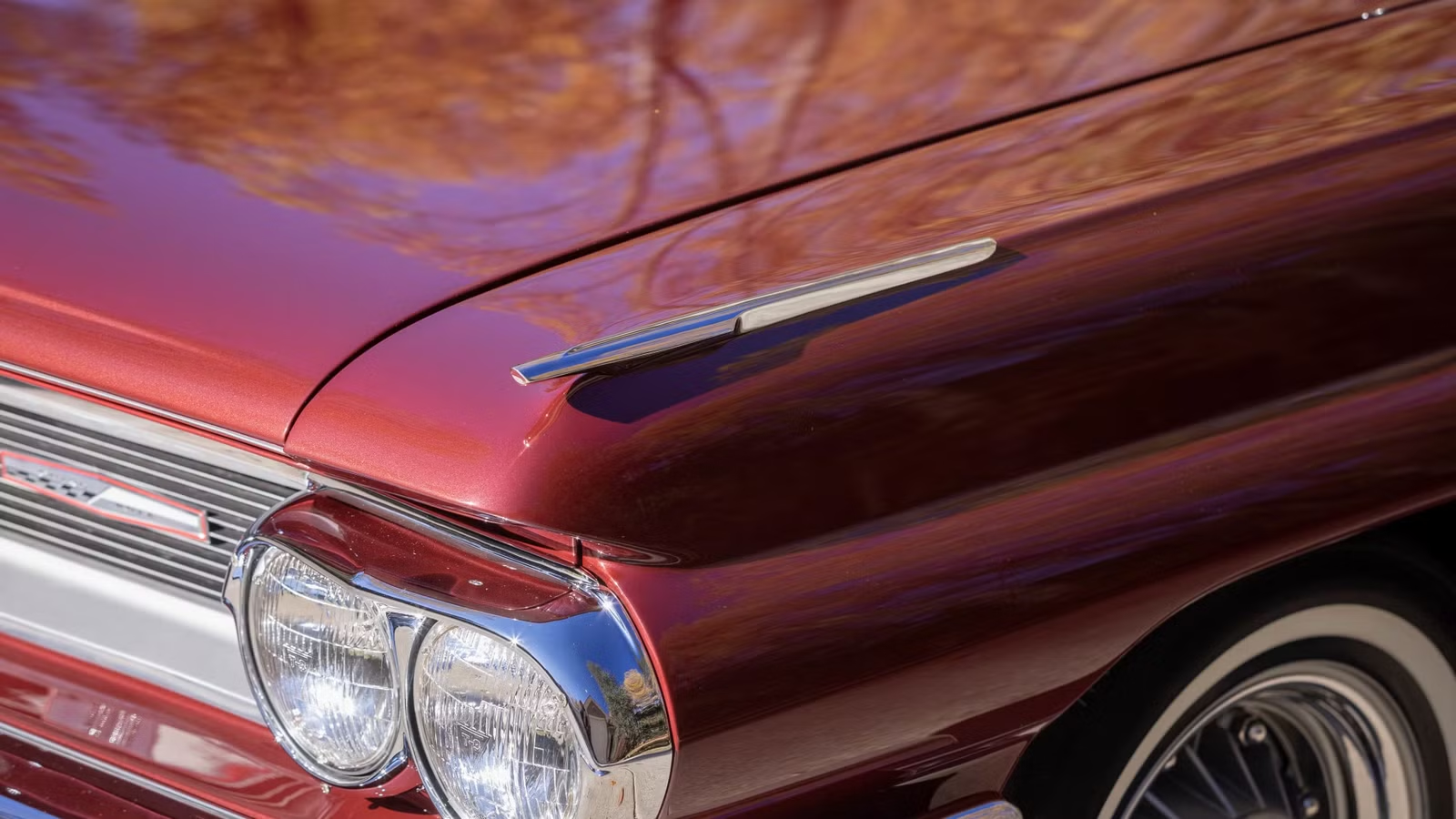
The muscle car was born in 1964, when Pontiac slipped a 389 V8 into a mid-size LeMans, badged it the GTO, and handed America an entirely new category of car. It is a clean story, and it gets retold every year.

Two model years earlier, though, a full-size Pontiac coupe with a formal roofline and a console-mounted tachometer ran the quarter-mile in 14.3 seconds at 103 mph, quicker and faster than the GTO managed on the same magazine’s clocks. Sixteen people bought that car. Only five are thought to survive.
Pontiac Was Already Winning The Horsepower War Before The Muscle Car Era
Pontiac’s racing program broke its industry’s own rules. The Automobile Manufacturers Association asked members to step back from motorsport in 1957, but general manager Semon “Bunkie” Knudsen and chief engineer Pete Estes treated that resolution as a suggestion, developing the 389 Super Duty as a competition package during the ban era.

The gamble paid off on ovals and drag strips. Pontiac became the car to beat in NASCAR and NHRA competition with the 389 Super Duty, then raised the stakes in late 1961 with the 421 Super Duty, the first of the big-displacement, super-performance V8s. Success on track pushed the division to third place in American new car sales.
The 421 started as a 389 enlarged to 421 cubic inches, and it was the first of the big-journal Pontiac V8s, built for track and drag strip dominance. Heavy-duty internals and a race cam profile came as part of the package rather than as options.
Pontiac rated the engine at 405 hp on the gross scale, though people close to the program believed the real number sat nearer 465 hp. Either figure was enough to force a response, and Ford’s 427, Chrysler’s 413 and 426, and Chevrolet’s 409 all followed suit.
An engine like that still needed a body to live in, and Pontiac had a full showroom to choose from. It picked the least likely car on the floor.
The 1962 Pontiac Grand Prix Arrived As A Luxury Coupe With A Tachometer

The 1962 Pontiac Grand Prix went on sale September 21, 1961, aimed at the Ford Thunderbird. Where the Thunderbird leaned entirely on personal luxury, the Grand Prix carried a clear performance flavor.
Pontiac built it on the Catalina Sport Coupe rather than the flagship Bonneville, which gave it a wheelbase three inches shorter than the division’s largest cars. It also wore less bright trim than the Catalina underneath it, a restrained touch in a year when most American cars were buried in chrome.
At $3,490, the Grand Prix was the most expensive two-door hardtop Pontiac sold that year, priced above even the Bonneville. A long list of standard equipment explained the premium.

Inside were Morrokide bucket seats, a full set of instruments, and a chrome center console holding a tachometer, floor shifter, and locking storage bin. The rear seat added a folding center armrest and its own speaker grille.
The standard engine was a 303-hp 389 with a four-barrel carburetor and dual exhausts. Tri-Power carburetion lifted output to 318 hp, a high-performance four-barrel made 333 hp, and the top Tri-Power version made 348 hp.
Nearly 90 percent of buyers ordered the $231 Hydra-Matic automatic, which says most of what you need to know about how these cars actually got used. Pontiac sold 30,195 in the model’s first year.
Pontiac Never Advertised The 421 Super Duty, And 16 Buyers Found It Anyway

The Super Duty appeared on the Grand Prix order form during the closing months of the 1962 model year, with no advertising campaign behind it and only a few dealers set up to handle it. Buyers had to know it existed before they walked in.
Checking that box added roughly $2,000 to a car that started at $3,490. The engine cost more than half as much as the Grand Prix wrapped around it, and with fewer than 20 ever built, it is the rarest version of the Pontiac Grand Prix ever made.
The race-bred 421 first reached customers in four-barrel form, rated at 320 hp. A dual four-barrel setup was the far more potent choice, taking the gross rating to 405 hp at 5,600 rpm.

Two Carter S4299 four-barrels sat on top. Underneath were cast-iron exhaust manifolds with bolt-on collectors containing cutouts to bypass the 2.25-inch dual exhaust, plus a specific harmonic balancer, oil pan, fuel pump, and oil pump.
Car Life noted at the time that the 405-hp rating could be raised to 432 hp with parts bought over the dealer counter. Nothing about the package was aimed at casual shoppers.

Pontiac built 16 Super Duty Grand Prix coupes, largely hand-assembled in the aisles alongside the regular production line. As confirmed by GM Authority, no official records of Super Duty output were kept, which is why totals for the Catalina version still vary between sources.
Out of 30,195 Grand Prix sold that year, that works out to roughly one in every 1,900 buyers.
The Fastest Accelerating Production Car Ever Tested

Car Life tested a 405-hp Super Duty Grand Prix in March 1962, and the magazine’s verdict was that it was “the fastest accelerating stock production-line car” its staff had driven. That was not a small claim from a title that tested everything Detroit built.
The quarter-mile came in at 14.3 seconds and 103 mph, with the 421 shifted at 5,800 rpm. The run to 60 mph took 6.0 seconds, and top speed had to be estimated at 135 mph because the test track ran out before the car did.
A base 303-hp Grand Prix, by comparison, needed 7.2 seconds to 60 mph and 15.9 seconds for the quarter.
Traction was the limiting factor throughout. Testers found the rear tires would break loose in any gear, including top, with any moisture on the road, and clean launches required feathering both throttle and clutch.

The standard suspension drew criticism as well, judged much too soft and billowy for the power on hand. This was still a luxury coupe underneath, and it drove like one.
Car Life ran a 348-hp Tri-Power GTO through the same procedure in 1964 and recorded 6.6 seconds to 60 mph and a 14.8-second quarter at 99 mph. The car credited with inventing the muscle car was slower than the personal-luxury coupe Pontiac had quietly sold two years earlier.
Pontiac, however, had a well-known habit of carefully preparing its high-performance cars before releasing them to the press.
GM Killed The Super Duty In January 1963, Then Sold The Idea Back As The GTO

General Motors ordered its divisions to end all race programs in January 1963, and Pontiac issued an internal bulletin on January 24 announcing the immediate discontinuance of the Super Duty 389 and 421 engines. Zone managers were told to advise the dealers who normally handled that type of business.
Only 88 Super Duty V8s made it out the door for 1963. A program that had built Pontiac’s entire reputation ended inside a single memo.

Pontiac’s answer arrived the next year with the GTO, and its most famous road test was running the engine GM had just killed. The Car and Driver press car that recorded 13.1 seconds at 115 mph was later found to have a 421 Super Duty.
A restored survivor sold at Mecum in 2022 for $253,000. Five of the 16 are accounted for today. Sixteen buyers checked a box almost nobody knew was on the order form, two years before the rest of America was told the muscle car had just been invented.
Sources: Mecum Auctions, GM Authority, Hagerty, Curbside Classics

Related posts


Latest Post


No Comments