
The Roadster That Makes Speed Feel Secondary
Motorcycling has become remarkably efficient at making speed accessible. Middleweight naked bikes now produce the sort of performance that once belonged to superbikes. And modern electronics make that performance easier to exploit, while even fairly ordinary motorcycles can reach illegal speeds before the rider has even managed to wrap their head around the time warp.
That creates an interesting opening for the traditional roadster motorcycle. Strip away the obsession with lap times and acceleration figures, and there is still plenty of entertainment in an engine with a distinct rhythm and neutral handling. Sometimes, going faster simply isn’t the most interesting thing that motorcycles can do. An underrated Italian roadster proves that notion quite well in 2026.
A Great Roadster Doesn’t Need Superbike Numbers
The original roadster recipe was wonderfully straightforward. You had an exposed engine, conventional handlebars, a reasonably upright seating position, and enough performance to handle everything from commuting to a spirited Sunday ride. There wasn’t much specialization because there didn’t need to be.


Modern naked motorcycles have moved considerably further toward the performance end of that spectrum. Machines such as the Yamaha MT-09 and Triumph Street Triple now offer serious horsepower, sophisticated electronics, adjustable suspension, and braking hardware that wouldn’t have looked out of place on a dedicated sportbike not too long ago. They are brilliant motorcycles, no doubt, and they also demonstrate how far the humble roadster has evolved.

There is another approach where the humble roadster is given its due attention. Instead of adding performance until the motorcycle becomes a superbike with flat bars, a manufacturer can concentrate on how an affordable machine behaves at everyday road speeds. Throttle response, gearing, engine character, steering effort, and mechanical feel suddenly matter far more. This philosophy has kept one particularly old Italian name relevant for nearly six decades.
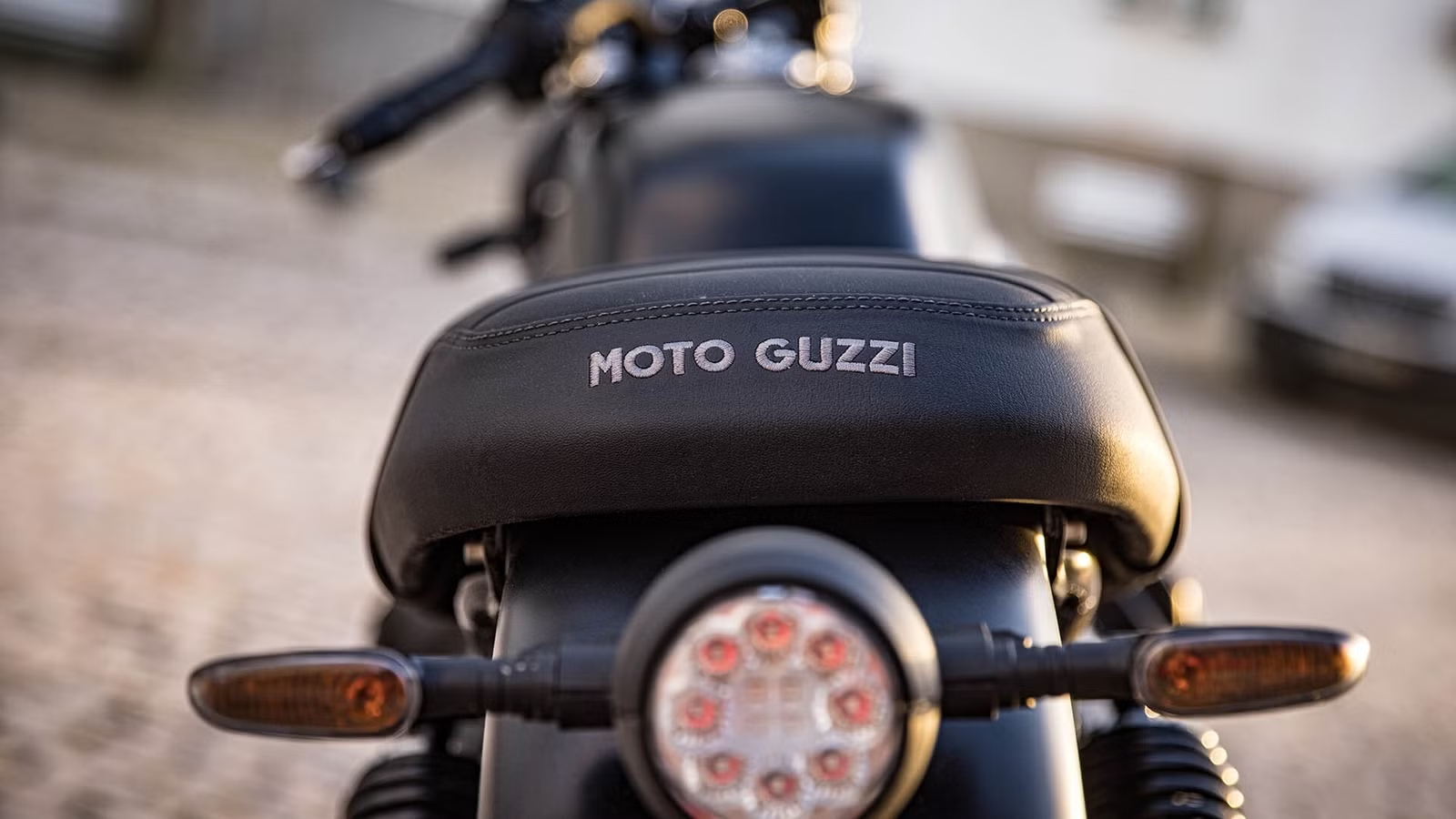
The Moto Guzzi V7 Is Happiest Doing Things Its Own Way

The Moto Guzzi V7 traces its roots all the way back to 1967, when the original 703 cc V7 introduced the transverse 90-degree V-twin layout that would become inseparable from Moto Guzzi. The V7 Sport followed in 1971 and pushed the platform toward genuinely sporting territory, but the modern V7 has settled into a different role. It is now Moto Guzzi’s traditional roadster, one that deliberately preserves much of the architecture that makes it recognizable.

The current family consists of the V7 Stone, V7 Special, and V7 Sport. All three use the same basic 853 cc V-twin and shaft drive, while the Sport gets substantially sharper chassis hardware and electronics. The Stone remains the cleanest expression of the idea, though. Moto Guzzi has priced it at $9,990 in the U.S. for the latest model year, placing it squarely among modern retros without pretending to be either an entry-level motorcycle or a high-performance naked.
The Transverse V-Twin Is The Main Event

The air-cooled 853cc, 90-degree transverse V-twin produces 67.3 horsepower at 6,900 rpm and 58.3 pound-feet of torque at 4,400 rpm. Those figures won’t frighten a modern 900cc naked bike, but they explain surprisingly little about why the engine works so well here. Moto Guzzi says 95 percent of the torque is already available by 3,500 rpm, so the V7 doesn’t require constant revs to make progress. Roll the throttle open in the middle of the tachometer, and the bike simply drives forward, helped by the six-speed transmission that suits relaxed road riding.

Then there is the engine layout itself, which is the brand’s signature that even its ADV uses. The cylinders project sideways beneath the fuel tank, while the longitudinal crankshaft and shaft final drive create sensations completely different from those of a conventional parallel-twin. There is a physicality to the drivetrain that hasn’t been engineered out of the experience, and that is arguably worth more here than another 20 horsepower.
The Chassis Keeps Things Simple

The standard V7 sticks with a tubular steel frame, conventional fork, twin rear shocks, an 18-inch front wheel, and a 17-inch rear. The layout sounds almost deliberately old-fashioned because it largely is. Yet the combination is claimed to give the bike predictable steering and neutral road manners that suit its power delivery. The V7 also benefits from a low 30.7-inch seat and a naturally upright riding position that lets you lock the knees on the indented 5.5-gallon fuel tank.

Push the basic Stone hard enough, and the conventional suspension and single front brake will eventually remind you that this isn’t trying to impersonate a modern sports bike. That is where the V7 Sport comes in, adding a 41-mm inverted fork, twin 320-mm front discs with Brembo four-piston monobloc calipers, and lighter wheels. Crucially, none of that involves replacing the engine with something frantic. It’s just a cycle parts upgrade to alter the experience rather than be pretentious about its intent.
The V7 Sport Modernizes The Experience Without Sterilizing It

The important part is what those chassis changes do, not simply that they exist just to define another trim level. The V7 Sport feels more deliberate when the pace rises, with quicker responses, stronger braking support, and less of the softness that suits the Stone better at relaxed speeds. Yet, because the engine is unchanged, the bike still delivers its performance in the same broad, torque-rich way rather than suddenly behaving like a more modern middleweight naked.
The Electronics Add A Layer Of Control

Ride-by-wire brings Road, Rain, and Sport modes, while a six-axis IMU supports cornering ABS and lean-sensitive traction control. Cruise control also comes standard here. The Sport mode sharpens throttle response and reduces traction-control intervention, but the emphasis remains on making the existing performance easier to exploit rather than managing big horsepower figures.
The V7 aims to enhance the riding experience with a layer of modernity that would help newer riders get accustomed to the power delivery and experienced riders get the most out of the V7’s handling capabilities. At $10,990, the V7 Sport is only $1,000 more than the Stone, making the chassis and electronics upgrades unusually easy to justify if the bike will regularly see faster back roads.
The Triumph Speed Twin 900 Is The Obvious Rival

Few motorcycles line up more naturally against the V7 than the Triumph Speed Twin 900. Its liquid-cooled 900 cc parallel-twin produces 64.1 horsepower and 59 pound-feet of torque, putting it remarkably close to the Moto Guzzi on paper. It also gets lean-sensitive ABS and traction control, KYB suspension, twin analog instruments, and a 10,000-mile service interval. At $11,495, though, it costs more than both the $9,990 V7 Stone and $10,990 V7 Sport.

The Speed Twin 900 is the more polished interpretation of the traditional British roadster, while the Moto Guzzi’s shaft drive, a larger fuel tank, and the distinct character of its transverse V-twin make it the Italian retro to chase. In Sport guise, it also brings a stronger parts package for less money. While neither bike needs huge performance figures to make its case, the V7 does a particularly good job of emphasizing the character of a motorcycle rather than its ability to reach the destination faster.
Source: Moto Guzzi

Related posts


Latest Post


No Comments