
The BMW M3 Manual Is Slower. Buyers Are Choosing It Anyway, Here’s Why
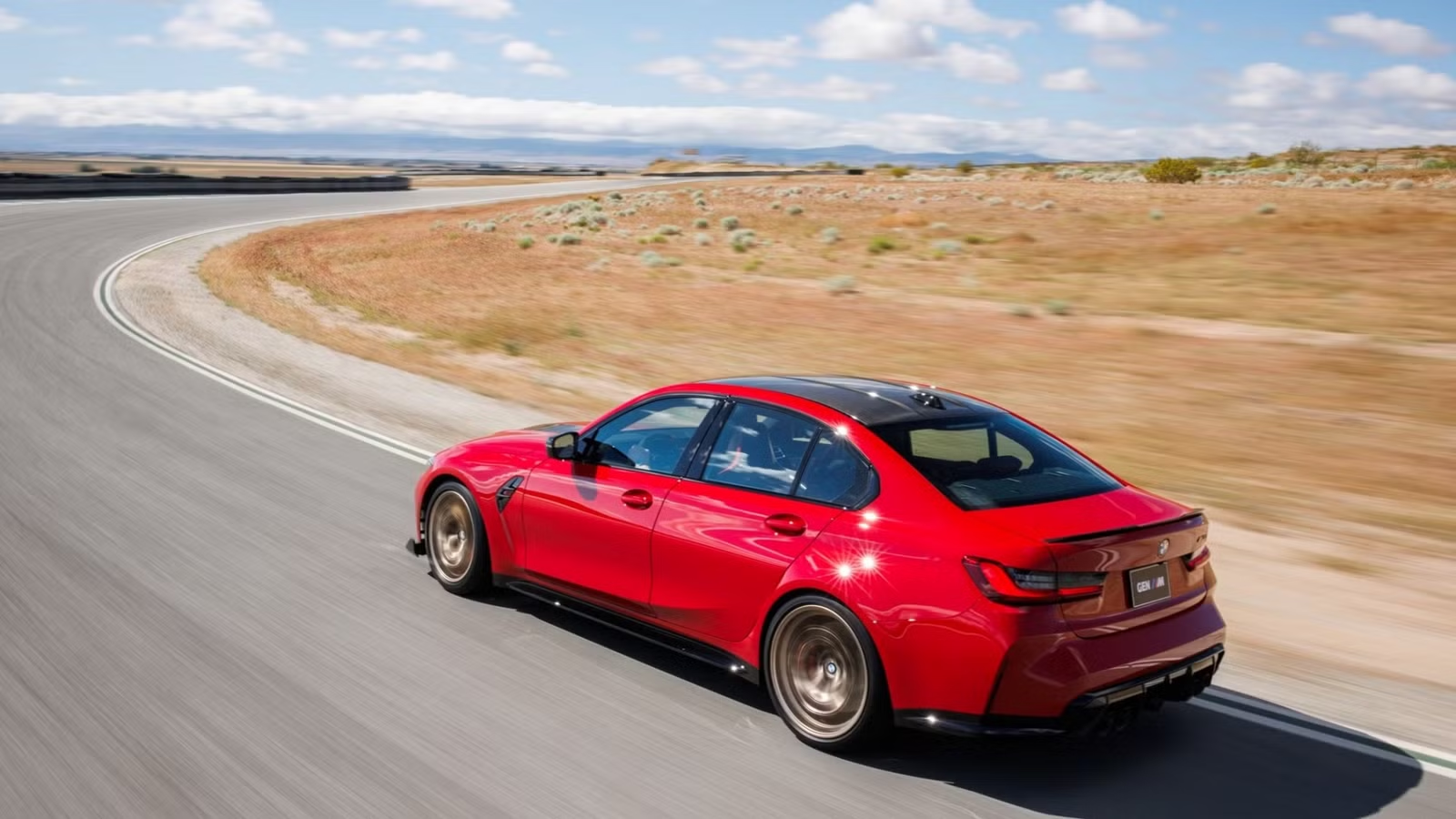
Half of every BMW M2 sold in the United States comes with a clutch pedal. That number is striking on its own, but it gets more interesting when you look at what those buyers are giving up: 30 horsepower, 70 lb-ft of torque, all-wheel drive traction, and roughly 0.7 seconds to 60 mph. On paper, the manual M3 and M4 are the worse cars. Buyers are ordering them anyway, in meaningful numbers, and the M3 CS Handschalter — a limited-run, manual-only special that cost more than the automatic equivalent while making less power — sold out almost immediately.

This is not nostalgia talking. These are deliberate, informed trade-offs made by people who know exactly what the spec sheet says and have decided the spec sheet is not the point. To understand why, you have to think about what a performance car actually delivers on a public road, and what the gap between a 4.1-second 0-60 and a 3.4-second 0-60 means when the speed limit is 65 mph.
What the Manual M3 Actually Gives Up
The numbers are not ambiguous. The manual M3 and M4 use the same 3.0-liter twin-turbocharged inline-six as the automatic Competition models, but BMW detunes it for the stick-shift application. Output drops from 503 horsepower and 479 lb-ft of torque in the automatic Competition xDrive to 473 hp and 406 lb-ft in the manual. The manual is also rear-wheel drive only — there is no xDrive option for the clutch-pedal crowd. Put it all together and the manual reaches 60 mph in 4.1 seconds against 3.4 seconds for the automatic xDrive version.

That 0.7-second gap is real. In a straight-line drag race, the automatic wins every time, and it’s not particularly close. The automatic also shifts faster than any human can, manages torque delivery with surgical precision, and in slippery conditions has the xDrive system to distribute power where the tires can actually use it. If the goal is the quickest possible time between two points, the automatic is the rational choice. The manual buyer knows this. That’s what makes the choice interesting.
Why the 0-60 Gap Barely Matters on Public Roads

A 3.4-second 0-60 and a 4.1-second 0-60 are both, in any practical sense, instantaneous. From a rolling start at 40 mph onto a highway on-ramp, the difference in real-world feel is negligible. Neither car is going to leave you wanting for acceleration in normal driving — both will embarrass almost anything else on the road the moment you ask them to. The performance penalty of the manual exists almost exclusively in conditions that are either illegal (street racing) or track-specific (where lap times matter and consistent, repeatable shifts are essential).
For the vast majority of M3 miles — commuting, weekend canyon runs, the occasional track day where you’re not chasing a personal best — the manual’s slightly lower output and slower shifts are simply not factors. What is a factor, every single time you drive the car, is how it communicates. The clutch pedal, the gear lever, the rev-matching on downshifts: these are constant inputs that keep the driver actively engaged rather than a passenger managing a very fast point-to-point machine. That distinction sounds philosophical until you’ve driven both back-to-back on the same road.
Rear-Wheel Drive and the Case for Uncorrupted Dynamics

The manual M3’s RWD-only configuration is often listed as a limitation, but for a specific type of driver it’s the feature, not the bug. BMW’s xDrive system is genuinely excellent — it can behave like a rear-wheel-drive car when you want it to, and the M-specific tuning keeps it from feeling sanitized. But there is a difference between a system that mimics rear-wheel-drive behavior and a car that simply is rear-wheel drive, with no electronic arbitration between the front and rear axles deciding how much slip is acceptable.
With the manual and RWD, the driver is the traction management system. Throttle modulation, steering input, and clutch control become the tools for managing the car’s attitude. That demands more skill and attention, which is exactly what a certain kind of M buyer is looking for. The manual M3 rewards a driver who has learned to read the car. The automatic xDrive rewards a driver who wants the car to be fast regardless of their inputs. Both are legitimate goals. They just describe fundamentally different relationships with the machine.
The M3 CS Handschalter Proves Demand Is Real

If the manual M3 were a niche preference kept alive by a vocal minority, BMW would have let it fade quietly. Instead, the company introduced the M3 CS Handschalter — a US-exclusive, limited-run manual variant of the already-expensive CS — at a price premium over the automatic CS, with lower power and torque figures than that cheaper automatic sibling. It sold out quickly.
That sellout is significant because it removes the nostalgia argument. CS buyers are not sentimental about gearboxes. They are performance-focused buyers spending serious money on what is already a highly capable, track-ready car. When that audience votes for a manual version at a price premium despite the power deficit, it suggests the manual is delivering something the automatic cannot replicate at any price. BMW clearly read that signal — the manual M2, M3, and M4 remain the only current M cars offered with a stick, and they are US-market exclusives that exist in part because American buyers demonstrated demand clearly enough to justify the engineering investment.
The Supply Problem BMW Is Racing Against

Keeping the manual alive is not simply a matter of BMW deciding to offer one. The supplier base for manual transmissions capable of handling the torque output of modern turbocharged performance engines is shrinking. Most transmission manufacturers have shifted resources toward automatics, dual-clutch units, and EV-specific gearboxes. The pool of suppliers who can build a manual that reliably handles 400-plus lb-ft of torque in a performance application is narrowing with each passing model cycle.
This is part of why the manual M cars are positioned as they are — offered in limited configurations, US-market focused, and increasingly treated as special-edition variants rather than standard lineup items. BMW is threading a needle: responding to genuine enthusiast demand while working with a supply chain that is moving in the opposite direction. The M3 CS Handschalter’s rapid sellout may have bought the manual some runway, but the long-term trajectory is not favorable. Buyers who want a manual M car are, in a real sense, buying one while they still can.
A Rational Choice, Not a Sentimental One

It would be easy to frame the manual M3 buyer as someone clinging to the past, choosing feel-good nostalgia over objective performance. That framing misses what’s actually happening. The manual buyer has looked at the spec sheet, understood the trade-offs, and concluded that the experience the manual delivers — the direct connection, the active engagement, the RWD dynamics — is worth more to them than the 0.7 seconds and the xDrive safety net.
That is a rational trade-off. It’s the same logic that leads some buyers to choose a lighter, less powerful car over a heavier, faster one: the numbers don’t tell the whole story of what it’s like to drive something. The automatic M3 Competition xDrive is a faster car by every measurable standard. The manual M3 is, for a specific kind of driver on a specific kind of road, a more satisfying one. BMW has recognized that distinction is worth preserving — and the buyers lining up for manual M cars, including the sold-out CS Handschalter, are proving them right.
The manual M3 will almost certainly become rarer as the decade progresses. Tightening emissions standards, a shrinking supplier base, and the industry’s broader shift toward electrification all point in the same direction. For now, though, BMW is still building them, American buyers are still ordering them at rates that justify their existence, and the M3 CS Handschalter’s sellout has made the case more clearly than any spec sheet could: slower, in this context, is not the same as worse.

Related posts





Latest Post


No Comments