
Ford’s Forgotten Factory Long-Travel Suspension Hid Under Millions Of F-150s
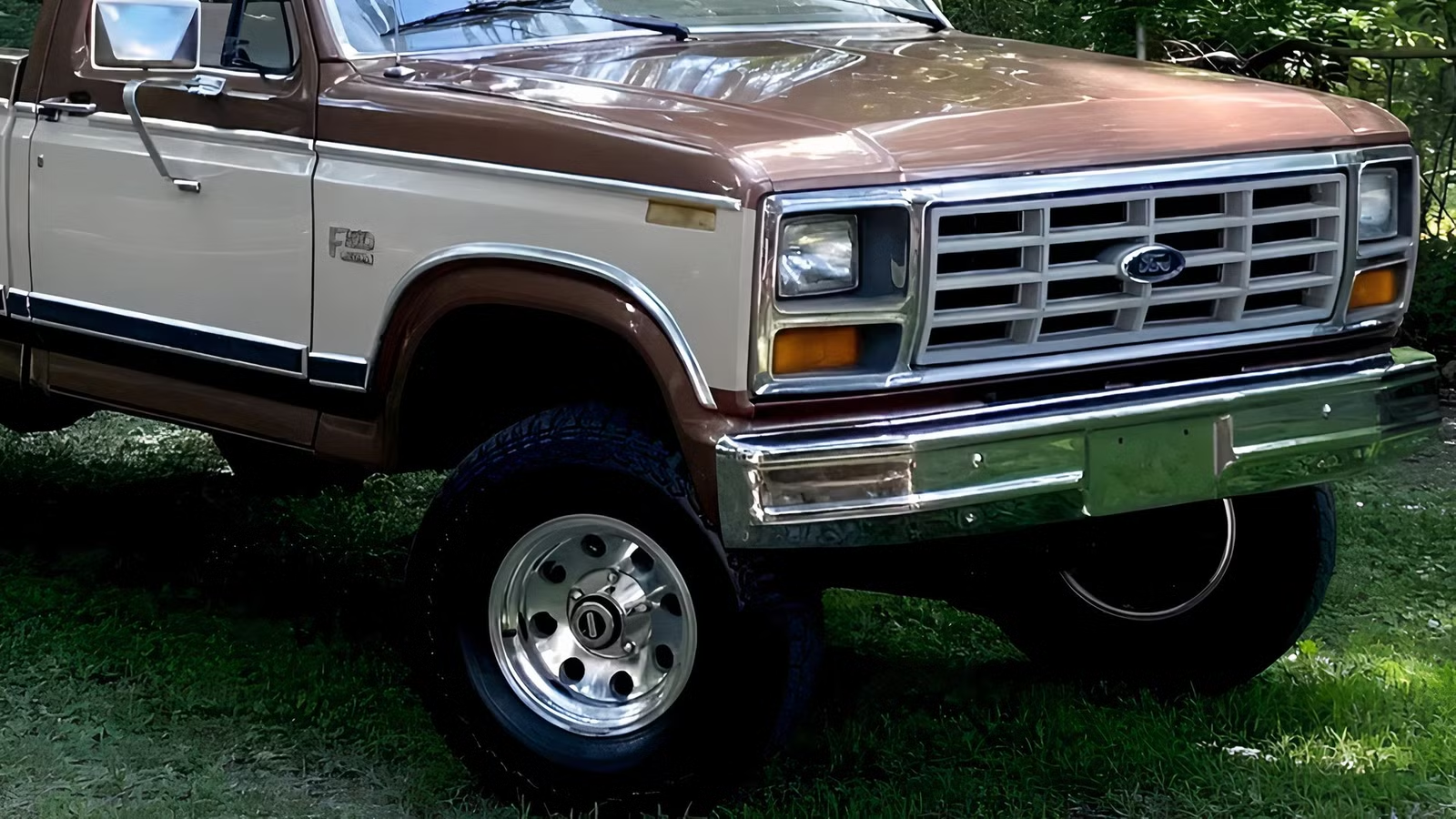
Every half-decent full-size four-wheel-drive pickup should be halfway decent at off-roading. It’d be a giant paperweight if it wasn’t. Yet, being competent off-road and maintaining a bare minimum of competency used to be two mutually exclusive paradigms. Put simply, you bought one or the other, and you didn’t complain about it when your back was sore at the end of the day. As far as Ford is concerned, that all changed when it decided to merge the two paradigms into a format that satisfied both camps. Wouldn’t you know, the F-150 has been the best-selling vehicle in America ever since.
Ford Trucks Pre-1980: Great at Hauling and Off-Roading, Useless on the Road

Let’s provide some context for the dilemma Ford trucks were facing in the years before 1980. Roughly speaking,this applies to the fifth-generation “Bumpside” built between 1967 and ‘72, and the sixth-generation “Dentside” made from ‘73 to ‘79. If you bought an F-series in those days, you had the keys to a tank-like Dana 44 solid axle up front, and an equally legendary Ford nine-inch rear end in the back. For truck-coded activities like hauling heavy loads in the bed or towing behind it, this was the best possible setup you could ask for in those days.
Better still, off-roading wasn’t a hurdle for these mid-century 4WD Ford trucks. If anything, the Dana 44 was downright happy tootling down woodland trails, rock quarries, or just about any non-road environment you could think of. That solid Dana 44 bounced right off boulders, chewed up deep mud like we chew cheeseburgers, and often lived its whole life running around farms, parked in barnyard sheds at the end of the night. But occasionally, people would try to do novel things, like driving them down paved roads for any length of time beyond five minutes, and that’s where they started running into some real issues.
2WD Ford trucks weren’t quite as bad, owing to their Twin I-Beam front setup with two steel swing arms that crossed over each other to the opposite frame rails for a more comfortable ride. That’s not a luxury afforded to 4WD trucks, where that same real estate had to be taken up by a drive axle. The result? That’d be a truck that was more like a road tractor than a road-going motor vehicle. Not only was the ride terrible, bouncy, and unforgiving, but it also forced you to white-knuckle your way down the highway.

Enter the “Bullnose” Ford, and Its Big Secret Weapon

Clearly, by the time 1980 rolled around, Ford knew something had to change on multiple fronts. Not only were previous Ford trucks useless on pavement, but they were also in danger of not adhering to contemporary fuel economy requirements. The oil crisis of 1979, the second one that decade, put intense scrutiny on gas-guzzling pickup trucks that, before then, only applied to passenger cars. Being a full-size truck through and through, a dramatic downsizing campaign the likes of which happened to the rest of the Ford lineup simply wasn’t possible. Put simply, that meant Ford had to get clever, and fast.
If cutting down on size or weight was out of the question, what Ford could do without much pushback was streamline the chassis it was working with, trimming excess weight where possible and re-engineering the undercarriage of the truck to better suit the needs of the time. On the surface, the seventh generation F-Series was a burly brute of a truck, with flat body panels, and a squared stance that gave it its “Bullnose” nickname. In hindsight, it was a timeless look, one that still gives this generation of Ford truck instant credibility when you see it on the road. On top of that,it was the basis for the Bronco SUV of the same era.
Under the hood was a veritable who’s-who of great Ford engines of the period, including small-block V8s in 255 and 302-cubic-inch variants, the beloved 300-cubic-inch straight-six, the 351-cubic-inch V8 in Windsor and Cleveland flavors, the 400 and 460-cubic-inch big-block V8, and even the International IDI diesel V8. Paired to a durable AOD four-speed automatic gearbox, these Bullnose Fords were some of the toughest trucks of the 1980s. In those pre-Powerstroke years, they were also among the first to introduce Americans to diesel engines outside of a tractor-trailer setting. Still, these Gen-VIIs had another advantage that Fords before them lacked. Namely, their on-road manners were much improved, thanks to one addition in particular.
Twin-Traction Beam Front Suspension: Curing Tractor-Like Ride Quality One Truck at a Time

Ford’s initiative to evolve its live front axle into something that didn’t rattle teeth and shake bones at every bump was a total game changer for its full-size truck lineup. In effect, what they did was take the architecture of the 2WD twin I-Beam front suspension setup and engineer a Dana 44 front axle directly into one of the beams, particularly on the driver’s side. Dubbed the Twin-Traction Beam setup, the new architecture gave Bullnose Fords the off-road capability of older trucks, plus the road manners of a 2WD pickup.
It also didn’t sacrifice any of the towing or hauling capability that previous trucks took for granted. All-in-all, it seemed like a pretty foolproof means of bringing some genuine comfort factor to a form factor that seldom had anything of the sort. Yet, there were one or two snafus. Namely, in how the glaring issue of wearing through tires wasn’t quite put to rest. If anything, the problem even got slightly worse.
Where modern truck suspensions are engineered to keep a tire’s contact patch more or less flat and level with the asphalt it drives over, the Twin-Traction Beam’s three-foot swingarms revealed some truly unsettling camber issues. Per inch of suspension travel, there was roughly one degree of camber change. Driving over a pothole or a rut in the road, the compression phase of the dip made the tire tilt inward toward negative camber; on the way back up, it would rebound in an equal and opposite fashion that made all three of Newton’s laws play out in real time. The result? Tire shops made an absolute killing on Bullnose Ford owners back in the 1980s. The owners of these shops often put their kids through college thanks to the Twin-Traction Beam setup, doubly so if the trucks were on a lift kit. Was it perfect? No. But it did signal a new path ahead for Ford trucks, one where they at least attempted to ride nicely over the road.
Setting the Precedent for All Future Ford Trucks

We’re not sure if you’ve driven a Ford truck built in the last 40 years or not, but there’s one common theme you’ll find. They certainly ride and drive far nicer than their brutish exterior often makes it look like they do. That noticeably car-like ride and handling traces its roots directly back to the changes Ford made back in the early 1980s.
Heck, even a modern fourteenth-generation F-150 relies on suspension tech which originates back in the 80s. Though they sport advanced coilover setups instead of the stamped steel beams of the past, the core tenet of integrating a smooth-going front drive axle into a tough-as-nails full-size pickup hasn’t been lost over the years. If anything, it has just been refined, optimized, and adapted into something that makes sense in 2026. Even if prices have jumped into the stratosphere, the bare building blocks between the two really aren’t that far off.
Source: blueovaltrucks.com

Related posts
Latest Post


No Comments