
Honda Priced Its NR750 Oval-Piston V4 Above A New 911
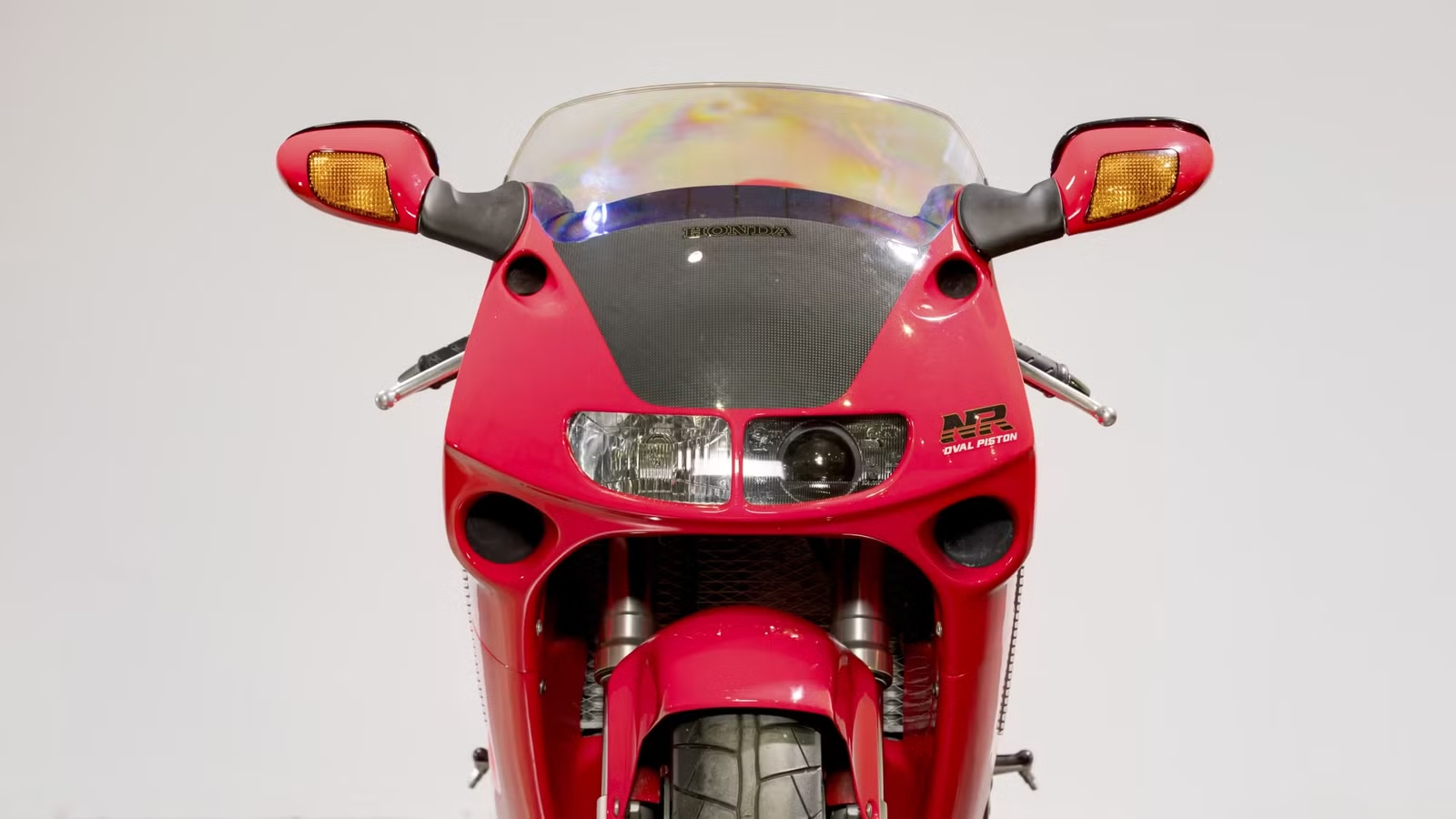
Honda has always had an aversion to building two-stroke motorcycles. This aversion became something of a liability in racing circles back in the 70s, with two-strokes consistently outperforming four-stroke motorcycles on track. In an effort to remain competitive, Honda spent incredible sums of money experimenting with all sorts of different engine configurations.
A Pseudo V8 Shows Promise
Decades before the Italian manufacturers came to the realization, Honda had discovered that the V4 engine configuration offered the greatest performance ceiling. The brand would eventually use it in a series of production motorcycles, but long before that, the racing division developed a V4 engine that acted more like a V8 in practice. The NR500, which debuted in the 1979 GP season, had oval pistons with two conrods each in an effort to skirt racing regulations that limited all motorcycles to four cylinders.

Unfortunately, it was plagued with reliability concerns and the project was scrapped after a few rather dismal seasons. Its failure effectively forced Honda’s hand. They rushed the two-stroke NS500 into development, and ran it in place of the four-stroke NR500, and in this respect, the rest is GP history. But, the time and effort, not to mention resources, poured into the pseudo V8 meant that it merited another shot. By 1987, a 750cc endurance racer with over 160 horsepower was developed. Once again, it proved unreliable, and even though it did eventually win a race in Australia, the project was shelved once again.
Back In 1992, The Honda NR750 Cost More Than A Porsche


In the same year, Honda gave us the very first FireBlade, a road going version of the NR finally made it into production. Albeit, limited production, largely thanks to its exorbitant $50,000 price tag. For reference, that was more than a contemporary Porsche 911! It also cost five times as much as the FireBlade, and in most respects was upstaged by the affordable superbike. The unfortunate timing of its launch was not so much a PR blunder, but more to do with production delays. The NR was announced in 1990, and should have come out the year prior.
Although Honda may still have harbored some hopes of taking this oval-piston bike racing in one of the production race series around the world, homologation requirements of the time would have required Honda to produce at least 1,000 of these motorcycles, and only 322 left the factory before Honda called time on the whole oval piston project. These low production numbers certainly made it highly collectible. For the lucky few who were in a privileged enough position to afford a $50k motorcycle back in the early 90s got a bike that is now worth well over $100,000 in the right condition.
The NR Is An Engineering Marvel

The oval pistons with two conrods a piece are only one small part of this enormously complex puzzle. Like a modern V8, this engine has 32 valves. All of which need to operate with extreme precision, which necessitated the use of gear-driven camshafts. Unlike most bikes of the time, it also featured electronic fuel injection, which may seem trivial today, but back then it was also a pretty impressive feature. Unfortunately, all this complexity comes with some pretty serious drawbacks.
Advanced, But Flawed

The biggest issue was always getting a good seal within the combustion chamber with these odd-shaped piston rings. The race applications of the early 80s could rev up to a dizzying 22,000 RPM, and the heat generated by this kind of load would distort them and compromise performance, if not cause engine failure. This road-going application reined that in considerably, with it only producing 125 horsepower at 14,000 RPM (compared to the 160 horsepower the aforementioned endurance racer was capable of producing). Even for the time, this was unspectacular, but it was sold in this relatively mild state of tune in an effort to improve reliability. All this added complexity also added a substantial amount of weight. Even though Honda used several lightweight components, it still tipped the scales at well over 500 pounds, largely thanks to how heavy this engine is.
A Design That Inspired A Generation

Objectively speaking, the NR represents an almost cataclysmic failure. Honda poured hundreds of millions of dollars into this racing project throughout the 80s, a decade of eternal optimism for all the Japanese brands, with almost nothing to show for it. Even the final iteration of the project, which was framed as an ode to engineering, serves more as a reminder that we can’t always engineer our way out of a problem. Sometimes simplification is the best course of action, evidenced by the enormous racing success Honda eventually experienced with their two-stroke machines.
To the average observer, even the design of the bike will blend in with the 90s crowd. But, Massimo Tamburini was not the average observer. He drew inspiration from this model, taking one look at its clean lines and seeing the incredible potential. The Ducati 916 will forever be remembered as one of the most beautiful motorcycles ever designed, but it can thank the NR for its single-sided swingarm and under-tail exhaust. Key design features that made it look the way it did, which would in turn shape motorcycle design for a generation.
A Racing Failure Has Become A Collectible Classic

Naturally, much hangs off of the condition of the motorcycle, but most of these bikes have been stashed away somewhere safe for the last three decades. With the incredible story behind its engine, and its design, it is without doubt a motorcycling icon. As such, it is well worth its seven-figure price tag to collectors around the world.
The value of these bikes also paints a rather bleak picture of the collector market as a whole, which doesn’t always make a whole lot of sense. Hoarding an unusually unique motorcycle like this for decades seems criminal, yet, in this world that is precisely how you get financially rewarded. For us, we’d rather ride the thing, because a bike like this will only ever make sense once you are in the saddle.
Sources: Honda Global, Superbike Archives, and various auction sites

Related posts


Latest Post


No Comments