
The Forgotten Kawasaki 250 That Was A GP Bike For The Street
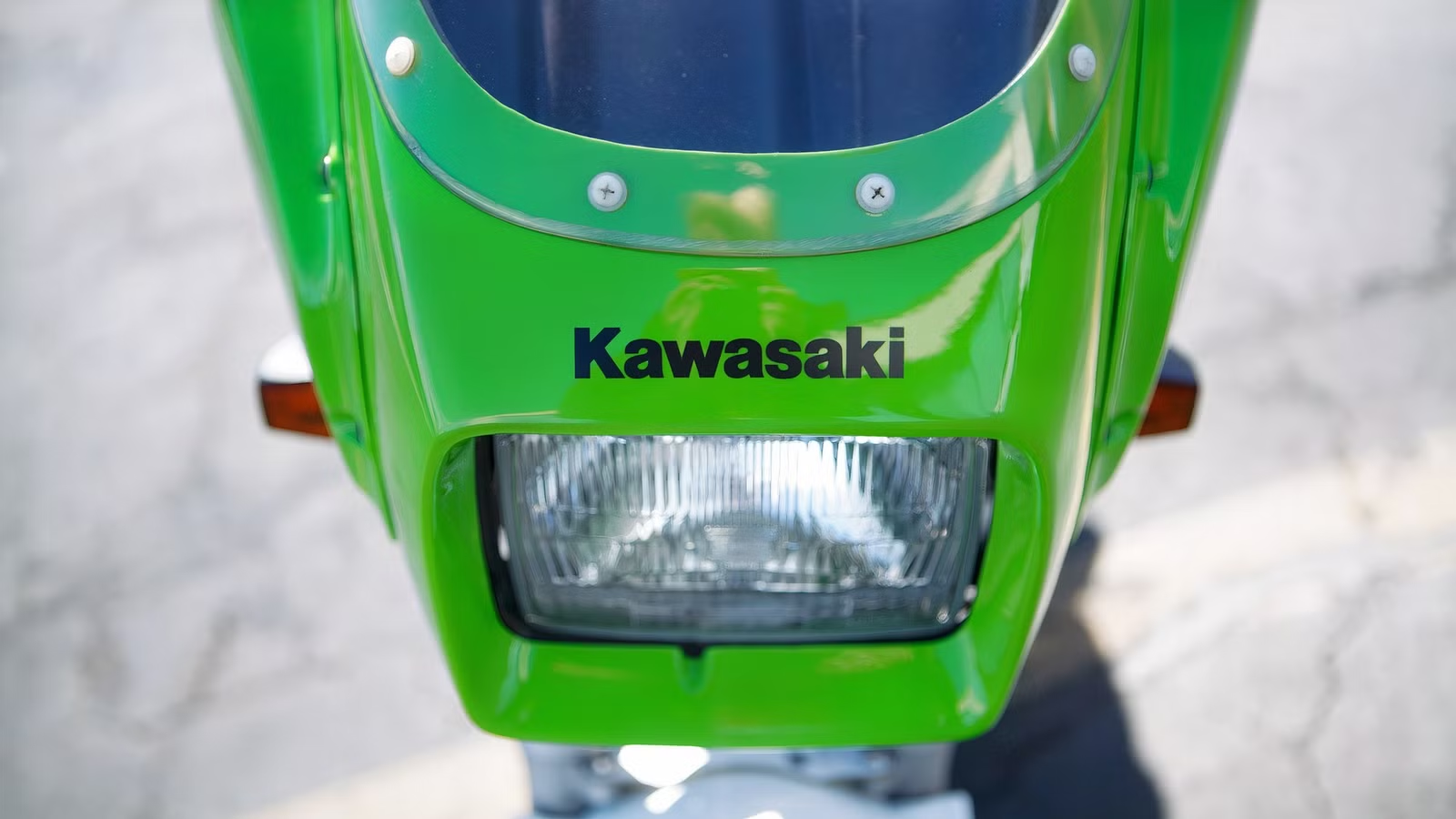
Innovation is so often about putting one foot in front of the other, but for Kawasaki and this 250cc bike, it was about putting one cylinder in front of the other. This format worked surprisingly well on the Grand Prix circuit and, with the layout a success, it went one more step further and put it on the road. The bike that came with it was, in some ways, a road-legal GP bike. But for all of its innovation, the bike is barely known today.
Kawasaki’s Two-Stroke Dynasty Was Something Else Entirely

While Kawasaki might be known today for sophisticated performance motorcycles like the H2, the track-only H2R, and the Ninja ZX-6R, its modern performance edge can be traced back to its more humble two-stroke Grand Prix program. In the late 1970s and early 1980s, the 250cc class was a proving ground for lightweight, innovative engineering, and Kawasaki approached it in an unconventional way: eschewing the typical parallel-twin engine formula, it instead developed a narrow tandem-twin, putting cylinders back-to-back rather than side-by-side. The downside was that it meant that it required two crankshafts instead of one, but that’s small fries when compared to the far more compact engine it allows for.
This unique engine layout gave Kawasaki plenty of credibility. In the hands of South African rider Kork Ballington, Kawasaki won consecutive 250cc World Championships in 1978 and 1979, with German rider Anton Mang continuing the trend in 1980 and 1981. Four straight championships proved that this wasn’t just an eccentric experiment, but a successful Grand Prix weapon.
But Kawasaki’s engineers weren’t just doing this to fill a trophy cabinet. In stark contrast to Japan’s usual proclivity for keeping Grand Prix and street bikes separate, regular riders would actually be able to taste paddock-honed machinery on the road.

When Grand Prix Engineering Started Reaching The Street

By the early 1980s, the gap between a regular Japanese sportsbike and a Grand Prix motorcycle was starting to blur. It was still a few years away from the groundbreaking Suzuki GSX-R750 and the rise of the true race replica, but manufacturers were starting to incorporate more of their race-bred technology to give their showroom bikes an edge. Two-stroke power valves, aluminum frames, and anti-dive front suspension were all originally designed for competition, but were finding more practical applications in the sales war.
This, of course, wasn’t an easy task. A race bike spends its life in a very narrow, incredibly specific window, with everything focused solely on getting it faster and everything else being a compromise. This wouldn’t work for a road bike. Normal riders won’t stand for cramped riding positions, minuscule powerbands, and poor reliability, so the challenge became not how manufacturers could devise these systems, but how they could coerce them into working on bikes with plates.
Kawasaki took a more literal approach. It already had a great motorcycle in its KR250 Grand Prix racer, so rather than reinventing the wheel (or, in this case, the KR250), it adapted the tandem-twin layout that had already proven so effective in racing. And it was a good one.
Meet The Kawasaki KR250: A GP Bike In Street Clothes

The road-going motorcycle that Kawasaki eventually released in 1984 was also named the KR250 but, importantly for riders, it didn’t simply share the same name as Kawasaki’s Grand Prix machinery. Of course, some compromises had to be made along the way, as a bike made for winning championships doesn’t need to worry itself with trivial things like commuting, luggage, traffic, covering thousands of miles, or starting easily on a cold winter’s morning, but the 249cc tandem-twin layout that had proved so effective on the circuit was retained for the street-legal bike… but with a few changes.
The road bike had two crankshafts that connected the cylinders, although plenty of other changes were made as Kawasaki prioritized a broader spread of usable power. That power was, understandably, reduced as well, going from around 56 HP to roughly 45 HP. That said, the compact, tandem engine layout that had genuine racing pedigree was still there, for anyone brave enough to throw a leg over it.
The two front-to-back cylinders also meant there were two separate exhaust ports, with the front one being routed underneath the bike and exiting by the rear wheel, while the rear cylinder exited next to the seat. Not only did the double-exhaust give the bike even more of a distinctive aesthetic, but it allowed a greater lean angle by keeping the lower exhaust tucked underneath the bike.

The rest of the KR250 echoed the racing spirit of its namesake. The aluminum frame helped to keep weight down to a 293 lb dry weight (similar to that of the contemporary Suzuki RG250 Gamma), a six-speed gearbox allowed riders to make the most of those 45 horses, and the Uni-Trak suspension (something Kawasaki introduced five years prior and which replaced the traditional dual-rear shock absorbers with one centrally-mounted one) meant that it could be used to devastating effect in the corners.
It all made for a bike that could be called a race replica, but not in the traditional sense. It looked like a sportsbike, and would fit in with others like the RG250 or the Honda NSR250R, but eagle-eyed riders would notice something different. The engine. It was an interesting take on the segment, as it wasn’t just a shape or a part or a fairing that gave it its replica badge of authority, but the engine itself, which was the real connection to its title-winning cousins.
The KR250 wasn’t the fastest bike that Kawasaki would sell. Nor would it be the most famous, or even the biggest. But it wasn’t supposed to be. What it was, was the clearest demonstration of what happened when a Grand Prix engineering department was allowed to influence the road-going bikes.
The Two-Stroke That Most Riders Never Got To Experience

As good as the bike may have been, the KR250 was still a relatively niche bike. Kawasaki never officially sold it in the US, instead preferring to target domestic Japanese sales in addition to Australia and South Africa, given the 250cc racing scene in those countries. As a result, the bike stayed somewhat secret, as any models outside of these countries were gray-market imports and not done in any great numbers.
Kawasaki did eventually move on from the KR250 as it released the KR-1 and KR-1S in 1988 and 1989 respectively. This was a far more conventional parallel-twin sports bike, which kept the 249cc displacement but bumped power up to around 55 HP, with the KR-1S bumping it up slightly more. These largely overshadowed the lesser-known, lesser-powered KR250 but, in doing so, they also marked the end of Kawasaki’s unusual approach to the 250cc genre.
Why Collectors Are Finally Hunting The Forgotten KR

For years, the KR250 was one of those bikes that slipped through the cracks of motorcycle fandom. Not being officially sold in markets like the US or UK meant that examples there had to arrive as gray imports, while better-known rivals like the RG250 Gamma gave it even more competition for attention. But those problems are turning into positives.
Collectors have started to recognize that the KR250 isn’t just an obscure piece of engineering, but a bike with a truly interesting story that can’t be found anywhere else. It’s rare, it’s bold, and it’s a 249cc two-stroke that has Grand Prix thinking behind it. It’s a combination which is hard to ignore.
Exactly how many bikes were made is difficult to establish, and finding one for sale is even harder. A 6,750-mile example sold for $8,239 in 2025, but documented sales remain few and far between. That makes it difficult to put a definitive value on the KR250, but that’s beside the point. The bike has been overlooked for decades, and that obscurity is now becoming part of its appeal. It was never Kawasaki’s fastest, nor most successful two-stroke, but it was certainly one of its most captivating.
Sources: Webike Japan, Iconic Motorbike Auctions, Motorcycle News, Old Bike Australia

Related posts




Latest Post


No Comments