
The 2WD Jeep Airfield Tug That Outsold Its Own Pickup Two-To-One
The American pickup market has never really been in danger of thinking small. For decades, manufacturers focused on making things bigger — bigger engines, bigger cabs, bigger payloads, bigger bragging rights. But while America wanted larger, other countries wanted smaller. Or rather, smaller running costs, more compact dimensions, and better economy. Jeep’s solution for a more compact pickup initially failed to find buyers overseas, but would find a second life with a very different purpose. And somehow, that second life would be significantly more interesting than what Jeep had first intended.
When America Wanted A Different Kind Of Pickup

The global pickup market was changing in the late 1970s and early 1980s. Compact Japanese trucks like the Datsun 620, Toyota Hilux, and the Mazda B-Series were smaller and lighter than American pickups, making them a more economical choice for a daily workhorse than their larger American counterparts. Australia in particular liked these more practical 4x4s, giving manufacturers ways to get into the market without having to build a full-size truck.
While smaller trucks were gaining popularity, the American pickup was still associated with size and power. It was a popular format domestically, with bigger meaning better, but overseas markets didn’t share the same ideals. They wanted something smaller, more economical, and compact without sacrificing the rugged utility they needed from a working vehicle.
For Jeep — a company forged during wartime and whose name was built on military vehicles and off-road transportation — the opportunity was obvious. It needed to create a compact, utilitarian pickup that combined the toughness of American 4x4s and the practicality that foreign markets were demanding.

The Strange Second Life Of A Failed Export Truck

While the brief was simple, the realities weren’t quite as straightforward. Japanese manufacturers had long been perfecting the economical vehicle formula, and it had a clear advantage on pricing and exchange rates that could very quickly make any American truck look like a far worse proposition.
Jeep’s answer was the CJ-10. Using a J-10 pickup chassis adapted to CJ-style bodywork, it came with the choice of a 2.5-liter four-cylinder or a 4.2-liter six-cylinder. But it just wasn’t popular. Fewer than 1,000 CJ-10s are thought to have been made, around 300 of which were constructed in the US before production was moved to Mexico, and then stopped entirely.
But while the truck was ostensibly a complete failure on the road-going front, there was still hope for it. The platform was solid and while it hadn’t succeeded in the civilian market, a completely different opportunity emerged: turning the CJ-10 into a dedicated aircraft tug. It needed some modifications but, with the backing of the U.S. government, it could still be made into a success.
Meet The Jeep CJ-10A: A 25-MPH Aircraft Tug

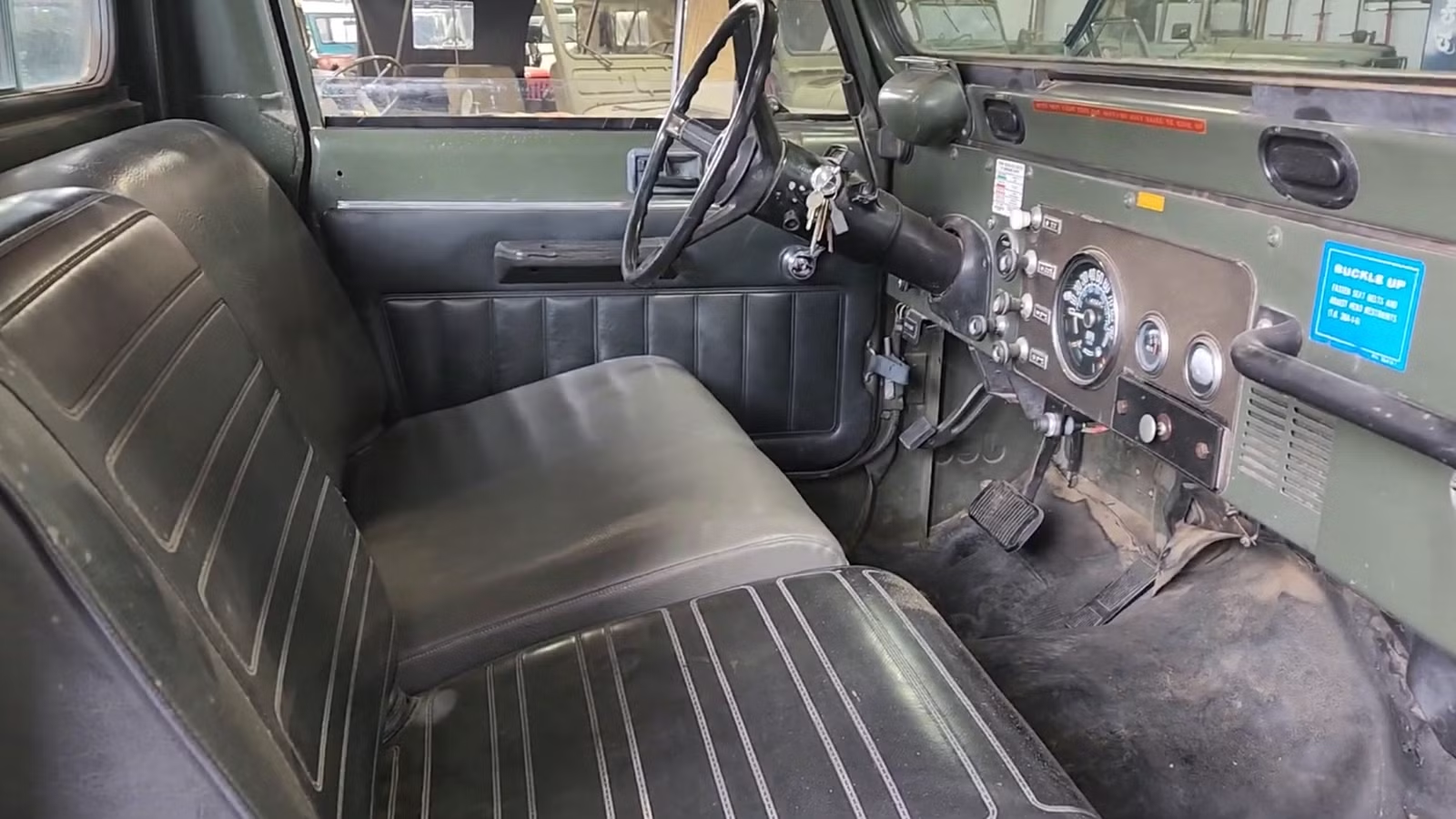
With the CJ-10 a good but unsuccessful pickup, Michigan-based PSI-Mobile and AMC’s AMTEK set about turning the vehicle into something more useful — an aircraft tug. With the pickup no longer needing to satisfy the needs of potential customers, and having just one singular purpose in mind, the designers were able to make some radical changes.
The pickup bed disappeared to start with, and the wheelbase was shortened from 119 inches to just 88 inches, putting the rear wheels almost inside the cab and making it look somewhat like Jimothy the raccoon. The four-wheel-drive was dropped in favor of two-wheel-drive, a substantial ~2,000-lb rear ballast (containing the fuel tank, toolbox, and compressed-air system, among other things) was put over what was left of the rear of the truck, and the transfer case was permanently locked into low range, given it wouldn’t exactly be breaking any speed records with a plane attached to the back of it.
The engine wasn’t safe from modifications either. The original engines were removed and Nissan’s 3.3-liter SD-33 naturally aspirated diesel—more commonly associated with the Nissan Patrol—was put in. It was good for around 81 hp and 138 lb-ft of torque, but power wasn’t what the CJ-10A was about. It was about pulling power.

The result was something even odder than the initial CJ-10, as the little pickup was limited to just 25 mph but was rated to tow up to 40,000 lbs on flat ground. That’s an incredible mismatch, and meant that the CJ-10, which started out intended to be used by farmers, miners, and off-roaders, would now be towing planes like the Fairchild A-10A Thunderbolt II and other massive vehicles on the flightline.
Interestingly, though the CJ-10 had failed initially, this tug iteration was far more popular. Estimates put it at slightly over 2,000 units sold before the model ceased production in 1986, making it much more successful than the civilian model ever was.
Why A 25-MPH Jeep Actually Made Sense
The CJ-10A looks entirely impractical on paper. A 25 mph top speed, 88-inch wheelbase, and a 3.3-liter engine don’t sound like the ingredients of anything even driveable, let alone successful. But while it would have been entirely impractical on the roads, it was an advantage for the runway.
Dropping the mass-market and being laser-focused on a single task meant that the compromises normally associated with road cars didn’t have to hold the CJ-10A back. It could excel on military airstrips, where speed was largely irrelevant and low-speed control, traction, and towing power were far more important.
The CJ-10A’s short wheelbase also made it more maneuverable, allowing it to be more precise in its positioning rather than simply dragging something from place to place. The huge ballast, meanwhile, gave it the weight that it needed to put the power from that 3.3-liter engine down. It made for a vehicle that wasn’t so much a compromised road-goer, but something that had its own job and did it well.
The Forgotten Jeep That Became Its Own Legacy

Both the CJ-10 and the CJ-10A are relatively unknown today. With around 3,000 made, and the majority of them being confined to military runways, it’s not exactly confusing why. But it means that the CJ-10A in particular enjoys an especially peculiar place in Jeep history: a hyper-specialized machine that had one singular purpose, with its obscurity being part of its importance.
Born from a failed attempt to break into the compact market, then modified and rejigged until it was barely recognizable, it became the utility vehicle that Jeep had always hoped it would be and which the CJ-10 never became.
Today, the CJ-10A remains a reminder that a vehicle does not necessarily have to be an immediate success in order to be considered useful. An iteration on its first version, it achieved something far more interesting and useful, albeit stranger, by first struggling to capture the Australian market. And while it may be one of Jeep’s most unconventional machines, that’s exactly why it deserves to be remembered.
Sources: MotorTrend, Flickr

Related posts





Latest Post


No Comments