
McLaren GT Sedan: First Four-Door in Brand History Confirmed
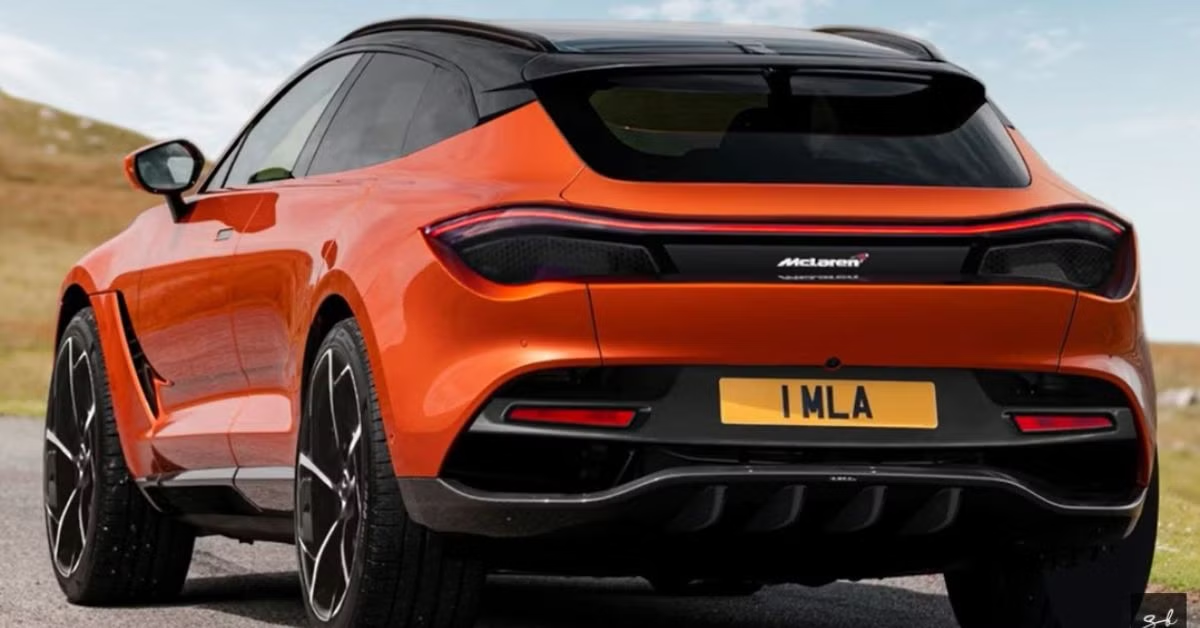
McLaren has spent more than three decades building exactly one kind of road car: a mid-engined, two-seat supercar with a racing pedigree to match its price tag. That era is ending. A dealer briefing reported by Automotive News this week revealed that Woking is planning at least one new model per year through 2028 — and the third reveal on that list is the one nobody expected. Alongside a hybrid V6 supercar and a full-size SUV, McLaren is developing a front-engine, sedan-like gran tourer. A four-door GT. From McLaren.

The SUV has been rumored long enough that enthusiasts have had time to make peace with it. The GT sedan is a different kind of shock. It would be the first four-door road car in McLaren’s history, a direct break from the supercar-only philosophy the company has held since the F1 went on sale in the early 1990s. If the SUV felt like McLaren following Ferrari and Lamborghini down a familiar path, the GT sedan feels like Woking charting its own uncomfortable new territory.
What the Dealers Actually Saw

According to the Automotive News briefing, the sedan-like gran tourer is described as a front-engine GT — a layout McLaren has never used on a production road car. Sources say it will adopt a 2+2 seating arrangement, adding rear accommodations that no McLaren has ever offered. The working theory is that it replaces the GTS in the lineup, but with meaningfully more practicality baked in from the start.
Powertrain details for the GT haven’t been confirmed from the briefing, and no internal code name has surfaced the way P34 and P47 have for the supercar and SUV. Timeline is similarly vague — dealers were shown the direction, not a launch date. What is clear is that this car sits below the SUV in terms of ride height but above the traditional supercar in terms of daily usability, positioned as the grand tourer for buyers who want McLaren DNA without the back-wrenching ingress of a mid-engine two-seater.
The Competitive Pressure Behind the Decision

McLaren isn’t inventing this segment — it’s arriving late to a fight its rivals have been winning for years. Lamborghini previewed its own four-door gran tourer with the Lanzador concept, an electric GT that signals where Sant’Agata is heading beyond the Urus. Ferrari has the Luce in the same general space, though its all-electric powertrain has drawn criticism from the Maranello faithful. Aston Martin has arguably owned this territory longest; the DB12 is the current benchmark for a front-engine GT that blends genuine performance with long-distance comfort.
For McLaren, the calculus is straightforward even if the execution is unprecedented. Ferrari sells the Purosangue. Lamborghini sells the Urus. Aston Martin sells the DBX. Each of those models generates revenue that funds the halo cars enthusiasts actually obsess over. McLaren has watched that dynamic play out across the exotic segment without participating — and the new ownership and management structure appears to have decided that restraint has a cost.
The Other Two Reveals, For Context

The GT sedan is the third and strangest item on a list that was already remarkable. First is the P34, a mid-engine hybrid supercar pairing a twin-turbo V6 with an electric motor for a combined 810 horsepower and around 800 pound-feet of torque. McLaren developed the engine and gearbox in-house, and the P34 is reportedly longer than the Artura, with a tempered-glass engine cover and an F1-inspired cabin. It’s expected to start around $313,000 and go on sale in 2027, with McLaren targeting 1,000 units in the first year.
Second is the P47 SUV, due in 2028. Dealers who saw a clay model described it as larger than a Porsche Cayenne Turbo GT, riding on 24-inch wheels, with a muscular sculpted body. Four doors, five seats — everything McLaren has historically refused to build. The P47 alone would have been the headline a year ago. Now it’s the middle child.
Why the Sedan Is the Real Story

An SUV from McLaren is radical, but there’s a template for it. Every exotic brand that has gone high-riding has survived the backlash and banked the profits. A front-engine GT sedan is something else entirely. McLaren’s identity is inseparable from the mid-engine layout — the F1, the MP4-12C, the P1, the 720S, the Senna, the W1. Moving the engine to the front and adding rear seats doesn’t just expand the lineup; it rewrites what the brand is.
Gearheads who’ve followed McLaren since Gordon Murray’s F1 set the template will feel this one differently than the SUV news. The SUV is a business decision. The GT sedan is a philosophical one. Whether Woking can pull it off without diluting what makes a McLaren feel like a McLaren is the question dealers didn’t get answered — and the one the rest of us will be watching closely as 2027 and 2028 approach.

Related posts




Latest Post


No Comments