
The Sport Bike That Can Make A Weekend Track Day More Fun Than A Superbike
A weekend track day can reveal some things that spec sheets often hide: more power does not automatically mean more fun. Superbikes are astonishingly fast, but extracting anything close to their potential can require vast racetracks, enormous commitment, and a right wrist that is capable of making very careful decisions at extremely high speeds. A middleweight sport bike, on the other hand, offers a slightly different kind of thrill. It lets the rider work the engine harder, brake later, carry more corner speed, and spend more time feeling involved rather than simply hanging on.
Why Middleweight Sport Bikes Make More Sense On Track Days
You Can Actually Explore More Of The Motorcycle

That sense of involvement starts with something counterintuitive: less power. A superbikecan turn a racetrack into a place where straights disappear with almost suspicious speed. With 200-plus horsepower available on many modern liter bikes, opening the throttle fully can become an event rather than a casual part of riding. That performance is spectacular, but it can also leave plenty of capability unused. A strong middleweight sport bike can change that equation. It still offers enough power to feel genuinely fast, yet asks the rider to carry momentum and use the gearbox rather than relying on brute force.

This makes cornering more interactive. The fear of going too fast into a corner is taken away, giving you the freedom to focus on line choice, body position, and getting back on the throttle at the right time. These are the things that help make you a better rider. Mistakes are still mistakes, of course, and a racetrack is wonderfully efficient at exposing them. Where a superbike will launch you into next Tuesday, a middleweight can be more forgiving.
Less Power Can Mean More Laps With A Bigger Smile

Another reason middleweights make more sense is the fact that track days aren’t just for posting your top speed. Often, track-day enthusiasts come to enjoy riding and trying to wring out every ounce of performance from their motorcycles. This is very difficult to do on superbikes. The lower power of middleweights encourages you to stay relaxed enough to focus on improvement. You’re not wrestling with face-melting acceleration anymore, but you are enjoying the corners, the missed apexes, the not-so-smooth transitions, and the wrong lines. You’re always looking to be better on the next lap. But not every middleweight is built with the track in mind. One Italian manufacturer took the concept further than almost anyone else — and the result is something that sits in genuinely uncomfortable proximity to a superbike.

How MV Agusta’s F3 R Sits Uncomfortably Close To A Superbike
The F3 R Lives In The Gap Between Middleweight Accessibility And Superbike Drama

The MV Agusta F3 R is an easy motorcycle to choose for this conversation because it occupies a particularly tempting space between middleweight accessibility and near-superbike drama. Its inline-triple engine and a 0-62 mile-per-hour time of 3.05 seconds give it considerably more muscle than many traditional middleweights, so nobody is going to mistake it for a gentle introduction to performance riding.
But what makes the F3 R so compelling is that this performance is paired with equipment intended to help the rider, from fully adjustable suspension and an up-and-down quickshifter to a comprehensive electronic suite. The F3 R is capable, certainly, but it has a particular ability to make the rider feel more involved with the track.
The F3 R’s Three-Cylinder Has A Very Different Personality

Powering the MV Agusta F3 R is a 798 cc liquid-cooled inline-triple engine with a 13.3:1 compression ratio and titanium intake and exhaust valves. This produces 147 horsepower peaking at 13,000 rpm and 64.9 pound-feet of peak torque at 10,100 rpm. These numbers explain why the F3 R makes such a strong case for itself. There is enough peak power to feel properly exotic, but the three-cylinder configuration gives it a character that’s distinct from the inline-four experience.
MV Agusta describes the engine as rich in torque across the rev range, and the triple layout helps create that useful middle-ground between low-end punch and top-end urgency. For the track, this makes gear selection less punishing than on a peaky engine that demands absolute precision to stay in the sweet spot. But the F3 R still asks to be revved, with its maximum power waiting all the way at 13,000 rpm.
The Counter-Rotating Crankshaft Comes Straight From The Track

One of the F3 R’s more unusual technical features is the counter-rotating crankshaft, a piece of engineering more commonly associated with racing-derived thinking. The company says the F3’s three-cylinder engine is race-influenced and that the crankshaft rotates in the opposite direction to the wheels. The aim here is to reduce some of the gyroscopic forces generated by rotating components, helping the bike change direction with less resistance.
Marzocchi Forks, Brembo Stylemas, And A Trellis Frame Built For Corner Speed

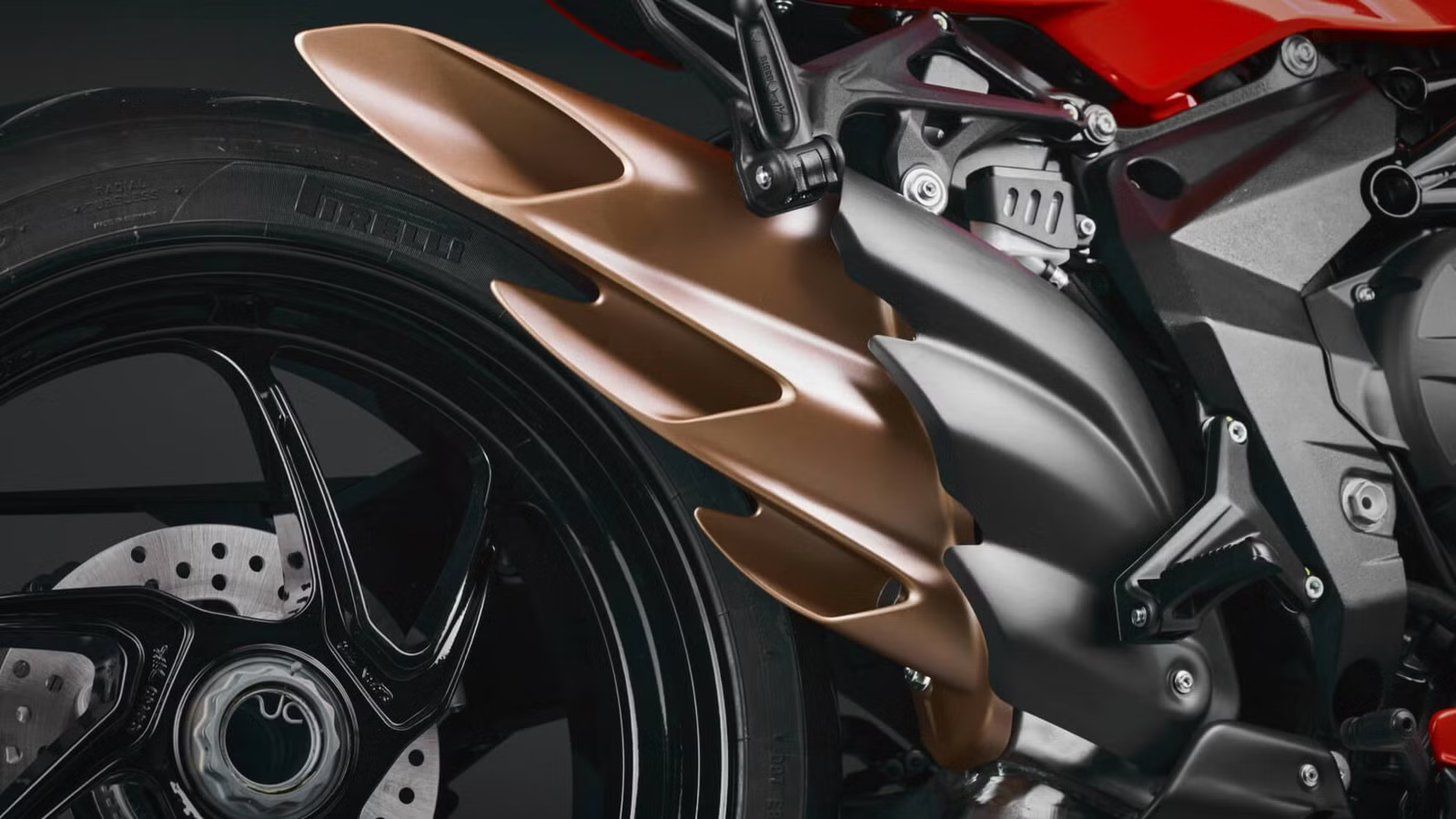
The F3 R uses MV Agusta’s ALS steel tubular trellis frame paired with aluminum-alloy swingarm pivot plates and the distinctive aluminum swingarm. This layout does give the bike some visual theater, but the construction is intended to provide the stiffness and feedback needed for aggressive riding.
The bike’s agility comes from its 54.33-inch wheelbase and a 3.89-inch trail. Suspension comes from a 43 mm Marzocchi inverted fork at the front with 125 mm of travel and adjustability for compression damping, rebound damping, and spring preload. There’s a Sachs single shock at the rear with 130 mm of travel and adjustment for rebound, compression, and preload. This is a serious amount of adjustability for riders who want to refine the bike around their riding style or a particular track.

Stopping power is equally dominant on the F3 R. At the front, two 320 mm floating discs spin inside Brembo Stylema radial monobloc calipers with four pistons. At the rear, a 220 mm steel disc is clamped by a Brembo two-piston caliper. Wheel sizes are conventional 17-inch supersport sizes wrapped in 120/70 ZR17 and 180/55 ZR17 tires at the front and rear, respectively. All of this comes together to provide a confidence-inspiring chassis that is focused on quick steering and sporting grip.
How The F3 R’s Electronics Turn A Track Day Into A Riding School
The F3’s Electronics Help The Rider Grow

The F3 R’s electronics package is one of the strongest arguments for its track-day credentials. The six-axis inertial measurement unit manages the bike’s rider aids with four riding modes: Rain, Sport, Race, and Custom. Someone just starting out on track can use these modes to measure their progress by customizing everything from throttle sensitivity and torque delivery to engine braking, response, and rev-limiter behavior.

Traction control offers eight levels of intervention, while front lift control manages wheelies and launch control manages hard starts. Rear-wheel lift-up mitigation adds another layer of control during hard braking. Everything is adjustable and customizable, letting the rider enjoy not just their bike but the day at the track exactly as they want.
The F3 R Makes The Case That Exotic Doesn’t Have To Mean Intimidating

The MV Agusta F3 R proves that there is more than one route to track-day excitement. Superbikes remain extraordinary machines, capable of performance most riders will never fully unlock. But that does not make them the most entertaining choice for every circuit or every weekend.
With a 798 cc three-cylinder, a counter-rotating crankshaft, adjustable suspension, powerful brakes, and a full suite of electronics, the F3 R sits in an enviable middle ground. It is fast, exotic, and technically sophisticated, but its performance still invites the rider to participate rather than hang on to the bars the entire day.
Source: MV Agusta

Related posts


Latest Post


No Comments