
The ADV Bike With BMW GS Comfort And Italian Character

Ever since its inception, the boxer GS lineup has attracted thousands of buyers all over the world. The oil-head and hex-head models were quite popular, and the updated wet-head R 1250 GS truly cemented its dominance. The current R 1300 GS and GS Adventure build on that idea, introducing some comprehensive updates in the lineup. These were BMW’s highest-selling bikes last year.

However, the base price has risen beyond $20,000, and it breaches $30,000 if you want the full premium bits. That has inevitably opened up the market to rivals, some of which offer a better base package than the GS at a lower starting price. We’re talking about one such bike here, which not only has more oomph than the GS, but it even gets you exotic Italian character.
The BMW GS Is The Bike To Beat In The ADV World
There are a few reasons why the GS lineup has dominated for so long. First and foremost is the reliability. Modern-era boxer-powered GS bikes have always been highly dependable regardless of your use case. Six-digit odometers are common, with very rare major issues. Then, there’s the dollops of performance. Sure, the output isn’t class-leading, but the spread of power is immense, which aids in tractability across terrains.

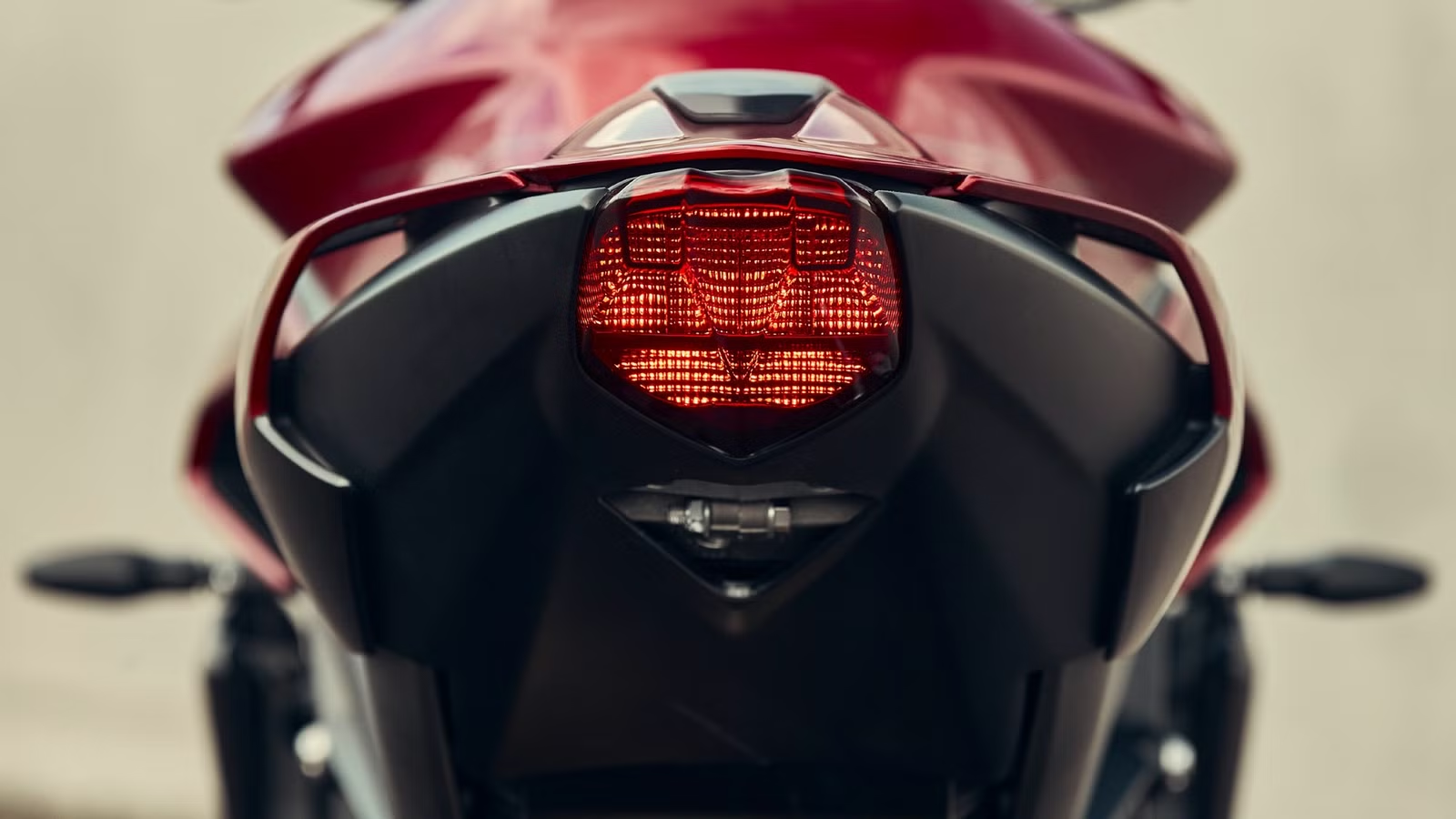
Last but not least is the comfort on offer. BMW’s top-drawer Telelever and Paralever suspension serve as the crown jewels, minimizing dive and unsettling characteristics. That, along with a carefully crafted ergonomic triangle, ensures fatigue is minimal on your tours. A recent addition is the optional Automated Shift Assistant, which means no stress of gear shifts or clutch actuation.
But More Affordable Rivals Make You Think Twice Today

As good as all that is, the rivals have truly caught up in recent years. There are worthy alternatives to the GS from all over the world, and even Harley-Davidson whipped up an ADV to rob away sales from the Bavarian company. However, BMW’s biggest headache is from Bologna, offering similar comfort, more power, better technology, and surprisingly, a considerably lower base MSRP.
The Ducati Multistrada V4 Is The Italian Kryptonite To The BMW GS

We’re talking about the Ducati Multistrada V4. In base trims, the Multistrada actually offers you more for the money, and this includes comfort. For reference, the base GS has a slim two-up saddle and a puny windscreen, compared to the Multi V4’s visibly larger perch and adjustable windscreen that’s shared with the higher-end variants. In contrast, you need to spend at least $5,000 more if you want the comfier perch on the BMW.
Speaking of which, the Multistrada V4 starts at $19,995–an MSRP it has held for a few years, despite a couple of updates in recent times. That makes the Italian ADV $400 cheaper than the base R 1300 GS. That seems like a small difference, but there are some caveats. Firstly, BMW’s official configurator lists the GS’ new base price as $23,795, hinting a large hike for the bike.

Secondly, finding a base BMW is like finding a needle in the haystack. We checked several dealers, and the cheapest new R 1300 GS examples we see are equipped with some or the other optional package, taking the total price beyond $24,000. Let’s not forget BMW doesn’t let you pick and choose accessories. Either you get the full $5-6,000 pack, or you don’t get anything. Considering these cases, you’re looking at a net price difference of around $5,000 between the Multi V4 and the GS you actually take home.
A Deep Dive Into The 2026 Ducati Multistrada V4

To make its case stronger, there aren’t any obvious misses for the $19,995 Ducati Multistrada V4. It checks all the boxes you’d expect a premium ADV to, be it in terms of performance, features, or creature comforts. If you feel something is missing, the official accessories take care of that. Let’s dive deeper.
Non-Desmo Granturismo V4 Engine With 170 HP

If you associate Ducati with Desmo, this is your cue to look away. That’s because the Multistrada V4 boasts a non-Desmo Granturismo engine. This has four cylinders, laid out in a 90-degree V-angle to displace a total of 1,158cc. That helps produce 170 horsepower and 91 pound-feet, where the former is higher but the latter is lower than the twin-cylinder GS. A six-speed transmission sends power to the wheel via a chain final drive.

While the absence of desmo valves might feel like a bummer, there are obvious benefits. Firstly, this has allowed Ducati to infuse variable valve timing here. This is said to help spread the power throughout the rev range for extra punch. And having ridden the bike, the system works brilliantly. Next and more important is the service schedule. Ducati’s recommended service interval is a sizable 9,000 miles (or once every two years), while the valve clearance check is at a whopping 37,000 miles.
Fully Adjustable Suspension From Reputed Brands

With the V4 engine, Ducati also overhauled the chassis on the Multi V4. Unlike its trellis frame-equipped predecessors, this one has an aluminum monocoque chassis. Ducati says the setup uses learnings from the MotoGP world to ensure sharp handling on the road. When things get rough, the suspension comes into play.
Beefy Marzocchi 50 mm USD forks up top and a Sachs monoshock at the rear offer around seven inches of travel. Full adjustability is present to improve versatility, topped with an automatic lowering device at the rear (between 6 and 30 mph). As for wheels and brakes, a 19/17-inch alloy wheel combination is present, each wearing 2x 320 mm and a 280 mm disc, respectively.
A Near-500-Pound Weight And Low Seat Height Boost Ease Of Riding

All that use of aluminum helps Ducati cap the Multistrada V4’s weight at 505 pounds (wet without fuel). That is in the ballpark of its rival, but the seat height is 0.3 inches lower on the Multistrada, thanks to the automatic lowering device. You also get a two-inch longer wheelbase than the GS, which should help with off-road and freeway stability.
Sophisticated Electronic Aids Make Your Journey Safer
Being a premium Ducati, there are all the necessary rider aids that improve real-world usability. These are derived from the world of racing, so you know they’ll do their job well. Coming to the package, a six-axis IMU and ride-by-wire allow wheelie control, cornering ABS, and cornering traction control. Ride modes, hill hold, cruise control, and power modes are also present, and so is a two-way quickshifter as standard. Rounding things off is a five-inch TFT display–1.5-inch smaller than the GS.
Source: Ducati USA

Related posts


Latest Post


No Comments