
Inside Plymouth’s Rare GTX Mopar Insiders Still Chase
During the height of the American muscle car wars, the street was a battlefield where big engines made the most power and races were won by inches. In the late 1960s and early 1970s, Plymouth was right in the thick of it with a legendary roster of street warriors that cemented the brand’s place in the muscle car society. However, as the horsepower race reached its absolute peak, Plymouth executives realized something: not every buyer wanted to sacrifice their lower back and eardrums just to run a 3-second quarter-mile.

There was a growing segment of enthusiasts who still wanted tire-shredding performance but in a premium package with vinyl bucket seats, thick carpets, and enough sound insulation to hold a conversation even while speeding on the highway. This desire for a machine with a dual personality set the stage for one of the most sophisticated, yet criminally overlooked muscle cars of the era.
The Hemi Cars Dominated This Scene
When people look back at this era today, one word tends to drown out everything else: Hemi. The legendary 426 Hemi V8 was the undisputed king of the boulevard, a race-bred monster with revolutionary hemispherical combustion chambers that struck fear into the hearts of Chevy and Ford drivers alike. The Hemi was on every car magazine cover, present on the drag strip, and heavily advertised by dealerships. It became the ultimate status symbol. Unfortunately, the massive shadow cast by the Hemi meant that other great engines that were arguably better suited for actual street driving faded into the background, becoming well-kept secrets known only to the most observant Mopar fans.
Plymouth Had A Few Fast Muscle Cars


Plymouth’s strategy during this golden age of performance was to have some diversity. They didn’t just offer one performance model and call it a day; they built an entire lineup of cars based on their midsize (intermediate) B-Body platform. If you walked into a Plymouth dealership in the late 1960s with a fairly tight budget, the salesman would steer you directly toward the stripped-out, bare-bones Road Runner. But if you were a young executive, a successful entrepreneur, or someone who had the means to purchase a premium vehicle with a heavy dose of acceleration, your eyes would naturally wander to the top-tier Plymouth GTX. The GTX was positioned as the brand’s premium performance car blending speed and high-end luxury.
Plymouth Needed Something More Than Just Another Fast Car

By the late 1960s, the muscle car market had a lot of offerings with some very fierce competition. Having the biggest engine in a mid-size coupe with some decals wasn’t enough. Plymouth wanted to separate itself from the sea of loud, unrefined street racers. The goal was to build a true American grand tourer that could blend speed and comfort in a premium package. It needed to look respectable parked outside a high-end steakhouse, yet have the ability to humiliate almost anything else in the parking lot when the light turned green.
Plymouth Already Had The Right Vehicle

Achieving this ambitious balance didn’t require Plymouth to design a brand-new car from scratch. They already had the perfect platform, launched in 1967 and based on the corporate B-body architecture: the Plymouth GTX. Its intermediate architecture was incredibly versatile, featuring a robust unibody construction and a torsion-bar front suspension with a remarkably stable ride height and predictable handling for a car of its size. For 1970, this car received a major styling refresh with smoother, more muscular body lines, a heavy loop-style front bumper, and a beautiful, revised rear deck. The GTX utilized this platform to its absolute fullest potential, coming standard with heavy-duty suspension components, an extra-strengthened unibody structure, and a nicer interior that immediately set it apart from its budget-conscious stablemates.
The Plymouth GTX 440 Six Barrel Was A Rare “Gentleman’s Muscle Car”

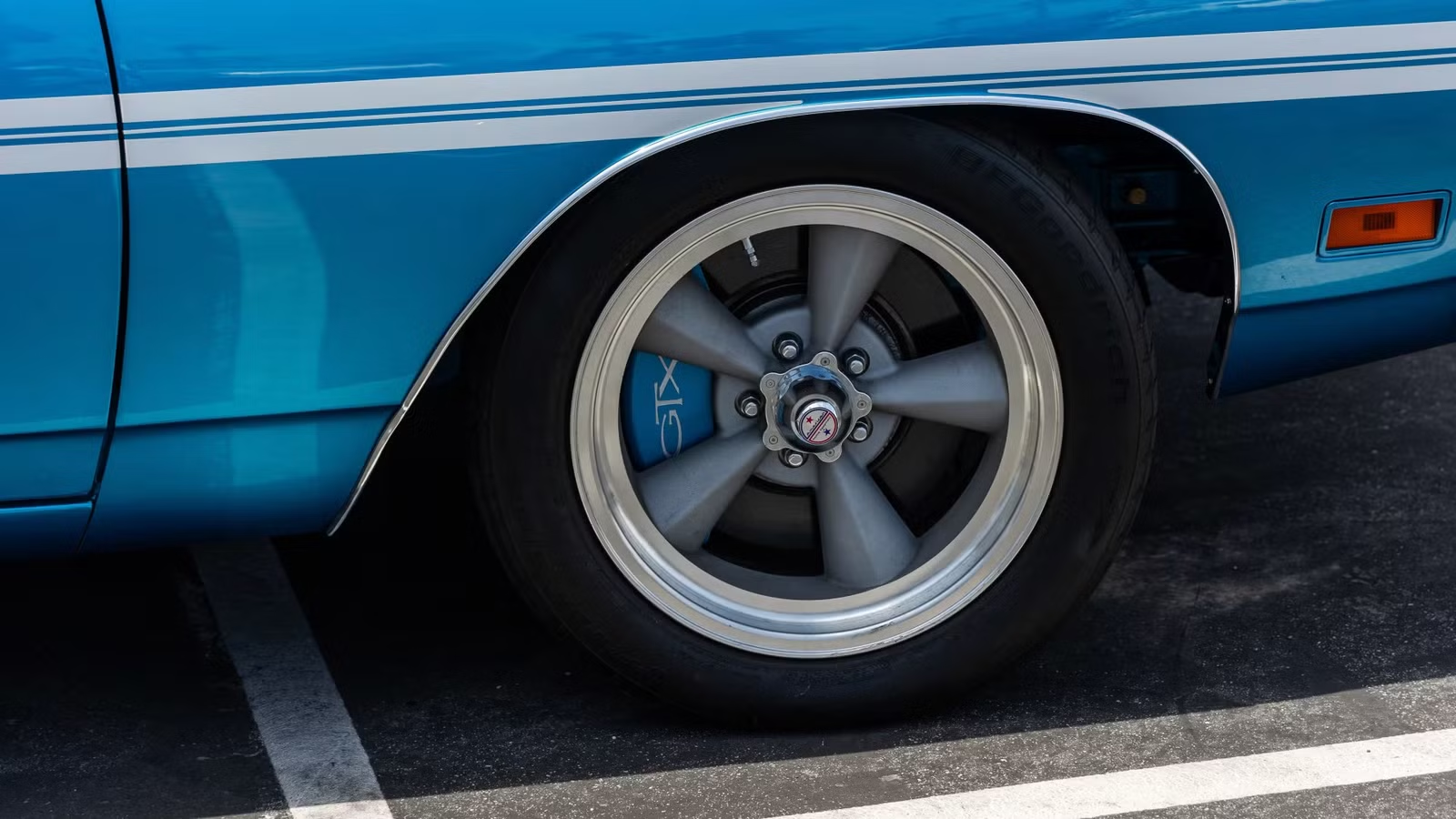
The ultimate expression of this philosophy was realized in a very specific configuration: the 1970 Plymouth GTX 440 Six Barrel (6BBL). This machine was the quintessential “gentleman’s muscle car.” While a Road Runner looked aggressive with its cartoon graphics and optional bright paint, the GTX went about its business with a quiet, menacing elegance. It featured standard luxury items like deep-plush carpets, extra sound insulation, woodgrain dashboard accents, and premium bucket seats. Today, knowledgeable Mopar enthusiasts consider the 1970 GTX 440 Six Barrel to be one of the division’s best-kept secrets because it offered a rare combination of top-tier luxury and mechanical sophistication that was rarely matched by contemporary rivals.
The 440 Six Pack Powered Plymouth’s Flagship

At the heart of this luxury cruiser was an absolute powerhouse of an engine: the 440 cubic-inch (7.2-liter) “RB” big-block V8 with Chrysler’s legendary triple-two-barrel induction system. Officially dubbed the “Six Barrel” by Plymouth, this setup was an engineering masterpiece. Instead of using one large four-barrel carburetor, the 6BBL used three dual-barrel Holley units mounted in a row on top of a specialized Edelbrock cast-iron intake manifold. The genius of the system was its progressive nature, linked to your right foot. Your throttle position determined how much air flowed through the engine.
Under normal driving conditions, the engine runs entirely on the center 350-CFM carburetor. This provided smooth throttle response, stable idling, and surprisingly reasonable fuel economy for a massive V8. The moment a driver pressed the gas pedal past mid-throttle, vacuum diaphragms snapped open the front and rear 500-CFM outer carburetors. Instantly, the engine’s breathing capacity skyrocketed. This sudden transformation altered the car’s personality entirely, forcing a massive gulp of air and fuel into the high-compression cylinders and producing a deeply intoxicating, mechanical intake roar that became a signature characteristic of the Six Pack.
The GTX 440 6BBL Was A Direct Alternative To The Hemi

|
Engine |
440 Six Barrel |
426 Hemi |
|---|---|---|
|
Displacement |
7.2-liter |
7.0-liter |
|
Induction System |
3×2-barrel Holley Carburetors |
2×4-barrel Carter AFB Carburetors |
|
Compression Ratio |
10.5:1 |
10.25:1 |
|
Horsepower |
390 hp @ 4,700 RPM |
425 hp @ 5,000 RPM |
|
Torque |
490 lb-ft @ 3,200 RPM |
490 lb-ft @ 4,000 RPM |
|
Transmission |
Four-speed manual/Three-speed Auto |
|
|
0-60 mph |
5.7 – 6.0 seconds |
5.3 – 5.6 seconds |
|
1/4 Mile |
13.7 – 14.0 seconds |
13.3 – 13.5 seconds |
|
Top Speed |
135 mph |
145 mph |
For the discerning buyer in 1970, the 440 Six Barrel served as a direct alternative to the expensive 426 Hemi. While the Hemi was a high-RPM race motor forced to work on the streets, the 440 Six Barrel was built mainly for street use. Thanks to its massive displacement and the precise fuel distribution of those three carburetors, the Six Pack delivered its peak torque much lower in the RPM range.
By comparison, the Hemi didn’t truly come alive until it climbed past 4,000 RPM. At a stoplight showdown, the 440 Six Barrel was often easier to launch and felt noticeably punchier down low where street drivers spent 99% of their time. It also needed significantly less maintenance than the Hemi. It had almost all of the Hemi’s real-world speed without any of its high-maintenance headaches.
Plymouth Built Fewer Than 700 Of These Cars

Despite its incredible real-world performance advantages, the 1970 Plymouth GTX 440 Six Barrel is incredibly rare today. Plymouth produced just 688 units configured with the Six Barrel engine for the 1970 model year. Several factors kept production numbers relatively low.
The Hemi was heavily marketed, and if you wanted the absolute fastest car, the 426 Hemi was the default option. By 1970, insurance companies were cracking down on cars with large-displacement engines exceeding 400 cubic inches (6.5 liters) and 350 hp. This made cars like this expensive to insure, especially for younger buyers. More stringent emissions and efficiency regulations also made cars like these difficult to own into the 1970s.
From Forgotten Alternative to Serious Collector Status

For decades, the collector car market mirrored the showroom trends of 1970, with enthusiasts focusing their attention almost exclusively on original Hemi-powered cars. The 440 Six Barrel GTX models were often viewed as alternatives. They were good cars, but not the crown jewels of a major collection. However, the classic car market has undergone a massive shift. Hemi cars are now easily high six-figure (and sometimes seven-figure) machines. Savvy collectors have started looking for vehicles that offer similar levels of historical significance and mechanical excitement, are still fairly rare, and cost less.
This demand has driven a steady, undeniable upward trend in auction values for verified, numbers-matching 1970 GTX Six Barrel models. Recent public auctions have highlighted this dramatic shift, with exceptional, highly documented examples regularly clearing the $120,000 to $150,000 mark at premier auctions like Mecum and Barrett-Jackson. The market is finally waking up to the reality that these cars are significantly rarer than many of their Hemi counterparts.
Why Collectors Are Finally Paying Attention

The newfound obsession with the 1970 GTX 440 Six Barrel comes down to a mix of scarcity, usability, and unique identity. Collectors have come to realize that while you might see three or four Hemi Road Runners at a dedicated national Mopar event, an original, factory-documented 1970 GTX Six Barrel is a genuine unicorn.
Furthermore, modern collectors actually want to start and drive their cars. The 440 big-block remains a reliably strong, easy-to-tune engine platform that runs beautifully on modern pump gas with minor adjustments, making it far more enjoyable to own than a finicky, race-tuned Hemi. After spending decades in the shadow of the Hemi, this ultra-rare “gentleman’s muscle car” is finally receiving the respect, recognition, and spotlight it rightfully earned more than fifty years ago.
Sources: Chrysler, Plymouth, Dodge, Mopar, Classic.com, Mecum Auctions, Barrett-Jackson.

Related posts





Latest Post



No Comments