
VW Exploring Tacoma and 4Runner Rivals for America
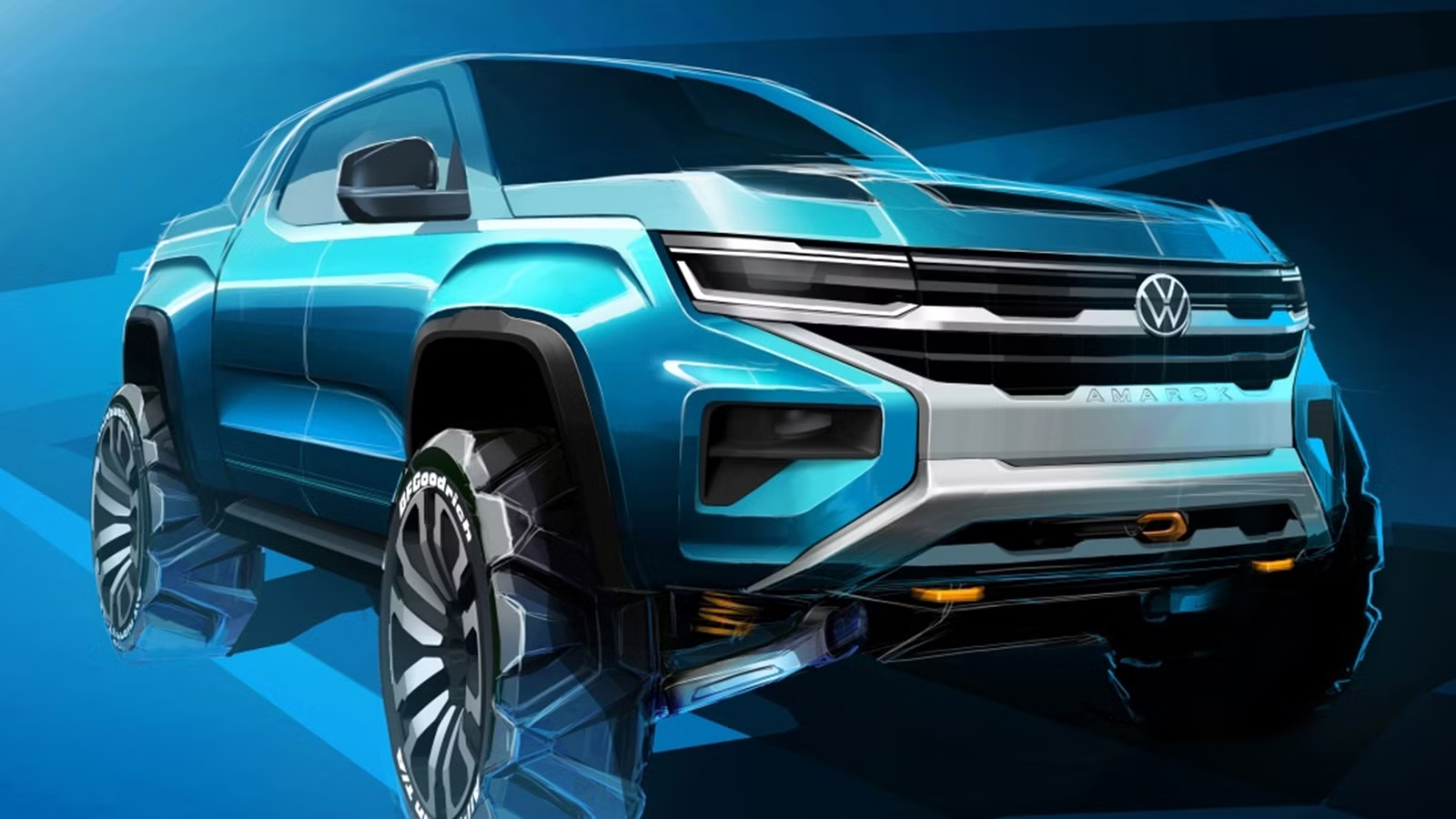
Volkswagen is in the middle of the most painful restructuring in modern automotive history — 100,000 jobs cut by 2030, a lineup slashed by as much as half — and yet its new American boss just announced the brand wants in on the booming body-on-frame truck segment. Marco Schubert, who replaced Kjell Grünner as VW’s North American chief, confirmed last week that VW will explore body-on-frame pickups and rugged SUVs for the U.S. market as part of a dedicated North America strategy.

The timing looks contradictory on the surface. But the BOF segment is one of the few bright spots in a softening new-car market, with the Ford Bronco outselling the Wrangler, the Land Cruiser making a triumphant return, and Nissan confirming a new Xterra. VW sees an opening — and, crucially, it has a platform path that rivals entering this space from scratch simply don’t.
What VW Actually Said, And What It Didn’t
The official statement was carefully worded. VW confirmed it will “explore opportunities in the highly popular body-on-frame B-segment, including robust SUVs and pick-up trucks, as a potential component of Volkswagen’s future product portfolio.” That’s not a product announcement. There’s no confirmed model name, no locked timeline, and no production commitment.

What Schubert’s announcement does establish is a strategic posture: VW intends to treat North America the way it treats China and Europe — as a market that deserves models engineered specifically for it, not just adapted global product. A Tacoma-class midsize pickup and a 4Runner-class SUV are the targets, according to CarBuzz reporting on the announcement. One earlier Reuters report suggested a potential arrival before the end of the decade, which would put any production model no earlier than 2029 or 2030. VW has not specified a prototype timeline.
The Chicken Tax Problem, And Why Scout Changes the Math

VW has been here before. The Amarok — a genuinely capable, over-engineered midsize Truck sold across Europe, Australia, South America, and Africa since 2010 — never made it to American showrooms. The culprit was the Chicken Tax, the 25% import tariff on light trucks that has been on the books since 1964. Importing the Amarok would have made it uncompetitively expensive before a single one rolled off a dealer lot. The second-generation Amarok shares Ford’s Ranger T6 platform through the Ford-VW joint venture formed in 2019, but even that architecture hasn’t unlocked a U.S. path. A teased third-generation Amarok is reportedly not the truck headed to America.
The solution, if VW pursues this seriously, is domestic manufacturing — and that’s where the Scout brand becomes a genuine competitive lever. VW has invested $3 billion in reviving Scout as an independent American EV brand, with the Scout Terra pickup and Traveler SUV built on a rugged body-on-frame architecture. Production at Scout’s South Carolina facility is expected to begin in 2027. Patent filings have already revealed how versatile that platform is, including details on a range-extender engine setup that extends Scout’s range significantly. Audi is reportedly borrowing the same architecture for a G-Class rival, which means VW Group is already planning the kind of multi-brand platform sharing that dramatically reduces per-model development cost and time to market. VW’s Chattanooga, Tennessee plant — which currently builds the Atlas and ID.4 — has also been floated as a potential production site for a VW-badged truck.
A Crowded Segment, But VW Is Not Too Late

The BOF revival isn’t a VW-only story. Hyundai unveiled its Boulder concept and confirmed a full ladder-frame family — pickups, SUVs, and potential Kia and Genesis derivatives — targeting roughly half of its 35% global sales growth through 2030, with a first model expected around 2029. Mitsubishi is returning to the U.S. truck market, sharing a new platform with Nissan that will also underpin the next-gen Frontier and a revived Xterra. Mitsubishi’s new Pajero has been revealed globally, with a Montero nameplate likely for North America if it arrives stateside.
VW is late relative to Toyota and Ford, but not late relative to the wave of new entrants. Hyundai and Mitsubishi are also still years from production. The difference is that VW, through Scout, already has a body-on-frame architecture in development with a confirmed production facility on American soil — something Hyundai is still working out at its Georgia Metaplant and Mitsubishi is planning around its Mississippi plant. If VW can leverage the Scout platform efficiently, it could reach market around the same time as rivals who are starting from a blank sheet.
The skepticism is fair. VW is simultaneously cutting workforce and global model complexity while asking American buyers to wait for a truck that isn’t confirmed yet. But gearheads who remember what the Amarok was — a truck that embarrassed rivals on capability while wearing a suit — have reason to believe VW knows how to build one right. The question is whether Wolfsburg has the organizational will to follow through while the restructuring burns.
For truck enthusiasts who’ve watched the BOF segment explode without a VW option anywhere in sight, Schubert’s announcement is the most promising signal yet. Let’s hope Scout’s platform gives VW the shortcut it needs to actually show up.

Related posts
Latest Post


No Comments