
The Roadster That Makes Modern Bikes Feel Overengineered
Motorcycles have always been an escape from the complicated world we live in. They are simple: turn the key, thumb the starter, ride out somewhere. It all may have started with so much promise, but along the way, we lost the very thing that made it such great fun. Motorcycles today have become complex, heavy, and specialized to the point of requiring specialized skills to ride them well. That, or they only perform well in their element, which might be a racetrack or a dirt track. Whatever happened to motorcycles that were truly fun on the street?
Modern Neo-Retros Abandoned The Working-Class Café Ethos

The modern neo-retro motorcycle has a bit of an identity crisis. The café racer originated as a lightweight, affordable naked bike that was stripped down to reduce weight. The fact that they had to race from café to café meant that their owners were working-class riders who didn’t have the money to afford real performance motorcycles of the time, or access to a racetrack. Today’s café racers are mostly rich men’s toys. They look the way they do because the genre dictates it, but they have electronics that are on par with any modern motorcycle. That means they have the best of both worlds, and manufacturers command a premium for them.
Mechanical Tactility Delivers Greater Street Thrills Than Electronic Aids

For a motorcycle to be fun on the street, it doesn’t require NASA-level electronics or power that would make a race car proud. What it needs is an engine with great midrange punch, linear power delivery, an evocative exhaust sound, and a chassis that communicates better than your therapist. True engagement on a motorcycle comes from mechanical simplicity that allows you to feel what is happening while remaining predictable; it doesn’t need the filter of electronics all the time.
Royal Enfield Is Best Placed To Make Such A Motorcycle

Royal Enfield has been making exactly such working-class motorcycles that thrive on mechanical purity rather than a dependence on electronics for well over a century. It has had a renaissance lately, but even when it updated and modernized its range, it has not let go of its core tenets. It took a calculated risk by rejecting complete modernization in favor of great engineering and mechanical tactility. This not only allowed it to undercut the competition, but happily also gelled with its history. That said, philosophical purity alone doesn’t make a great motorcycle. The question is whether Royal Enfield’s restraint actually delivers a better riding experience — or just a cheaper one.

The Continental GT 650 Revives Pure Analog Café Riding

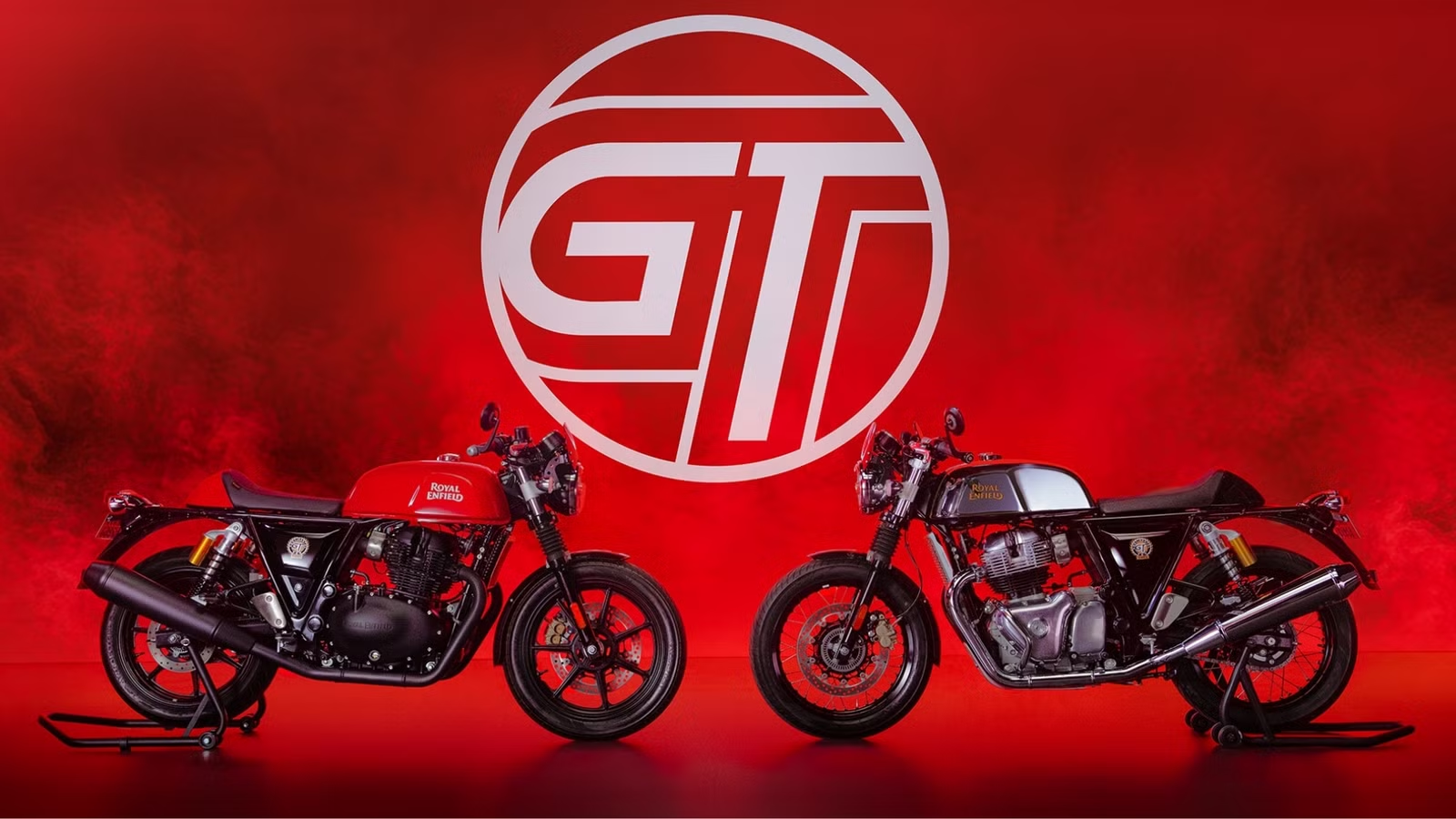
That motorcycle is the Continental GT 650. Royal Enfield has not equipped it with anything resembling complex electronics: there are no ride modes or traction control, and even the ABS is not switchable. It just gets an authentic café racer rider triangle with clip-on handlebars, rear-set footpegs, and a tank that looks the business. The 270-degree parallel twin loves to be revved and offers a great soundtrack, and while the chassis specs might look ordinary, it offers feedback that is truly unfiltered. This is one of the Royal Enfields that celebrates simplicity, and the kind of roadster that will remind you why we fell in love with motorcycling in the first place.
A $6,349 MSRP Secures Uncontested Multi-Cylinder Value

The Continental GT 650 retails for $6,349. That puts it in a very interesting space in the market, because there is only one competitor that is priced near it, and the next most expensive one costs almost twice as much. So if you want a café racer with more than one cylinder on a budget, you do not really have a choice. In other words, Royal Enfield has nailed the pricing with the Continental GT 650, which goes a long way to explain why Royal Enfield is growing so fast.
The 270-Degree Air-Cooled Twin Prioritizes Usable Midrange

Royal Enfield’s 650 cc range is powered by the same engine in the same state of tune, and it has proven to be an excellent fit for the purpose. With air and oil cooling, this is a 648 cc parallel twin with a single overhead camshaft and four valves per cylinder. It has a 270-degree firing order with a compression ratio of 9.5:1.
It generates 47 horsepower at 7,250 RPM and 38 pound-feet at 5,150 RPM, making it the most powerful Royal Enfield ever. It sends this power to the wheel via a six-speed manual gearbox with an assist and slipper clutch and chain drive. This is an old-school cable throttle with no quickshifter, so you have to do all the work yourself. But it is extremely rewarding because of its engaging, linear pull that lets you wring it out to the redline on back roads. It does run out of breath on the freeway, though.
Harris-Tuned Steel Frame Delivers Predictable Mid-Corner Stability

Royal Enfield has chosen a simple double-downtube cradle frame for its café racer. It might seem simple, but it offers genuinely good handling thanks to input from Harris Performance, which makes it essentially an in-house design. At the front, there are 41 mm telescopic forks with 4.3 inches of travel, and at the rear, there is a very nostalgic twin gas-charged shock setup with adjustable preload and 3.5 inches of travel.
The brakes could do with a little more assistance. The front brake is a single 320 mm disc with a two-piston floating caliper, while the rear disc is a 240 mm disc with a single-piston caliper. Royal Enfield has chosen 18-inch alloy wheel rims fitted with tubeless tires; the rear tire is a radial. The specs might be simple, but the chassis matches the engine perfectly and allows you to hustle the Continental GT 650 around within its limits. In simple terms, living with it will put a smile on your face.
Dedicated Clip-On Ergonomics Limit The Chassis To Solo Travel
The Continental GT 650 measures 83.4 inches long and 30.7 inches wide, and has a wheelbase of 55.1 inches. The ground clearance is 6.9 inches, the fuel tank can hold 3.3 gallons, and the curb weight is 472 pounds. While it does measure like a middleweight motorcycle, this is a motorcycle that provides everyday comfort for a single person only, which is all right; the INT 650 serves the purpose of a two-up solution. The short wheelbase guarantees flexibility, and the ground clearance is truly impressive for the kind of motorcycle it is; the only negative is the weight.
Twin Analog Dials And Basic ABS Preserve Vintage Cockpit Simplicity

Royal Enfield has chosen to keep the Continental GT 650 retro when it comes to the feature set. It has a twin-pod instrument cluster with analog dials for the speedometer and tachometer. There is also a small LCD display that shows information like the fuel level, trip meters, and odometer. Given the kind of motorcycle it is, this is all right. It has recently received small updates in the form of all-LED indicators and a fast-charging USB Type-C port to go with the dual-channel ABS that was always present. Once again, measured against its price, this is all right.
A 472-Pound Curb Weight Tests Budget Damping And Single-Disc Brakes

The GT 650’s high curb weight is a significant drawback. For context, the Thruxton 400 is a single-cylinder competitor, so it will naturally be lighter, but so is the Suzuki GSX-8TT, which is a twin-cylinder competitor with a larger displacement engine. What’s more, this Royal Enfield’s weight is within 10 pounds of both the Kawasaki Z900RS Café and the Triumph Speed Twin 1200 RS, which puts things into perspective.
It is the weight that demands better front brakes, not to mention more performance from the engine. The current single front brake disc needs a firm pull at the lever with two fingers or more, and can fade under rapid heavy use. This will become a bigger issue with the upcoming 750 cc Continental GT. The rear suspension could also use better spring rates and rebound damping.
The Triumph Thruxton 400 Challenges Royal Enfield On Weight And Tech

The Triumph Thruxton 400 is one of the coolest entry-level motorcycles and retails for $6,295, which is within $100 of the Royal Enfield’s price. Every other café racer on sale costs a lot more than the Continental GT 650. Suzuki has the GSX-8TT for $11,149, and the pricing only goes higher from there with the Kawasaki Z900RS Café ($13,299), the Triumph Speed Triple 1200 RS ($17,195), and even the upcoming Yamaha XSR900 GP.

The Thruxton 400 definitely has the look with its retro fairing for the headlamp and clip-on bars. It also has similar performance to the GT 650 from its 400 cc single-cylinder engine combined with its much lighter curb weight. It is a little more modern because of its liquid cooling and the ability to fit parts like a quickshifter thanks to its by-wire throttle, yet it follows an equally retro design scheme as the Continental, with an analog speedometer and an LCD dash.
Source: Royal Enfield USA

Related posts
Latest Post


No Comments