
The American Motorcycle That Quietly Became an Icon
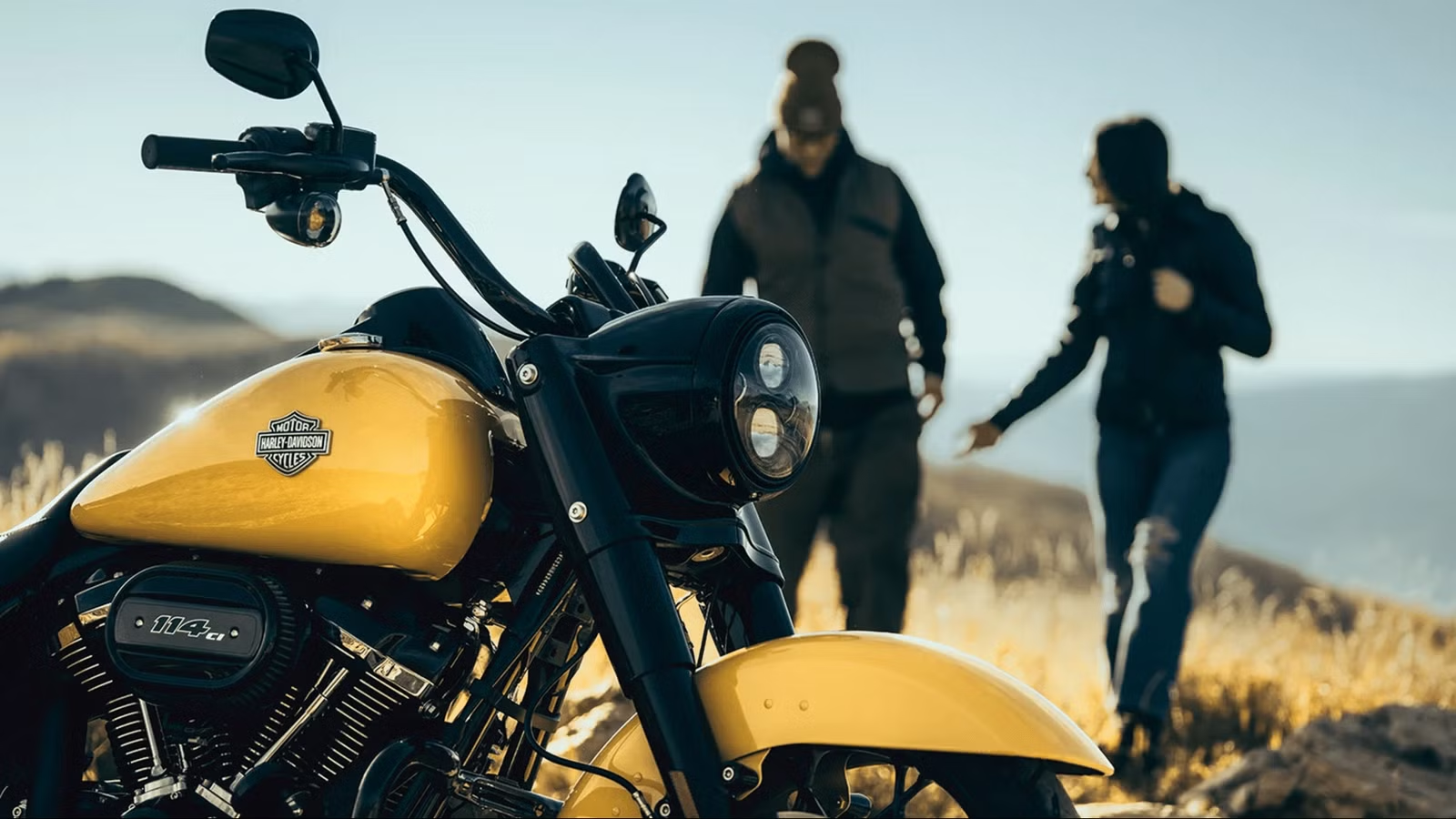
Every time a motorcycle cop pulls alongside your lane in the U.S., you’re looking at a silhouette of a Harley-Davidson that has been sold to American police departments since the 1990s. A big V-twin with the paraphernalia that is specific to police bikes is what most people could sketch the shape of from memory. Hardcore enthusiasts would be able to tell the exact model, but for the most part, it’s the very anonymity of it that has built the bike’s reputation.

Of late, however, this particular model was pulled from Harley’s two model-year reveals this year, and it simply wasn’t part of the 2026 range anymore. Nobody at Harley said much about why it was so, but we think a fitting farewell is due for this silently iconic H-D touring motorcycle.
A Simple Motorcycle Formula Turned Out To Be A Hot-Seller
In the 80s, Harley-Davidson took its FLH Electra Glide, a bike even Elvis couldn’t resist, and stripped it of its bulky fairing-equipped tourer look to create the Electra Glide Sport. This was a version with a plain windshield and hard saddlebags, minus the fairing bulk of the fully dressed tourer. Malcolm Forbes, the publishing magnate, had been a devoted owner of the outgoing Electra Glide Sport, and that was proof of the stripped-down look developing a solid following of its own.


Come 1994, the FLHS Electra Glide Sport developed into a new model line. Every first-year unit of that new bike sold within months, and enough buyers even flipped barely-used examples for a profit. The motorcycle went on to lead Harley-Davidson’s own sales charts for over a decade, a run that only ended when the Street Glide took over as the touring family’s bestseller sometime in the mid-2000s.

Once the windshield and bags come off, it leaves a clean, minimalist cruiser ready for a custom look or swapped bars, and the touring gear goes back on just as quickly for the next long weekend. This was a motorcycle that appealed to riders who wanted a bike that worked as a daily commuter and a cross-country hauler, delivering long-term value, and it marked the beginning of an iconic bike in the making.
The Harley-Davidson Road King Is An Underrated Icon

The Harley-Davidson Road King is the name Harley gave that formula in 1994, and for thirty-one years afterward, the company kept building it on almost the same recipe. That recipe is a chrome-heavy, fairing-free frame that lets a rider choose between a stripped commuter look and a fully bagged tourer without touching the frame itself. The last version of the Road King is still on sale and listed as the 2025MY Road King Special, with a starting price of $24,999. Definitely not cheap for a bagger but competitive against anything else wearing a comparable engine and chassis combination.
The Milwaukee-Eight 114 Sits At The Heart

The final Road King Special’s engine is Harley’s Milwaukee-Eight 114, a 1,868cc air-cooled V-twin with a 4.016-inch bore and a 4.5-inch stroke that makes 95 horsepower at 5,020 rpm and 122 lb-ft of torque at just 2,750 rpm. As with all big V-twins for cruisers, it’s that low-end torque that gives the bike a unique, powerful, off-the-line pull even when hauling a passenger and a full set of saddlebags. Harley rates it at an estimated 43 mpg, and pairs it with a 6-gallon tank that puts roughly 250 miles between fuel stops.
807 Pounds Ready To Ride

At a claimed 807 pounds ready to ride and a 26.4-inch laden seat height, the Road King Special stays easy to flat-foot at a stop despite its bulk. A 26-degree rake and 6.9 inches of trail keep the steering input light and agile enough to not make the front-end vague at highway speeds. Braking comes from four-piston fixed calipers at both ends, with dual floating rotors up front and a single fixed rotor at the rear, offering plenty of stopping power for a bike this size. The two saddlebags are rated at a combined 18.7 gallons of storage, so weekend jaunts can have all your necessities packed in.
The Icon That Got Built By Other People’s Choices

Harley never ran a campaign or shouted out loud to sell the Road King back in the 90s or even now as an iconic motorcycle. Instead, the product did the talking for itself, and people didn’t need convincing. Despite a plethora of capable options available, police procurement officers kept specifying this format. Even Harley’s main industry rival saw the Road King as a popular enough competition that it built an entire model just to match its formula years later. The result, three decades in the making, the Road King is one of the most recognized touring silhouettes in America.
Police Fleets Made It The Most-Seen Harley On American Roads

For most of the Road King’s 30-plus-year run, Harley built a dedicated police variant called the Road King Police (FLHP). It ran the same basic underpinning and formula without a fairing and quick-swap saddlebags alongside the lighting and siren package. And there were practical reasons behind various law enforcement departments specifying the Road King. It had less bodywork to repair after a low-speed drop during training, its relatively low saddle height let shorter officers feel confident with its low-speed handling, and it had the grunt to quickly get on with a pursuit. The current Police Road Glide runs the Milwaukee-Eight 121 VVT.
The Indian Springfield Picks Up Where The Road King Left Off

Such was the Road King’s success and popularity that when Indian wanted a direct answer to it, it practically lifted the same formula as it has in recent years. This motorcycle was also significant for Indian as it filled a gap in the manufacturer’s own lineup, being the only fairing-free bagger between the soft-bagged Chief Vintage and the heavily faired Chieftain. It launched in 2016 with keyless ignition and cruise control standard, plus remote-locking saddlebags and tire-pressure monitoring, which were equipment that the Road King didn’t offer standard at the time.

The 2026 Springfield continues doing what it started a decade ago. Powered by the air-cooled Thunderstroke 116 that displaces 1,890cc, its 126 lb-ft peak torque edges out the Road King’s 122 lb-ft by a little. The Springfield undercuts the Road King Special’s on price too, at $23,999 against $24,999, though it gives some of that back in storage and weight, at 17 gallons and 827 lbs. The Road King is also the more compact of the two, with a 64-inch wheelbase against the Springfield’s 67, which translates to tighter maneuvering and quicker handling while not compromising on straight-line stability.

A handful of 2025 Road King Specials are still sitting unsold as new stock right now, and they’re the last ones that you can get your hands on, as Harley’s stance on bringing the name back is uncertain as of now. But until Harley decides if the nameplate is worth reviving, the Road King’s quiet existence, its function in Harley’s lineup, as well as inspiring Indian’s own version of it, are proof of a concept that worked well, became a living legend, and yet remains underappreciated.
Source: Harley-Davidson

Related posts
Latest Post


No Comments