
These 10 Classic Cars Had Wild Features Automakers Won’t Touch Again
Every so often, scrolling through old car brochures or wandering a concours field, you stumble across a feature so audacious it stops you cold — something no modern product planner would greenlight in a million years. Classic cars were built in an era when engineers and designers swung for the fences, often without a safety committee or a focus group in sight. The results ranged from genuinely brilliant to spectacularly impractical, and the most memorable ones share one thing in common: they never came back.

From extravagant styling cues to bizarre functionality, these bygone features are, for the most part, extinct. They didn’t evolve into modern counterparts. They didn’t get adapted or refined. They simply disappeared. These ten cars showcase exactly that: features so unique, impractical, or era-specific that the industry quietly let them fade into history.
1958 Buick Limited
Dagmar Bumpers
The 1958 Buick Limited was the last hurrah of the ultra-ornate ’50s era before design sensibilities shifted. Among its many dramatic features, the one that turned the most heads — and likely bruised a few shins — were the prominent “Dagmar” bumpers. These large, bullet-shaped chrome protrusions sat at the front, giving the car a distinctive face that was both menacing and stylishly over-the-top.

Named after the 1950s television personality Dagmar, these bumpers were an exaggerated flourish borrowed from jet-age styling and pin-up culture. They offered no real performance benefit, yet they became a defining design cue of the era. As automotive safety and pedestrian-impact standards evolved, the very idea of pointed front bumpers became untenable, sealing the Dagmars’ fate as an extinct relic.
1960 Chrysler Imperial
Free-Standing Headlights

In a time when most cars began tucking their lights into integrated fender lines, the 1960 Chrysler Imperial stood defiantly apart. Its free-standing headlights, housed in chrome pods completely separated from the body, gave it a bold, almost sci-fi look. They were inspired by Virgil Exner’s “Forward Look” design language, which pushed Chrysler styling into flamboyant new territory.
The design made the Imperial instantly recognizable, but it came with real compromises. The pods added weight and complexity, and their exposed surfaces were difficult to clean and maintain. The look was divisive even at the time, and evolving design trends combined with stricter safety regulations ensured that no automaker would ever revisit the idea.
1957 Cadillac Eldorado Brougham
Perfume Dispenser

The 1957 Cadillac Eldorado Brougham was Cadillac’s most expensive and ambitious offering to date, with a sticker price that shamed a Rolls-Royce. As you’d expect, it came loaded with features that bordered on absurd, including a factory-installed perfume dispenser. Nestled in the glove compartment, a vial of Arpège by Lanvin was part of a curated selection of luxury amenities.
Cadillac saw the Brougham as a technological and luxury showcase, and the perfume dispenser added a touch of indulgence that even today feels over the top. Time and practicality caught up, of course. The feature had no measurable value, added to production costs, and didn’t age well with the car. Today, automakers still chase the luxury angle — but not quite with bottles of cologne built into dashboards.
1961 Lincoln Continental
Suicide Doors

The 1961 Lincoln Continental made a dramatic return with styling that embraced crisp lines and clean restraint. But its most iconic feature was its use of rear-hinged “suicide doors.” While the term might sound ominous, the design allowed easier entry and exit, especially in chauffeur-driven scenarios. It also helped the Continental cut a regal silhouette that defined 1960s American luxury.
Rear-hinged doors had existed in early automotive history but fell out of favor due to safety concerns — a door could swing open into traffic or fly wide if not properly latched while the car was moving. Lincoln revived them for aesthetic appeal, but by the late ’60s they were phased out again. Despite their elegance, suicide doors have become an endangered design, reserved for ultra-limited editions or one-off show cars.
1973 Chevrolet Chevelle Laguna
Body-Colored Urethane Nose

When the 1973 Chevelle Laguna debuted, it brought a small but impactful innovation to the front end: a body-colored urethane nose instead of the traditional chrome grille and bumper. It was a direct response to new federal safety regulations requiring 5-mph impact protection, and GM took the opportunity to blend compliance with style.
While the design gave the Laguna a clean, modern front fascia, it also introduced durability issues. The urethane material didn’t age well and was prone to cracking, fading, and warping over time. Eventually, advances in bumper engineering allowed manufacturers to meet safety standards without sacrificing aesthetics. The fully painted soft nose faded out quickly, surviving only a few model years before design priorities moved on.
1970 Plymouth Superbird
Nose Cone And 19-Inch Wing

The 1970 Plymouth Superbird remains one of the most recognizable cars ever to roll off a Detroit assembly line. Its distinctive aerodynamic nose cone and towering 19-inch rear wing weren’t just for show — they were engineered specifically to dominate NASCAR’s high-speed ovals. It was homologation at its most extreme, and it worked: the Superbird was a monster on the track.
For regular road use, however, the extreme aero features proved to be a liability. The nose cone made parking a nightmare, and the rear wing severely compromised rearward visibility. Once NASCAR changed its rules to restrict such aerodynamic advantages, there was no longer any justification for such designs on street cars. The Superbird’s look was never replicated, and the winged warriors of that era disappeared just as quickly as they arrived.
1954 Mercedes-Benz 300 SL
Tilt-Forward Steering Wheel

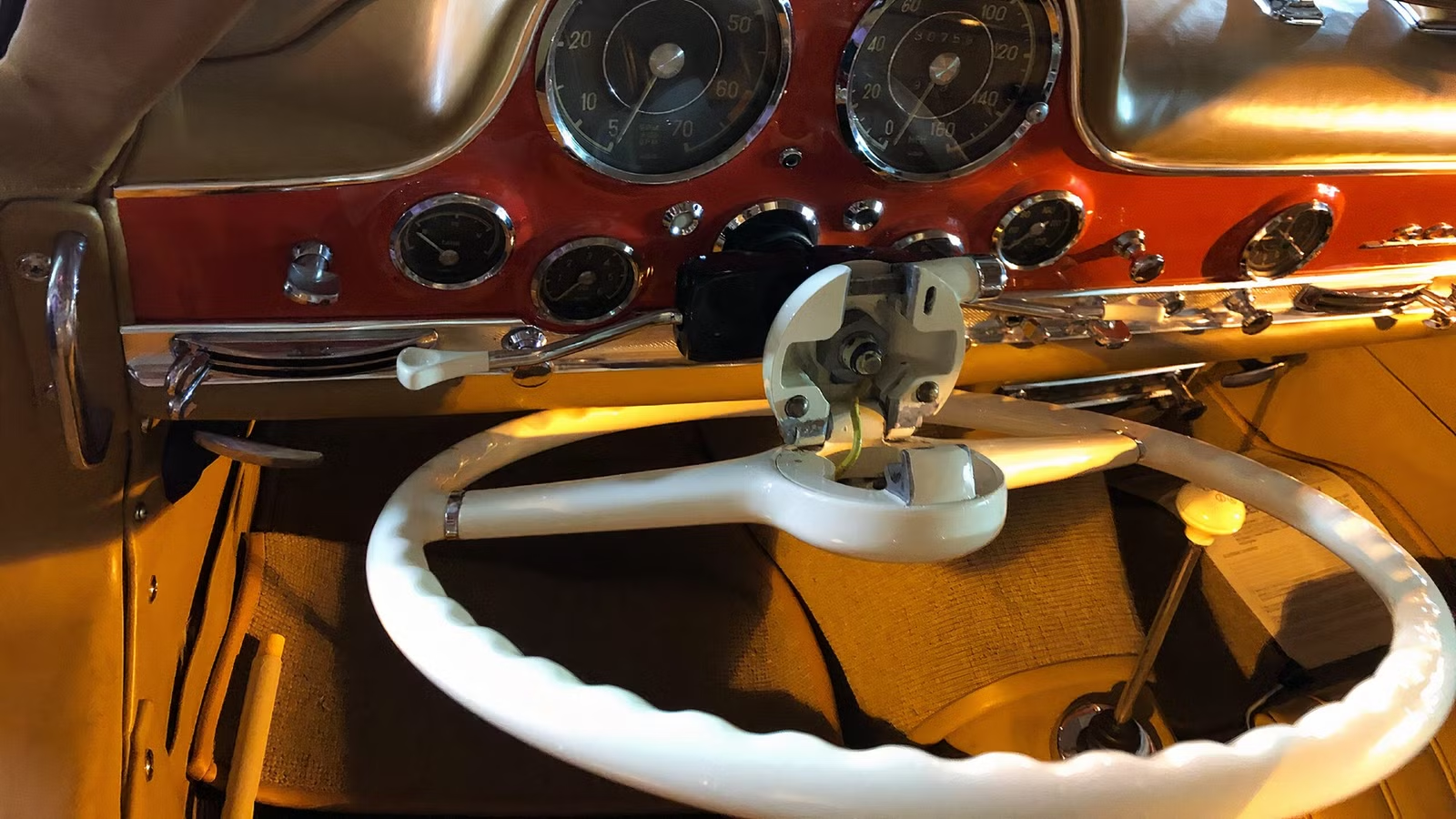
The 1954 Mercedes-Benz 300 SL Gullwing is best known for its iconic doors, but another unique feature helped drivers actually get behind the wheel: a tilt-forward steering column. Because the car’s high sills and fixed bucket seats made access genuinely difficult, Mercedes engineered a mechanism that allowed the steering wheel to swing forward for easier entry and exit.
While ingenious for its time, the feature was specific to the SL’s body design and never really caught on elsewhere. Once tilt and telescoping steering wheels became standard equipment, the forward-tilt design became unnecessary. Modern cars also favor structural simplicity over such mechanical workarounds. Today, the 300 SL’s swing-away wheel is remembered as both a clever solution and a charming quirk of a bygone era.
1975 Bricklin SV-1
Hydraulic Gullwing Doors With Safety Promises

The Bricklin SV-1 (short for “Safety Vehicle One”) was one of the most ambitious cars of the 1970s, created by Canadian entrepreneur Malcolm Bricklin. It featured hydraulic gullwing doors that were not only dramatic but central to the car’s safety-first mission. The idea was that the doors wouldn’t swing out into traffic, and their hydraulic mechanism was designed to prevent accidental closure on occupants.
In practice, though, the doors were notoriously finicky. The hydraulic system was underpowered, leading to slow or failed openings — particularly in cold weather. While gullwing doors have reappeared in modern cars like the Mercedes-Benz SLS AMG and the Tesla Model X, the Bricklin’s system was an overcomplicated solution tied to a now-defunct safety philosophy. Its quirks make it unforgettable, but it’s a design that won’t be repeated.
1974 Volkswagen Thing
Removable Doors And Windshield

Originally built for military use as the Type 181, the Volkswagen Thing was a boxy, quirky off-roader that fully embraced its utilitarian roots. One of its most unusual features was its removable doors and fold-flat windshield. You could literally strip the car down to its skeleton, making it feel more like a road-legal toy than a proper vehicle.
While undeniably fun, this level of modularity didn’t translate well to evolving safety standards. The open design offered virtually no crash protection, and the removable elements made theft and weather exposure a constant concern. As SUVs became more refined and heavily regulated, features like these had no place in the market. The Thing remains a snapshot of an era when practicality sometimes took a backseat to charm.
1985 Saab 900
Center-Mounted Ignition

Saab never followed convention, and nowhere was that more apparent than in the 900’s center-mounted ignition switch, positioned between the front seats near the gear lever. Saab engineers argued it was a safer location in the event of a frontal collision, and the placement also added an anti-theft function by locking the transmission when the key was removed.
This unconventional placement became a Saab trademark, but after the brand faded from the mainstream, the idea didn’t stick. Today’s cars favor push-button start systems and electronic key fobs that make ignition location almost irrelevant. But Saab’s design stood as a symbol of function-driven eccentricity that no other brand dared — and with good reason — to replicate.
Sources: Hemmings, Classic Driver, Streetside Classics.

Related posts






Latest Post


No Comments