
We Tracked Millions Of VINs: Sports Cars Get Sold and Resold More Than Any Other Vehicle
As the price of an average new car increases year after year, the appeal of buying pre-owned has perhaps never been greater. The case is even stronger amongst sports cars, where higher new sticker prices can be daunting, and investigating the used market seems prudent. But buying pre-owned in the sports car market does have its own set of risks attached.

It’s important to have an in-depth understanding of any pre-owned car’s ownership history, especially when talking about high-performance sporting models. Interestingly, GoodCar recently compiled ownership data for a large contingent of sports cars, allowing us to break down which vehicle types change hands most often after they first roll off the dealer lot.
Sports Cars Are Resold More Frequently Than Any Other Vehicle In The U.S.
The GoodCar’s data, based on 166 vehicles, indicates that an average sports car finds 5.12 owners after being sold as new.
But there are still some less commoditized examples to be found if one is willing to really look. The research found that 15.1% of the cohort have three or fewer owners, and 30.7% have been sold between three and five times.
On the other end of the spectrum,19.9% of the segment have had five or six owner, closer to the overall average. And in some rare cases – about 6% of the GoodCar sample – eight or more owners have had the keys. The more heavily traded, the more a car really requires a comprehensive history check before it lands in your driveway.
The 1997 Mitsubishi Eclipse Spyder Is A Unique Sports Car Outlier

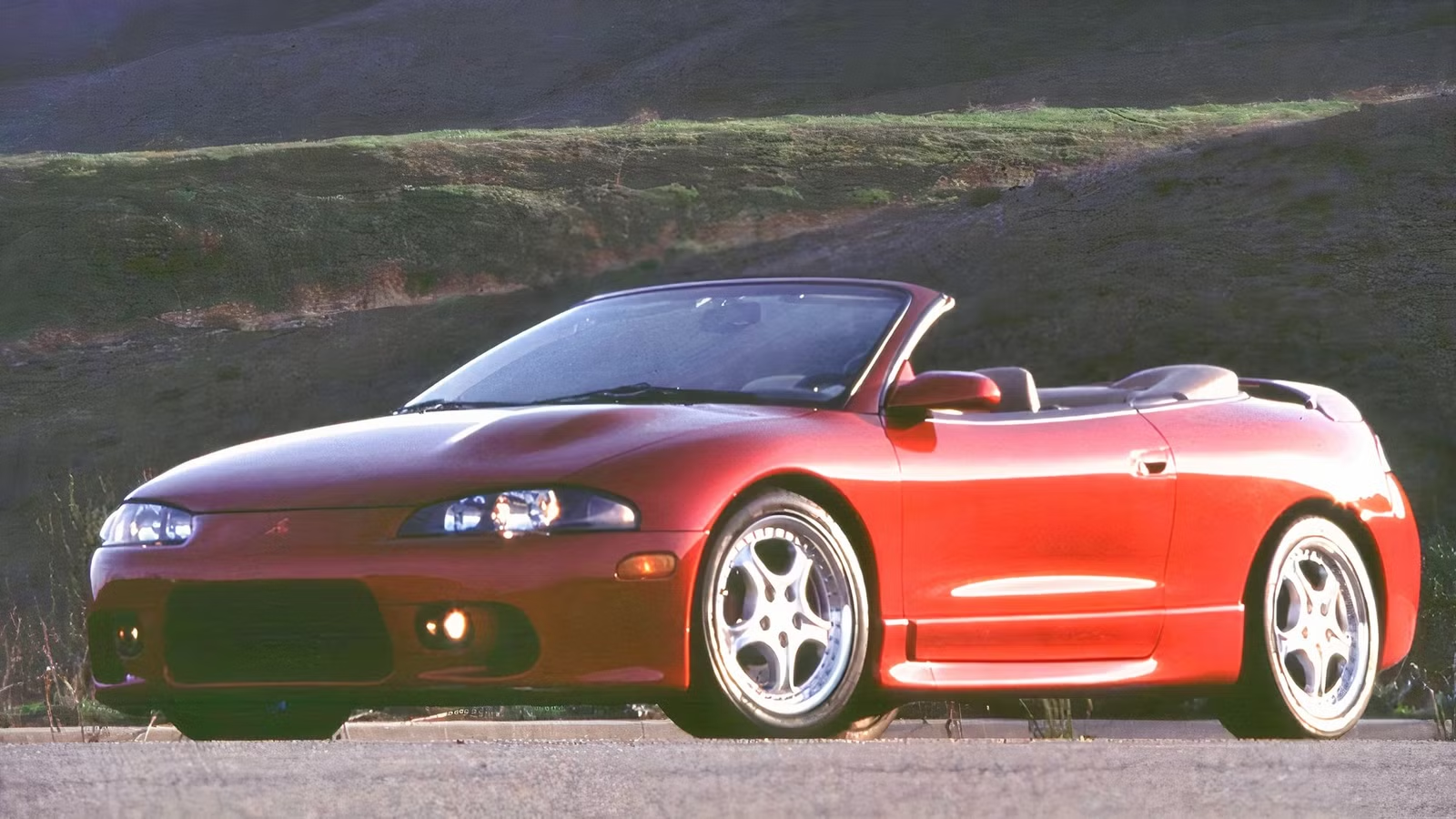
So, what’s the most frequently bought and sold car in the spreadsheet in front of us? That dubious honor goes to the 1997 Mitsubishi Eclipse Spyder with an average of 18 owners throughout its 29-year lifespan. It’s fair to point out that this is a noteworthy outlier even among other Eclipse Spyder model years.
GoodCar reveals the second most-owned example to be the 2001 model year Eclipse, averaging 6.67 owners. The 2008 model has a five-owner average, while the 1998 and 2005 model years both average four owners. Interestingly, the 2002 model year only experiences one owner throughout its 24-year cycle.
Sports Cars That Bring The Segment Average Up The Most

Within the sports car segment, there are some models that trade hands far more frequently than others, ultimately bringing the average up to the aforementioned 5.12-owner figure. The gap between sports cars and hybrids reflects a 1.96-owner difference. Looking at the data for all 166 sports cars that GoodCar recorded, here are the average owner numbers broken down by year, make and model.
Nissan GT-R Ownership Count
|
Model Year |
Owners |
|
2014 Nissan GT-R |
12 |
|
2009 Nissan GT-R |
9 |
|
2013 Nissan GT-R |
7 |
Volkswagen Golf GTI Ownership Count

|
Model Year |
Owners |
|
2001 Volkswagen Golf GTI |
10.5 |
|
2007 Volkswagen Golf GTI |
9.8 |
|
2009 Volkswagen Golf GTI |
8.3 |
Ford Mustang Ownership Count

|
Model Year |
Owners |
|
1982 Ford Mustang |
10 |
|
2010 Ford Mustang Shelby GT500 |
10 |
|
2012 Ford Mustang Shelby GT500 |
10 |
|
1999 Ford Mustang SVT Cobra |
7.8 |
Other Noteworthy High-Turnover Sports Cars

|
Model Year |
Owners |
|
1999 Mitsubishi 3000GT |
10 |
|
1991 Chevrolet Corvette |
8 |
|
2004 Pontiac GTO |
7.9 |
A Sports Car’s Age Is An Influential Factor

GoodCar’s data also shows us how a sports car’s age can impact the frequency of its average owner count. While the numbers mostly track with what you’d expect – newer cars have fewer owners – the averages help to set a baseline for shoppers researching their own purchase.
Models four years old or newer show an average of 2.08 owners; 5- to 9-year-old machines have an average of 4.2; 10- to 14-years-old the average 5.87 owners; and 15- to 19-year-olds hit 6.57 owners.
So, if you find a 10-year-old coupe or convertible that you like the looks of, and find it’s had three owners, you can rest assured that it’s got a leg up on its average counterpart.
Now, something really interesting happens when we look at models that are 20 or more years old: the average number of owners drops. Based on 79 examples in the data set, these classics show an average owner count of just 5.33. At some point, it seems, vehicles of an older vintage feel like keepers.
How Sports Car Sales Compare To Other Segments In The Used Market

Sports cars are sold marginally more often than other segments in the U.S. GoodCar’s data reveals that luxury sports cars trade through 4.67 owners, but this is only based on a tiny sample of three unique examples.
Luxury cars don’t fall too far behind, typically exchanging between 4.17 owners from the date of first sale. Standard passenger vehicles follow this with a four-owner average, while trucks trade hands 3.95 times. Motorcycles and scooters, minivans, and SUVs are sold 3.87, 3.76, and 3.59 times, respectively.
|
Category |
Average Owners |
|
Electric Vehicles (EVs) |
3.36 |
|
Commercial Vehicles |
3.26 |
|
Hybrid Vehicles |
3.16 |
How Ownership History Affects Your Purchasing Decision

GoodCar’s data set paints a revealing picture detailing the current state of America’s pre-owned vehicle market. Very few consumers view a conventional sports car as a forever purchase, leading to an ownership experience that only lasts a few years.
“Enthusiast vehicles tend to move quickly through their first few owners as each successive owner searches for the next car,” explains Anam Barkan, car expert and founder of HireGo Minibuses. “Someone may buy a 400-horsepower car and then decide they want 500 horsepower, a convertible, or simply a different model.”
This reflects a stark contrast to hybrids, which are more sensible vehicles intended to keep running costs low, while not necessarily inspiring driver engagement or visual appeal.
A sports car that has encountered several owners can be subject to a reputation of being less dependable. Gaps in servicing records, warranty-breaking modifications, and unaccredited repair work are also potential complications when the chain of ownership gets very long.
The owner count itself, however, does not reveal how the car was treated. “One owner may have tuned the engine, another lowered the suspension, and another used the car on a track,” Barkan adds. “Even with relatively low mileage, its mechanical condition can vary significantly depending on how those previous owners used and maintained it.”
Insurance history can provide further context. “A car with six owners and continuous coverage can be a safer bet than one with two owners and a lapse between them,” says Rami Sneineh, vice president and licensed insurance producer at Insurance Navy Brokers. “A clean claims history can make up for a higher owner count, so buyers should not treat that number as the deciding factor.”
Using a VIN checker like the one on GoodCar’s site gives you better insights into a car’s accident history, true mileage, title records, relevant recalls, and other informative data you’d typically need to make a secure used car purchase.
GoodCar’s Data Gives Us A Better Understanding Of The Used Market

GoodCar is an online platform known for its comprehensive, VIN-specific vehicle background checks. You can use this service to gather title records, collision history, safety recalls, and detailed equipment specifications. Important points of information, all, when looking to put a new-to-you sports car in the garage. Maintenance records can help buyers distinguish a carefully used sports car from a neglected one, while a VIN decoder can confirm its specifications, model year, and factory configuration. “Frequent brake or tire replacements without supporting service documentation may indicate spirited driving,” Barkan adds. “However, evidence of regular fluid changes, timely brake servicing, and consistent tire replacement can make previous track use much less concerning.”
Between vehicle information lookup, some of the new baseline averages from the data used above, and your own common sense, finding your next sports car doesn’t have to be daunting. Remember, just because a vehicle’s had several owners in the past, doesn’t mean it can’t end up as your forever car.

Related posts



Latest Post


No Comments