The Compact SUV That Offers More Interior Space Than Its Size Suggests
9 minutes reading
Monday, 7 Sep 2026 01:45 0 7 autotech
SUVs can be very useful tools if you want to lug things around all day, but when you don’t, and there is no one riding with you, the size of some of them can make just driving to the shop a chore. Take the new Cadillac Escalade ESV: it has a maximum cargo capacity of 142.2 cubic feet, but it also measures in at 227 inches in length and 93.7 inches in width, with mirrors.
It is very handy sometimes, but not all the time. This is where some modern compact SUVs come into their own; they are small but can be roomy. This Mazda SUV proves that being big where it matters is far more important.
Big SUVs have an obvious advantage when it comes to space, but being physically larger does not guarantee that all that extra metal translates into a better cabin. Long hoods, sloping rooflines, thick bodywork, and bulky mechanical components can take up a lot of room without doing much for you inside. For example, the 2026 Toyota Sequoia is a fantastic family SUV, and measures in at 208.1 inches by 79.8 inches, but thanks to its high cargo floor, space behind the third-row seats (before sliding them forward) is only 11.5 cubic feet.
That’s why some smaller SUVs feel surprisingly spacious when you get in them. The smaller footprints can be a real advantage in everyday life, particularly if you drive in cities. The clever ones don’t try to compete with full-size SUVs on sheer volume. They focus on making the available space useful.
Why Wheelbase And Packaging Matter More
Front 3/4 action shot of 2026 Kia Sportage Hybrid driving off-roadKia
The numbers of some smaller SUVs show how clever packaging can mean more. The 2026 Subaru Forester Wilderness is 182.9 inches long, but its 104.9-inch wheelbase means you get 43.3 inches of front legroom and 39.4 inches in the rear. There is also 40.2 inches of front headroom, 37.6 inches of rear headroom, and 107.6 cubic feet of passenger volume.
It is hardly limo-like, but it is impressive for an SUV of its size. Cargo space is useful, too, with 26.9 cubic feet behind the second-row seats, and 69.1 cubic feet with them folded away. The hybrid CR-V is of similar ilk; it only has a 106.3-inch wheelbase, but a maximum cargo capacity of 71.8 cubic feet.
The 2026 Mazda CX-5 Has More Room Than You’d Expect
Front 3/4 action shot of 2026 Mazda CX-5 in red driving on roadMazda
When it comes to clever packaging and making the most of size, the 2026 Mazda CX-5 is the kind of compact SUV that punches above its size class. The new Mazda CX-5 measures in at 184.6 inches in length by 81.8 inches in width (with mirrors) by 66.7 inches tall. It also rides on a 110.8-inch wheelbase. So, still well within the realm of compact SUV territory.
A Longer Wheelbase Creates More Space For Passengers
Profile shot of 2026 Mazda CX-5 parkedMazda
The 2025 model rides on a 106.2-inch wheelbase, but still has a commendable 103.6 cubic feet of passenger volume, up to 39.7 inches of front headroom, 41 inches of front legroom, 39 inches of rear headroom, and 39.6 inches of rear legroom. The 2025 CX-5 also gets 59.3 cubic feet of storage space with the rear seats folded away. However, with the added inches to the wheelbase in the 2026 CX-5, passenger room has increased while keeping a small footprint for easy driving.
Shot of 2026 Mazda CX-5 showing seatsMazda
Mazda says the 2026 CX-5 has 106.5 cubic feet of passenger volume, 39.7 inches of front headroom, 41.7 inches of front legroom, 40.2 inches of rear headroom, and 39.9 inches of rear legroom. Just a few inches more can make a difference. Mazda also says that the longer wheelbase accommodates wider opening rear doors, which makes it easier for your rear-seat passengers to get in and out.
Generous Cargo Capacity Makes The CX-5 Surprisingly Practical
Shot of 2026 Mazda CX-5 cargo areaNicole Wakelin | TopSpeed
Then there is cargo capacity. The Honda CR-V is the compact SUV with the most cargo space, as mentioned above, but the new CX-5 balances a slightly smaller size compared to the CR-V with a very healthy amount of room for family life.
With all the seats in place, the new CX-5 has 33.7 cubic feet of storage space. With the rear seats folded down, you get a maximum cargo capacity of 66.5 cubic feet. That is more than the 2026 Equinox, the 2026 Escape, and the 2026 Corolla Cross. But cargo numbers only tell part of the story — the CX-5’s appeal goes well beyond what fits in the back.
Bolder Styling And A Fun-To-Drive Formula Set The CX-5 Apart From Budget-Focused Rivals
High-angle 3/4 shot of 2026 Mazda CX-5 parkedMazda
We find that a lot of compact SUVs are built for straightforward driving and getting the most for your money. That’s why we love them. The new CX-5 does that, but it also brings along a touch more class for its price point. That extra bit of polish is useful here, because some compact SUVs do feel like they’ve been designed solely around a spreadsheet.
The new CX-5 doesn’t do that, but it also doesn’t go overboard. It is easy to live with and practical, but Mazda has put some effort into making it look and feel a little less ordinary. Owners who left a review on Kelley Blue Book have rated it 4.5 out of 5 for everything: value, quality, reliability, performance, comfort, and styling, with 100 percent of owners recommending it.
Fresh Design Gives Mazda’s Best-Selling SUV A Premium Feel
Close-up shot of 2026 Mazda CX-5 grilleNicole Wakelin | TopSpeed
Exterior updates to the CX-5 are easy to spot. The 2026 model gets a wider, more upright front end with Mazda’s Signature Wing grille sitting between slimmer lights. The design is part of Mazda’s latest take on its Kodo styling, while available 19-inch wheels give it a more planted look. At the rear, new angular taillights tie the CX-5’s small stature to its larger siblings, while bold MAZDA lettering replaces the traditional badge on the tailgate.
Mazda has also made life easier at the back of the CX-5. The cargo area is almost two inches longer and more than an inch higher, while lift-in height drops by more than half an inch. That gives you more room to work with and makes loading heavy stuff less awkward.
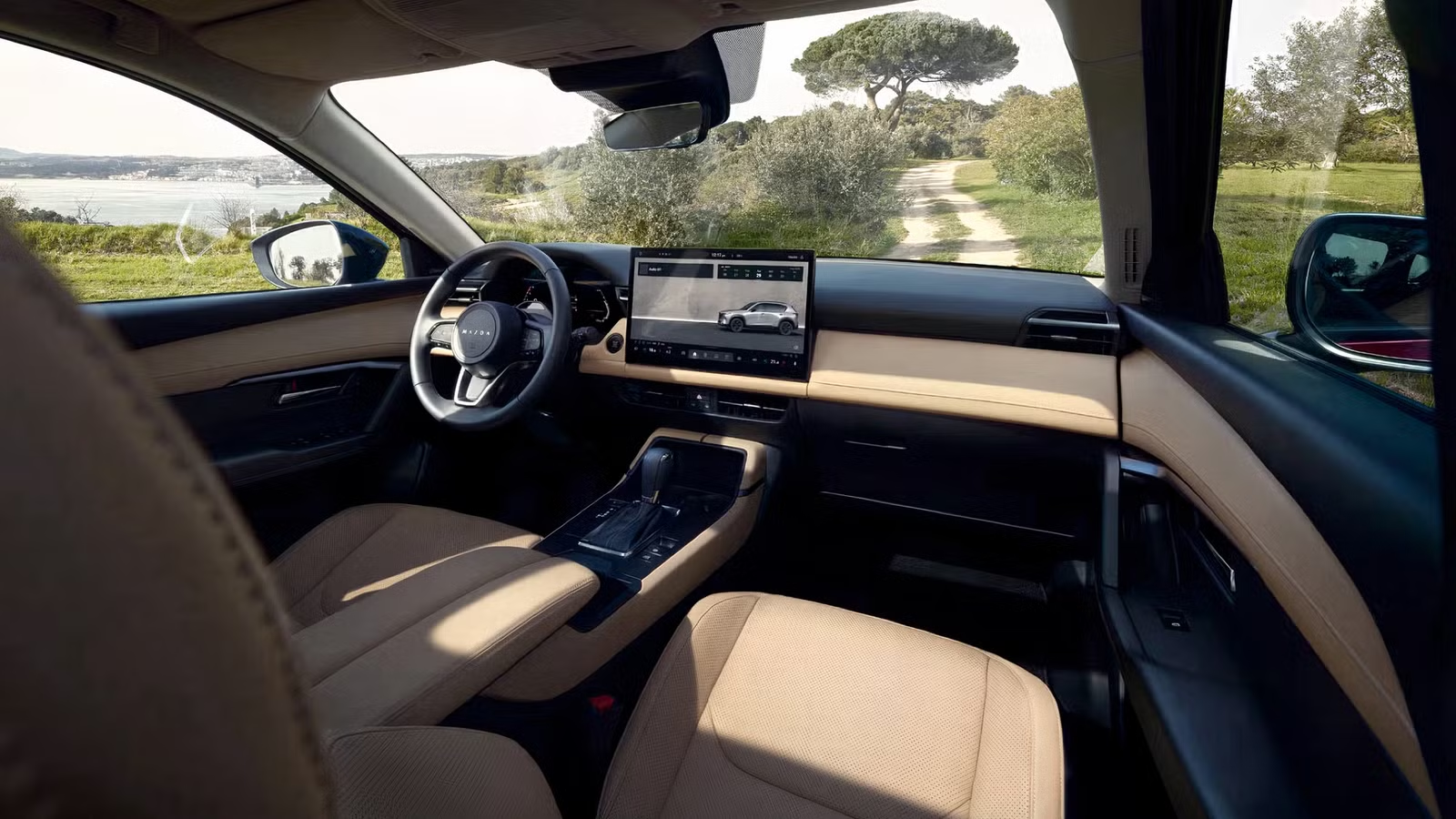
Shot of 2026 Mazda CX-5 interior showing cockpitMazda
Inside, the biggest change between the 2025 and 2026 models is the dash. The 2025 model gets a 10.3-inch Mazda Connect display, but the 2026 model gets a 12.9-inch one as standard. Some of the higher trims go even further with a 15.6-inch display, which Mazda says is the largest they’ve used. Google built-in is also available, while less techy improvements like a redesigned center console and glovebox make it easy to keep the cabin tidy.
Mazda has also changed the rest of the cabin rather than just bolting a bigger screen to the old one. The 2026 CX-5 gets a 10.25-inch digital instrument display, while higher trims bring leather-trimmed seats, Sport Tan upholstery, and seven-color ambient lighting in the front doors.
Familiar Formula Still Puts Driving Enjoyment Ahead Of Most Rivals
Rear 3/4 shot of 2026 Mazda CX-5 parkedMazda
Mazda has a knack for providing understated driving fun to even its most “entry-level” models, and the new CX-5 does well here. There is just one engine option this year: a naturally aspirated 2.5-liter Skyactiv-G inline-four mated to a six-speed automatic transmission. Horsepower is decent at 187, and you also get 186 pound-feet of torque.
This translates to 0-60 times of between eight and 8.5 seconds. It’s not the quickest, but you do get Mazda’s predictive i-Activ AWD system as standard. It is front-wheel biased to help with fuel economy when you are driving normally, but using 27 sensor inputs, the system monitors when more torque is needed in the wet, through corners, or when it is snowing.
High-angle 3/4 shot of 2026 Mazda CX-5 parkedMazda
Power is sent to the rear wheels to keep you steady, and you get a suitably sure-footed ride, even on back roads. You also get three drive modes: Normal, Sport, and Off-Road, with Sport mode tightening throttle feedback and holding on to gears longer, and Off-Road mode providing the most traction control. A TopSpeed review of the 2026 CX-5 says it nicely.
Leave the highway, and it’s composed and fun on winding roads. Choose Sport mode for the best experience in the twisties. Even when the driver is having fun, the ride is composed enough that your passengers will stay comfy, and kids in the back can peacefully slumber.
2026 CX-5 Could Be Mazda’s Most Well-Rounded Compact SUV
There is a good reason why the CX-5 is Mazda’s best-selling crossover, with over 1.6 million sold since its debut as the 2013 MY. Over the years, Mazda has kept it relatively simple but still retained a bit of everything that we want in a stylish little SUV. The 2026 CX-5 has a starting price of $29,990 for the 2.5 S trim; prices rise to $31,990 for the 2.5 S Select, $34,250 for the 2.5 S Preferred, $36,900 for the 2.5 S Premium, and $38,990 for the 2.5 S Premium Plus. So, for what you get in terms of usability and class, prices aren’t unreasonable.
FuelEconomy.gov says the new CX-5 can achieve 26 combined mpg (24 mpg city/30 mpg highway), despite getting a non-hybrid mill and AWD as standard. iSeeCars estimates that it has an average lifespan of 177,965 miles, or 16.4 years, and has a 33.9 percent chance of reaching 200,000 miles; and J.D. Power rates the 2026 model 82 out of 100 overall. If you are looking for a convenient little SUV that does most things well without making a big deal of it, the updated 2026 Mazda CX-5 makes a pretty convincing case for itself.
Base Trim Engine
2.5-L Inline 4
Base Trim Transmission
6-speed automatic
Base Trim Drivetrain
All-Wheel Drive
Base Trim Horsepower
187 hp
Base Trim Torque
185 lb-ft
Make
Mazda
Model
CX-5
Segment
Compact SUV
Sources: Mazda, J.D. Power, iSeeCars, Kelley Blue Book, and FuelEconomy.gov.












No Comments