
The Volvo S60 Recharge Is A Bona Fide Sleeper
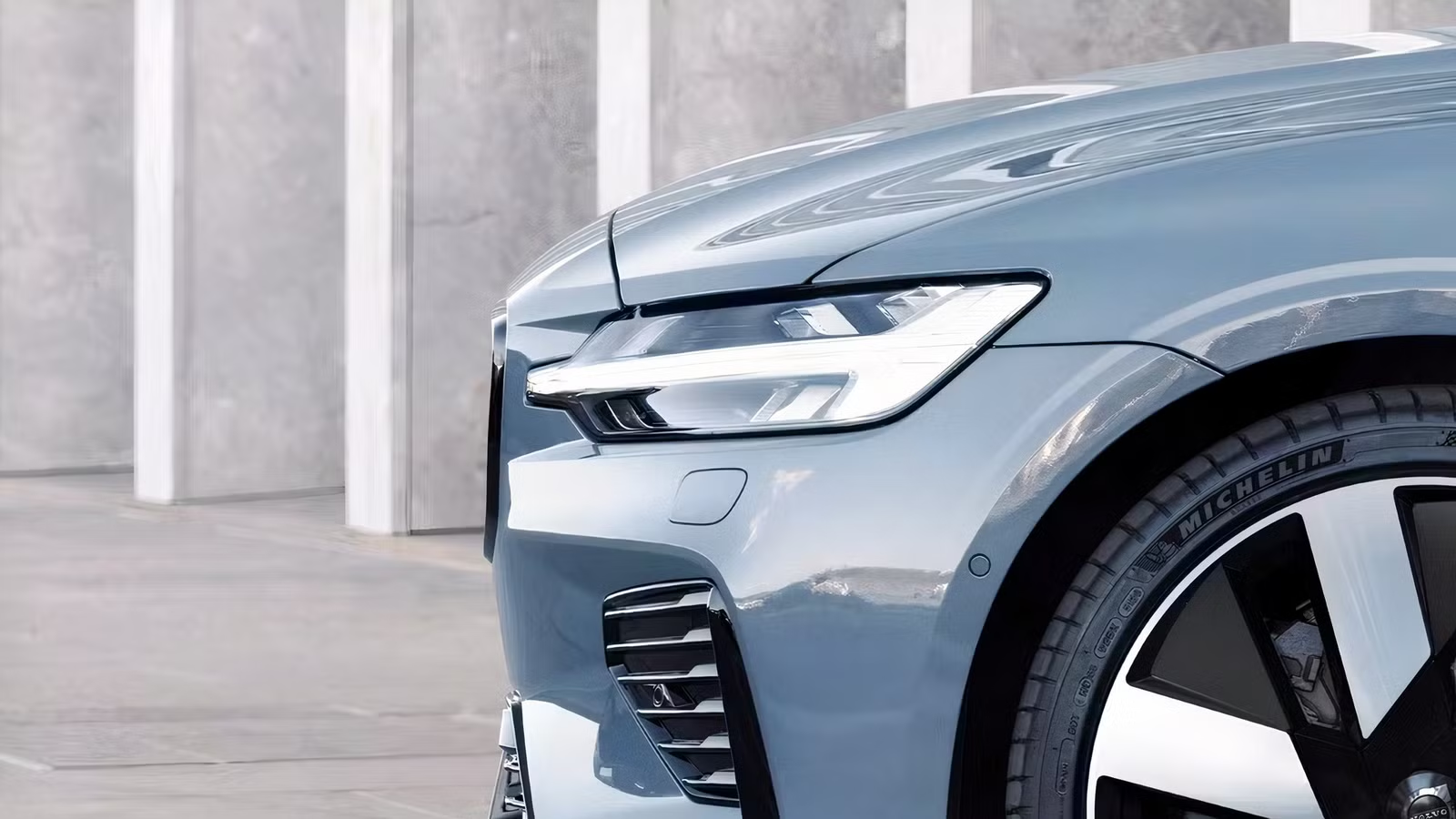
There’s a special kind of satisfaction that comes from a car nobody sees coming. Exotic supercars have their place — thunderous exhausts, dramatic styling, the whole show — but the real thrill belongs to the sleeper: a machine that looks utterly ordinary right up until the moment it leaves everything else behind. The BMW M5 used to own that territory, but decades of legend-building have blown its cover. These days, even a casual enthusiast spots the blue, red, and purple badge and knows exactly what they’re dealing with.

To find a genuine sleeper car in the modern era, you have to look beyond the obvious suspects. Volvo is a brand that has long appealed to architects and people who watch black-and-white films about existential pigeons — and also quietly makes some of the best sleepers on the planet. The Swedish firm is renowned for safety and Scandinavian minimalist design rather than drag racing, but that hasn’t stopped its engineers from slipping a few zingers into the lineup over the years.
Aside from that brief period in the ’90s when Porsche helped Volvo develop a few surprising sedans and wagons, it’s generally all very zen and grown-up over at Volvo HQ. But dig into the recent range and there is one car that could rightly claim the crown of the greatest sleeper of all time. You could walk past this conservatively styled machine on the street without a second glance, never suspecting it’s the most powerful Volvo ever built — with more horsepower under the hood than a 2000s Porsche 911 Turbo, and nearly as quick to match. Let’s take a closer look at this automotive glitch in the matrix.
For Decades, Volvo Has Been Hiding Speed In Plain Sight

Mention Volvo, and most people immediately think of safety ratings, sensible wagons, and the kind of cars favored by architects, professors, and anyone who values comfort over showing off. It’s an image the Swedish automaker has spent much of the last century cultivating, and one that remains largely intact today. Yet throughout its history, Volvo has repeatedly slipped surprisingly quick cars into its lineup.
It All Started In The 1980s

One of the earliest Volvo sleepers arrived in the 1980s with the 240 Turbo — a car that looked about as aerodynamic as a refrigerator and was roughly as fashionable. Beneath the boxy sheet metal, however, sat a turbocharged four-cylinder that transformed the humble 240 into a genuine performance machine. More importantly, it wasn’t just quick for a Volvo. The 240 Turbo went on to score victories in touring-car racing, including the 1985 European Touring Car Championship, proving that Volvo’s engineers were far more interested in going fast than the car’s sensible appearance suggested.
If the 240 Turbo proved Volvo could build a fast car, the 850 T-5R proved it could build a cool one. Launched in the mid-1990s, the bright yellow performance sedan and wagon packed a turbocharged five-cylinder with enough punch to embarrass plenty of supposedly sportier machinery. By the time the V70 R arrived, Volvo had perfected the art of hiding speed in plain sight. It retained the practical wagon body and sensible Scandinavian styling buyers expected, but beneath the surface was a 300-horsepower turbocharged powertrain and enough grip to unsettle plenty of sports sedans — the kind of car that could get the drop on unsuspecting performance drivers while hauling a week’s worth of flat-pack furniture.
Volvo Perfected The Sleeper Formula In The 2000s

Volvo’s sleeper tradition continued with models like the S80 V8, which looked every bit the respectable executive sedan but concealed a Yamaha-developed 4.4-liter V8 producing 311 horsepower. Then came the V60 Polestar Engineered, which paired a practical wagon body with a sophisticated plug-in hybrid powertrain, motorsport-inspired Öhlins suspension, and massive brakes capable of humbling sport sedans.
As impressive as the V60 Polestar Engineered was, Volvo wasn’t done pushing the boundaries of understated performance. In fact, the company’s most powerful production car would take the sleeper formula even further, combining muscle-car levels of torque with the comfort, practicality, and anonymity of an everyday luxury sedan.
Beware The Volvo S60 Recharge At A Set Of Lights

Let’s be honest — even the name “Volvo S60 Recharge” sounds a bit like a smoothie. The official website leans into elements such as the interior being “an oasis of safety and comfort” and highlights the standard air purifier. This being a Volvo, the exterior design is carefully considered, with gently sculpted lines and a deliberate absence of adornment and flash. In other words, it’s attractive but reads like any other mid-range executive sedan — a car for people who have no interest in attracting attention at the mid-week life-drawing class.
The Volvo S60 Recharge Packs A Massive Punch

|
Engine |
Power |
Torque |
Pure Electric Range |
|---|---|---|---|
|
2.0-liter inline-four + electric motor |
455 HP |
523 LB-FT |
41 miles |
But wait — surely those wild yellow sleds of the ’90s, the T-5Rs, must have been more potent? Not even close. The S60 Recharge is a plug-in hybrid, combining a turbocharged petrol engine with an electric motor for a one-two punch that hits well above its weight. The 2.0-liter inline-four B5 engine contributes 312 horsepower, plus another 143 horsepower from the rear-axle electric motor.
The combined output is 455 horsepower and 523 pound-feet of torque, qualifying this civilized luxury sedan as a bona fide sleeper that’ll embarrass muscle cars. To put that into perspective: it surpasses the output of some of the most legendary American muscle cars ever built. A Chevrolet Chevelle SS of 1970 packed a 454-cubic-inch V8 rated at 450 horsepower and 500 lb-ft of torque. But would the Volvo also beat the Chevelle in a drag race? Read on to find out.
Fun Fact: The gasoline engine powers the front axle while the electric motor powers the rear axle. That means the S60 Recharge’s all-wheel-drive system works without a traditional mechanical driveshaft connecting the two ends of the car.
A Closer Look At The Volvo S60 Recharge

The S60 Recharge — also known as the S60 Plug-in Hybrid and T8 — is no longer sold in the US, but its mythical, paradoxical status lives on in the secondhand market. Built at the Volvo Cars plant in Ridgeville, South Carolina, it came standard with all-wheel drive and that 455-horsepower plug-in hybrid system. Despite the formidable output, the hybrid S60 also returned an EPA-estimated 74 MPGe, 31 mpg in combined driving, and up to 41 miles of pure electric, zero-tailpipe-emissions range. And that performance output puts it squarely in Dodge Charger 392 Scat Pack territory.
Sports-Car Worthy Performance Figures

|
0-60 MPH |
0-100 MPH |
Quarter Mile |
|---|---|---|
|
4.1 seconds |
9.9 seconds |
12.5 seconds @ 112 mph |
One period test of the 454 Chevelle SS found it could cover the quarter mile in 13.44 seconds at 108.17 mph. The S60 Recharge hits 60 mph in 4.1 seconds, reaches 100 mph in 9.9 seconds, and dispatches the quarter mile in 12.5 seconds at 112 mph. To put that in historical context, the Volvo is just 0.3 seconds slower over the quarter mile than a Cobra 427 — one of the fastest cars of the 1960s.

To put it another way, the Volvo would smoke a 2012 Dodge Charger SRT-8, a 2010 BMW M3, a 2001 Chevrolet Corvette Z06, and even a V10-powered 2009 BMW M5. It’s also officially quicker over the quarter mile than the 2026 Dodge Charger Daytona R/T, which runs a 12.6.
The S60 Recharge Still Has Sensibleness As Standard

That’s not to say the S60 doesn’t have a sensitive side. The car came equipped with Volvo Cars’ sophisticated Advanced Driver Assistance Systems (ADAS) sensor platform — a comprehensive active safety suite consisting of radars, cameras, and ultrasonic sensors working together to keep occupants out of trouble. In an emergency, the system can detect other road users, apply automatic braking, and execute collision avoidance maneuvers. The Pilot Assist function also provides gentle driver support from a standstill all the way up to highway speeds.
The one concession to sensibleness that Volvo built in is an electronically governed top speed of 114 mph — enough to keep a quarter-mile run honest, but not enough for a full-bore autobahn blast. Inside, the S60 is available with a Harman Kardon or Bowers & Wilkins sound system, heated steering wheel, four-zone climate control, heated front and rear seats, a head-up display, and four USB-C ports. The top Polestar Engineered package adds sport seats with upgraded upholstery, gold-colored seatbelts, and a heated sport steering wheel.
The Volvo S60 Recharge Is Even A Bit Of A Bargain In 2026

In mid-2024, it was reported that production of the S60 would end in the USA, with no plans to import the car either. The Volvo S60 may not be as ubiquitous as a Camry or 5 Series, but it’s a shame to see it go — it represented an interesting and sophisticated approach to the executive sedan segment. Official used average pricing for the S60 Recharge isn’t widely published, but examples appearing on used-car sites are remarkably good value.
This is a car that, even at base level, started at $52,345 new, with options pushing the figure higher still. Used examples have depreciated sharply, with low-mileage cars available well below that original asking price — making the S60 Recharge one of the more compelling performance bargains on the secondhand market right now.
Sources: Cars.com; Edmunds.com

Related posts



Latest Post


No Comments