
The Cruiser With Honda Reliability And Harley-Level Presence
Every motorcyclist has wrestled with the same dilemma at some point: you want the swagger of a Harley-Davidson — that unmistakable V-twin rumble, the chrome, the attitude — but you also want a bike that starts every morning without drama and racks up miles without bleeding your wallet dry. For years, those two desires seemed mutually exclusive. Harley-Davidson commands the cruiser segment like no other brand, and its bikes have undeniable road presence. But reliability and low-maintenance ownership have never been the Milwaukee marque’s strongest suits, even as the bikes have improved considerably over the decades.

Japanese manufacturers, Honda chief among them, have long owned the reliability conversation. So the real question is: can you get the visual aura of a Harley with the no-fuss dependability of a Honda? A particular Yamaha cruiser makes a compelling case that you can. Let’s break down why Honda bikes set the reliability benchmark, what makes a Harley so hard to ignore, and how Yamaha managed to fuse the best of both worlds.
Why Honda Motorcycles Are Famed For Their Reliability
We often dismiss Japanese motorcycle makers as relatively boring compared to the more dramatic Italians. But that very conservatism in engineering is precisely what underpins Honda’s legendary reliability. Honda has always prioritized proven, robust technology that minimizes the risk of failure and extends service life. Most Honda motorcycle engines are engineered with generous tolerances and built to handle considerably more stress than they’ll ever see in normal use — reducing strain and boosting longevity.


Stringent quality control at every stage of production reinforces this further. From the beloved Monkey to the iconic, wicked-fast CBR sports bikes, Honda designs all of its two-wheelers with lower-maintenance components that are commuter-friendly, too. The icing on the cake is Honda’s extensive parts and service network, which provides easy, affordable access to spare parts and servicing. It is the combination of all these factors that makes Honda the benchmark in motorcycle reliability.
Why A Harley-Davidson Motorcycle Is A Certified Head Turner

Harley-Davidson is one of the oldest American motorcycle makers, turning 123 years old in 2026. That extraordinary lifespan has helped Harley earn the title of a timeless classic, especially with styling that still echoes old-school charm and muscular curves. Harley’s decades of expertise in building cruiser bikes has produced some genuinely gorgeous motorcycles — the Fat Boy (which enjoys near-celebrity status) and the modern-day Hydra-Glide Revival among them.

Harley has managed to fuse old-school charm with modern-day technology and safety features. The main contributors to a Harley’s head-turning appeal include timeless design cues, muscular aesthetics, generous chrome work, extensive customization possibilities, and distinctive styling details. Add a deep-rooted cultural legacy that connects with American ideals of freedom, independence, and a free-spirited rebel character, and you have a machine whose visual and emotional appeal is almost impossible to replicate.
Yamaha Bolt R-Spec: An Affordable Fusion Of Reliability And Street Presence
Priced From $8,999

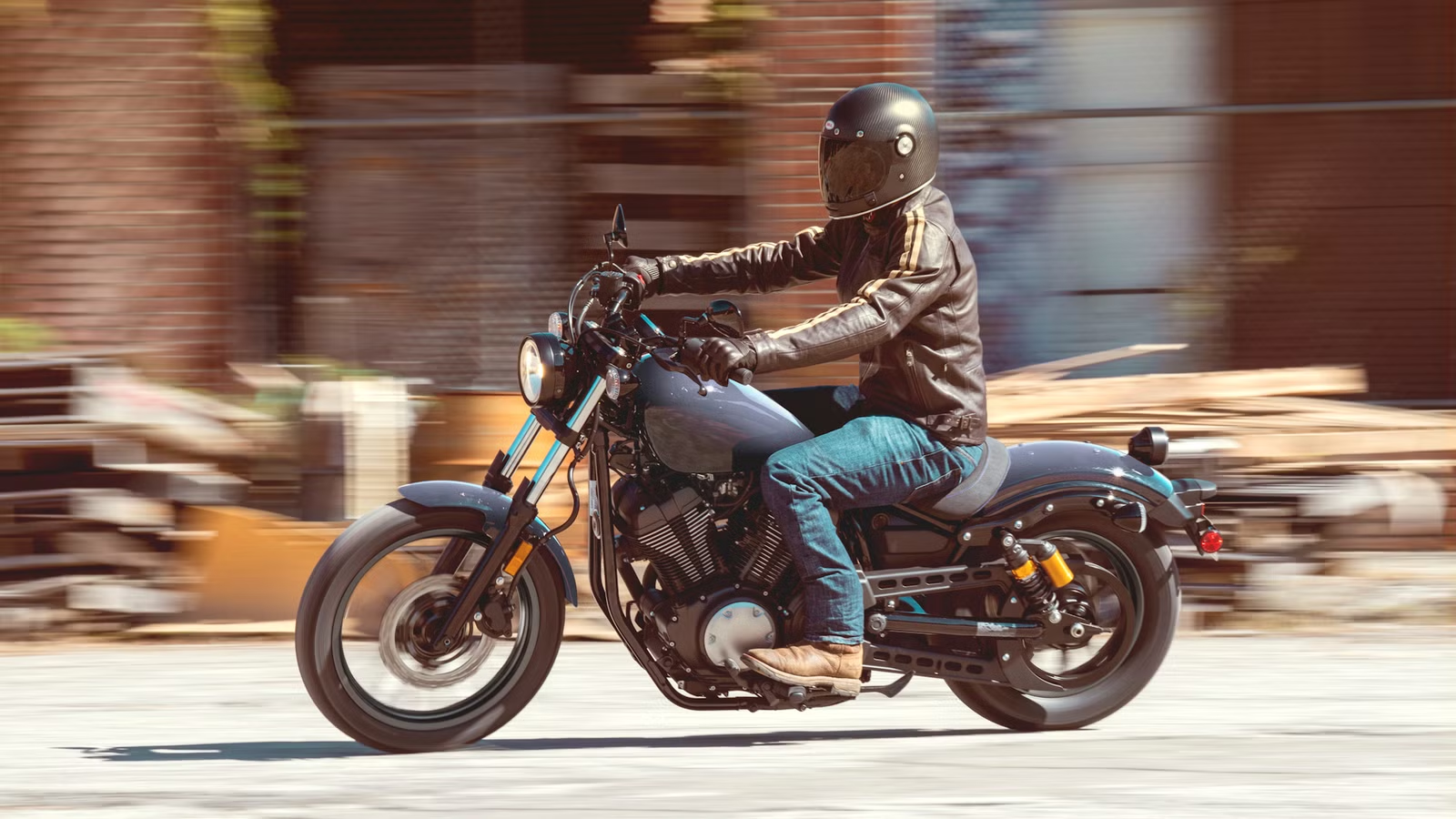
Few cruisers in this segment deliver the raw American V-twin aura of the Yamaha Bolt R-Spec. That impression comes down to the combination of its looks, its classic engine character, and its traditional underpinnings. This Americanized metric cruiser has been in production since 2013 and has received only incremental updates since its launch. While that makes it long in the tooth by modern standards, it has also given Yamaha ample time to refine the motorcycle and its components — resulting in a well-sorted, highly reliable package. The asking price of just under $9,000 reflects that value proposition.

Its visual appeal is hard to argue with, thanks to a familiar and purposeful design language. The minimal bodywork, clean lines, and exposed V-twin all speak to the American V-twin tradition. And because the Bolt R-Spec has been around for so long, there is an extensive catalog of aftermarket components to support custom builds. In stock form, the Bolt R-Spec is already a head-turner. But things get dialed up to eleven with bolt-on kits that can transform this Yamaha into bobbers, choppers, rat bikes, and even scramblers.
What Gives The Yamaha Bolt R-Spec Honda-Grade Reliability

The Yamaha Bolt R-Spec is powered by a 942cc V-twin engine that is about as straightforward as a modern V-twin gets. It features air-cooling, single overhead camshafts, and a low compression ratio of 9.0:1. Despite its near-liter-class displacement, this deliberately understressed engine produces around 65 horsepower and 59.3 pound-feet of torque. It also runs a proven fuel injection system that delivers consistent, hiccup-free fueling. That mechanical simplicity means there is very little here that can go wrong.

The engine’s internals add another layer of durability. Despite being an old-school design, it uses lightweight forged aluminum pistons that reduce friction and extend service life. With no complex electronics to contend with, routine maintenance is refreshingly straightforward. A low-maintenance final belt drive with a carbon-fiber core handles power delivery, and the two-into-one exhaust system keeps things equally uncomplicated.

That mechanical simplicity extends to the supporting components as well. The Bolt R-Spec rides on a double-cradle steel frame engineered for stability and long-term durability. The suspension — a telescopic fork up front and piggyback-style rear shocks — is said to offer greater durability and damping performance than standard shock units. Taken together, this straightforward hardware also makes the Bolt R-Spec genuinely easy for owners to work on at home.
Dependable Performance With Nothing But Routine Maintenance

Thanks to this build quality and mechanical simplicity, the Yamaha Bolt R-Spec has earned a strong reputation as one of the most reliable V-twin cruisers on the market. Owners on online forums regularly report covering more than 50,000 miles without any major mechanical failures. Put simply, all the Bolt R-Spec asks for in return for dependable performance is routine maintenance. It is the kind of bike you can count on — one that won’t leave you stranded on a weekend cruise.
Looks Like The OG Harley-Davidson Sportster

The Yamaha Bolt R-Spec arrived at a time when Japanese manufacturers were actively trying to capture a share of the American cruiser market by channeling classic domestic styling. The result is a motorcycle that draws heavily from American cruiser design — particularly the Harley-Davidson Sportster. It specifically resembles the H-D 883 Sportster, and the similarities run deep. The Bolt R-Spec’s distinctive silhouette, sleek teardrop tank, and bobber-inspired proportions are a clear nod to the 883 Sportster. Yamaha even matched the wheel and tire sizes, running 100/90-19 fronts and 150/80-16 rears.

Whether that reads as homage or imitation is a matter of perspective, but the Bolt R-Spec manages to retain its own Yamaha identity without coming across as a blatant copy of the Harley. Even with its minimal bodywork and understated paint options, it makes a genuine visual statement on the road. The cockpit is clean and minimalistic, featuring a simple digital LCD display — again echoing the no-fuss instrument layout of the classic Harley Sportster.
A Blank Canvas For Customization

That same simplicity of form makes the Bolt R-Spec an ideal blank-canvas motorcycle. It’s barebones by design — classic peanut tank, uncluttered underpinnings — so you can take it in virtually any direction. A quick scroll through Reddit turns up an impressive variety of customized Yamaha Bolts: West Coast custom builds, blacked-out bobbers, and even a scrambler version modified for light off-road use. With the vast aftermarket support available, the sky truly is the limit when it comes to personalizing your Bolt R-Spec.
Tractable Performance And Simple Hardware

A 60-degree air-cooled V-twin powers the Yamaha Bolt R-Spec. This 942cc mill reinforces its Harley-Davidson connection by mimicking the look and character of an old-school rumbling V-twin. Under the surface, however, it is a refined Japanese engine that prioritizes efficiency, torque delivery, and long-term reliability.
The V-Twin Produces 65 Horsepower And 59.3 Pound-Feet Of Torque

The Bolt R-Spec produces 65 horsepower and 59.3 pound-feet of torque. Power reaches the rear wheel through a five-speed manual gearbox paired with a final belt drive. A notable engineering detail that aids efficiency is the pent-roof combustion chamber, which directs the air-fuel mixture toward the center of the piston for improved combustion efficiency — contributing to a commendable fuel economy rating of around 51 MPG.
Old-School Underpinnings Get The Job Done

Underpinning this old-school cruiser is a sturdy double-cradle frame suspended by 41mm telescopic forks up front and twin rear shocks. Braking is handled by 298mm single discs at both ends. The hardware is deliberately straightforward, which pays dividends in repairability and long-term ownership costs. These underpinnings may feel traditional by today’s standards, but they are well-proven and will suit the vast majority of buyers just fine. After all, why fix what isn’t broken?
A Highly Accessible Classic-Vibing Metric Cruiser Motorcycle

The minimal form factor and low-slung design make the Yamaha Bolt R-Spec a strong contender as a beginner cruiser. Its low seat height of 27.2 inches and slim waist make it easy for riders — especially shorter ones — to flat-foot confidently. The rider triangle is relaxed, with slightly forward-set footpegs and a tall, wide handlebar. Despite channeling the look of a big-twin Harley, this Yamaha is genuinely compact, with a wheelbase of 61.8 inches and a manageable curb weight of 542 pounds, making it a capable urban runabout as well.
Source: Yamaha

Related posts

Latest Post


No Comments