
Return of the world car: China backs one-size-fits-all approach
China’s ability to build competitive cars at cheap prices shows that one product for all markets can work

Chinese car makers are reviving what many volume brands had written off: the idea of a ‘global car’ that works across all regions.
At the same time, however, premium brands are reluctantly having to admit that their once powerful ability to sell almost exactly the same car everywhere is coming to an end.
“The new trends are changing the game,” Renault CEO Fabrice Cambolive said at a recent event in Brazil. “All the Chinese OEMs are coming with global cars and we are also going in this direction.”

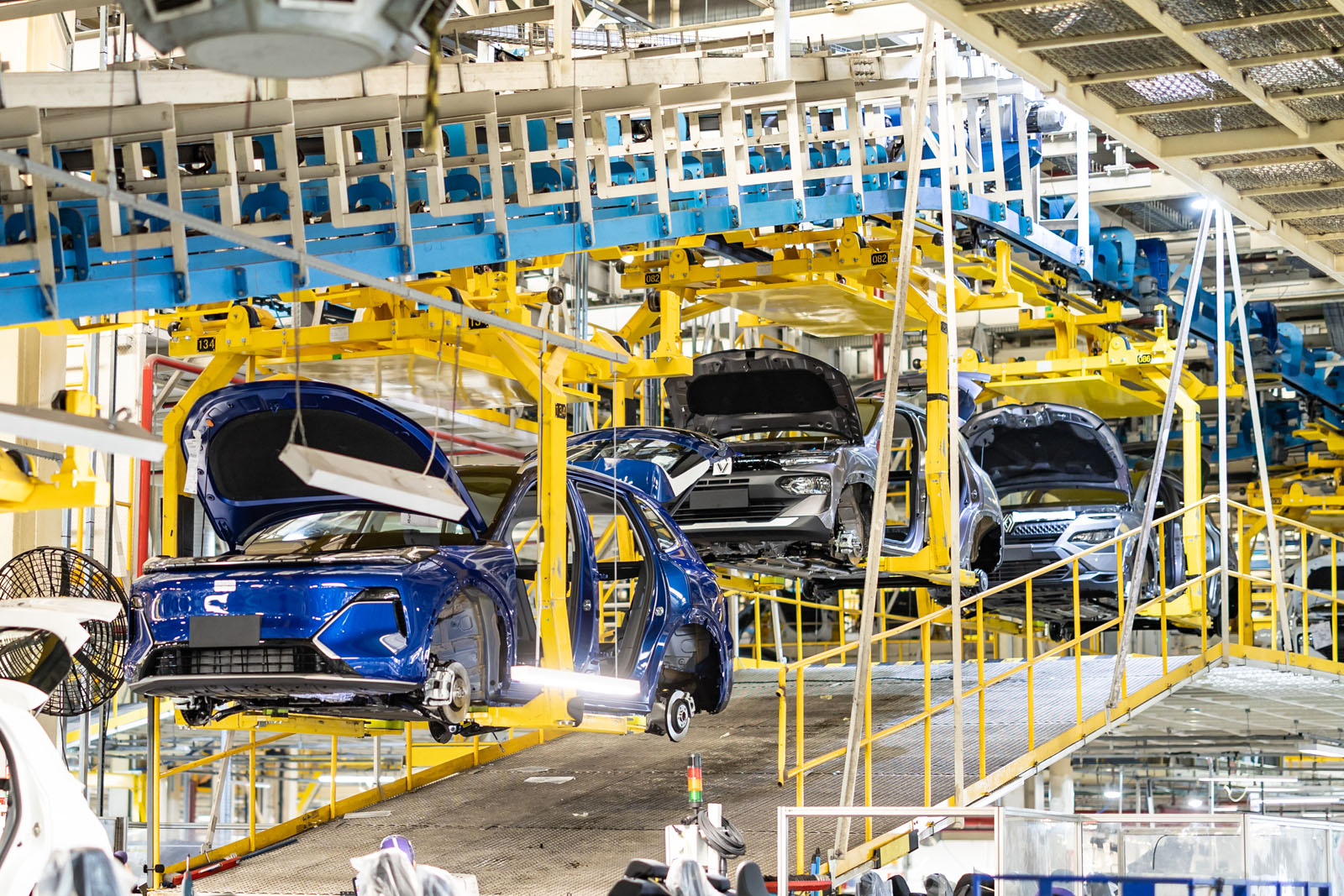
The Renault event marked the introduction of the Geely EX5 electrified SUV into the French company’s plant in Brazil. This is essentially the same as the car sold in China, Europe, the UK, Australia, Chile, Mexico and elsewhere.
The EX5 will be built on the same line as the Renault Boreal, a compact SUV derived from the Dacia Bigster that is being sold in 54 markets globally, including South America, Eastern Europe outside the EU and Turkey.
“To be sure the direction is to grow with global cars,” Cambolive said.
A car that works everywhere is the dream for an industry that grows rich on size and scale. When that scale is diminished by having to offer different models and variants for different markets, profits start to dwindle.
Two years ago, if you were car-spotting while holidaying somewhere exotic, the Toyota Hilux or Honda CR-V might be the extent of the overlap with models available at home.
Now go almost anywhere but the US you will see increasingly familiar Chinese cars such as the EX5, BYD Seal U, Leapmotor C10 and various Chery Tiggos.
China has achieved what others couldn’t partly because of its low cost base and high level of technology.
It wasn’t that one car doesn’t work globally, it was that European, Japanese and American cost levels didn’t work globally. China has shown that if you build a car cheaply enough, you can sell that same car almost anywhere.
Size and bodystyle are often a function of affordability, not preference. In predominantly small-car markets like Brazil, if you offer a bigger car at a similar cost with a surround-view camera and a plug-in hybrid drivetrain, customers will jump at the chance to trade up. With bigger SUVs, the Chinese can cover all major markets.
“Compact and mid-sized SUVs and crossovers are in high demand in many markets globally, and therefore exporting these vehicles works well,” Patrick Hummel, head autos analyst at investment bank UBS, told Autocar.
Renault wants to adopt the Chinese mindset, with the cost savings coming from building the same car in different factories as close as possible to the key markets. Then it hopes to get onto some sort of cost parity with the Chinese through deep parts localisation, protecting against both tariffs and dreaded currency fluctuations.
Chinese companies are working on the same model, albeit one that allows them to import as many parts as possible from their low-cost manufacturing base back home.
Premium brands meanwhile are finding that the fragmentation of their key markets is destroying their once prized global model.
“Globalisation – building one car and trying to sell it everywhere and build it in one factory at high scale – worked some years ago. It’s not going to work in the future,” outgoing Volvo CEO Hakan Samuelsson told investors in September. “We need to be much closer to our customers.”
While volume brands can rack up good volumes in lower-cost markets like Brazil, European premium brands need to have a strategy that works across the big three markets of the US, Europe and China.
Increasingly that means building cars specifically for the needs of those markets. In the US, for example, premium buyers increasingly want SUVs that are larger than anything Europeans will buy.
Audi, BMW and Porsche are developing larger SUVs to keep pace, while Volvo is developing a new model to sit above the XC90.
“Our car should not look small when they park beside a Range Rover [in the US],” Samuelsson said.
At the same time, US buyers are moving much more slowly towards electrification as global legislation frameworks sharply diverge under president Donald Trump.
Meanwhile, the Chinese car market has evolved so fast that European technology no longer cuts the mustard there.
Volvo is developing six models just for China, leveraging platforms from parent company Geely with locally tailored software. The first is the XC70, a long-range plug-in hybrid SUV.
Audi has come to the same conclusion, going so far as to launch a separate brand there, the no-rings AUDI.
“I think the idea of the global car, one car that fits for the world, is gone, to be honest. It’s not fitting any more in the US, it’s not fitting any more in China, so you need this kind of local-for-local [approach],” Audi’s chief technical officer, Rouven Mohr, told Australian publication GoAuto earlier this year.
It’s obviously not cheap to build different cars for different markets or even to swap the software.
“Although we have the advantage of operating with [computing giant] Nvidia in the US and with [automotive AI specialist] Momenta in China, that brings extra cost,” JLR chief financial officer Richard Molyneux told investors earlier this year. “We don’t want to have to develop two software stacks, but we’re going to have to because of the way geopolitics is going.”
Indeed, it’s not just consumer tastes forcing diverging model development. The US is banning Chinese connectivity software from 2027 models and hardware from cars sold from 2030. That doesn’t just affect Chinese brands but everyone using China as a low-cost parts-sourcing base.
Ultra-luxury brands stuck with global model
Brands operating at the very top of the luxury ladder have little choice but to carry on with what they’ve always done and build global cars.
During the mid- to late-2010s, when China was emerging as an automotive force and global emissions regulations were roughly in sync, brands like Porsche made hay. Now life is much tougher for them.
Porsche has seen China plunge from being its biggest market to one that it predicts will account for less than 10% of sales going forward.
“A recovery in China is not in our plan right now,” CEO Michael Leiters told investors earlier this month. “A recovery is only possible for us if we have the right product in the market.”
This suggests that only something China-specific could revive Porsche sales in that market. But luxury brands can’t afford models specific to one market, even if the net effect with China taken out of the equation is to focus just on Europe and the US.
“It’s economically challenging to say we’re going to produce a vehicle for Europe, for China or for North America. You need to have a vehicle that’s going to work ideally in all of those regions,” Rawdon Glover, managing director of Jaguar, told Autocar.
One reason for Jaguar focusing on electric power exclusively for its reinvention was because this presents fewer barriers to entry globally, even if EVs may not resonate with all customers everywhere.
“An electric platform gives us many, many things, but obviously an ability to access markets is one of them,” Glover said.
“In my opinion, the Tesla Model Y is the best example of a recent global car,” Pedro Pacheco, senior director for automotive at consultants Gartner, told Autocar.
Like the Chinese, Tesla has worked on pricing to pull customers into a size category that they wouldn’t normally consider, boosting sales in markets like Europe that typically prefer smaller models.
“Make a D-segment SUV that’s strong in overall product attributes [and] spec and the price goes below the sweet spot of its segment: this actually will attract new buyers to the segment,” Pacheco said.
What the Chinese do next will determine how the global model unfolds. China’s ‘global cars’ are more local cars they’ve pushed abroad as their own market struggled.
“Product cycles of the Chinese OEMs are very, very short, so they tend to react quite quickly to trends in their home market and then obviously try to leverage that and export markets,” Hummel said.
The trend now in China is for SUVs more than 5m long, Hummel pointed out, which could stop them becoming sellable in volume numbers in most global markets – or maybe not if they’re cheap enough.
There is a limit then to global cars. Europe’s traditional focus on smaller segments while still retaining the sophisticated attributes of segments above has forced all incomers to adapt, and the Chinese are no exception.
Already they are starting to design smaller cars with a more emotional appeal, such as the MG Go concept that previews a new small electric hatchback.
A hike in import tariffs on Chinese PHEVs in the EU and possibly the UK could further encourage them to further differentiate European models as they start to build here.
The global car is still the dream, but the reality of increasingly fraught geopolitics, divergent local regulations and regional tastes is continuing to frustrate car makers, perhaps more than ever.
Even China’s success in selling the same model can’t truly be called global when the US has slammed the door in their face. Global cars can’t really work when globalisation itself is in retreat.

Related posts




Latest Post


No Comments