
The First Civilian 4×4 Truck Was A De-Militarized WWII Combat Rig
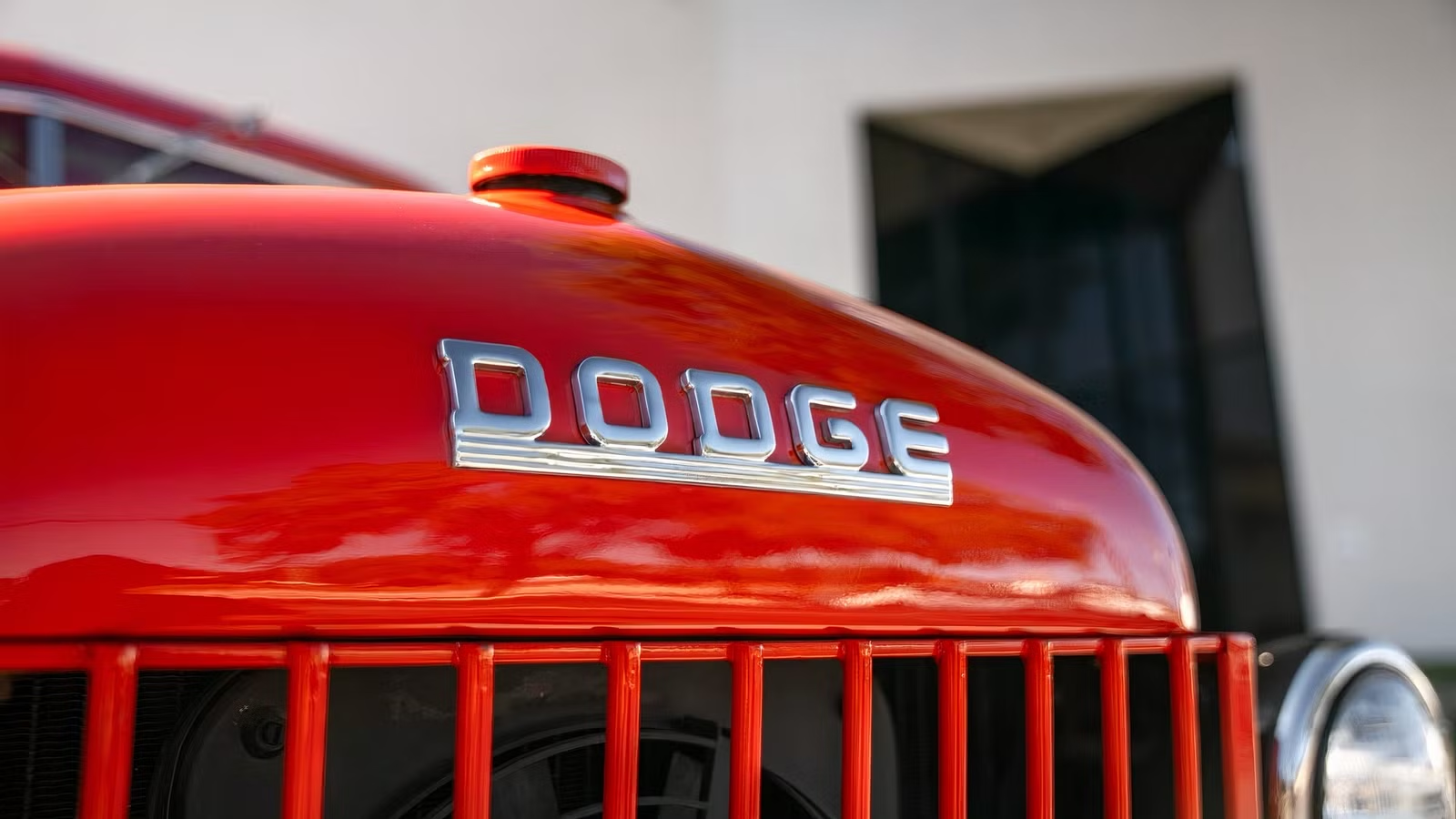
When WWII ended, Dodge had a problem that was also an opportunity. The company already knew how to build a brutally capable four-wheel-drive truck, and returning servicemen reportedly wanted civilian versions of the machines they had used overseas. Dodge’s answer was a civilian 4×4 that could haul, pull, winch, and even operate farm equipment through power take-off drives most pickups never touched, all wrapped around a chassis that had already survived a war. It ended up one of the strangest, most overbuilt trucks ever sold to American buyers, and nobody seemed to mind.
America Needed a Truck That Could Work as Hard as Its Military Counterpart

At the end of the war, factory-built civilian 4×4 light trucks were still rare in America, with Marmon-Herrington conversions representing one of the few options available. Dodge already had the mechanical foundation it needed in the 3/4-ton WC-series military trucks, so instead of starting over, it adapted the proven hardware for civilian work. That decision made sense for a country returning to peacetime but still needing machines capable of working farms, construction sites, logging operations, and remote roads. The resulting truck wasn’t designed around comfort or car-like manners. It was designed around getting a job done.
Dodge engineers reportedly built their first test mule out of surplus military parts back in 1945, well before there was a name or a sales brochure to put on it. That is not how a company develops a soft, compromised product. That is how a company develops something meant to survive exactly the kind of abuse its military ancestor already had.

Dodge could not settle on an actual name for almost a year, and one internal working title was the flatly bureaucratic General Purpose One Ton Truck, a phrase that seems engineered to bore a copywriter to death. None of the internal names survived contact with dealers, who were mobbed by buyers wanting the rugged wartime Dodge the moment sales opened in early 1946. A name finally stuck, borrowed from an old trucking trade magazine that had nothing to do with Dodge at all. Even the face of the truck told the same story before a single spec sheet did. The shell and grille borrowed from a heavy-duty 3/4-ton Dodge built for the Chinese Army, a truck nicknamed for the Burma Road it helped supply. A civilian pickup wearing a grille designed for a wartime supply route is not a subtle way to announce this truck meant business.

This Civilian Truck Could Do a Tractor’s Job

The strange part was just how far that philosophy went. A dual PTO setup could send power forward to run a winch or rearward to drive farm implements, turning the drivetrain into something that operated equipment instead of just moving the truck itself. Dodge even listed a 7,500-pound Braden winch as a factory option, not a line you expect to find on a pickup truck brochure, and the truck could still haul a 3,000-pound payload on top of all that. A belt pulley drive was available too, the same setup a stationary farm engine used to power a thresher or a buzz saw, just bolted to the side of a truck instead of sitting in a barn.
Then the University of Nebraska put one through its official tractor-testing program as Test 454, issued in November 1950. At its standard working weight, the truck produced 3,300 pounds of drawbar pull, an actual measured result rather than a number pulled from a sales brochure, and skeptics could mail five cents for the full report to check it themselves. That is an absurdly good bragging right for something wearing a pickup bed.

The Nebraska test made the Power Wagon’s agricultural credentials hard to dismiss. It wasn’t merely a pickup with a winch and some clever PTO hardware bolted on; it had enough traction and mechanical leverage to perform the fundamental job of a tractor. That 3,300-pound drawbar figure gave Dodge something far more meaningful than a marketing boast: independent evidence that its civilian 4×4 could put its military-bred hardware to work in the real world.
The Dodge WDX Power Wagon Was A De-Militarized WWII Combat Truck

That machine was the Dodge WDX Power Wagon, introduced for civilian sales in 1946 after production of the first examples began in 1945. Dodge based it heavily on the WWII WC-series, carrying over the basic mechanical architecture and many of the components that had already proved themselves in military service.
The launch truck used a 230-cubic-inch T-137 L-head inline-six with a 3.25-inch bore and a 4.63-inch stroke, producing 94 gross horsepower at 3,200 rpm and 185 lb-ft of torque at 1,200 rpm off a modest 6.7:1 compression ratio. Behind it sat a New Process four-speed non-synchronized transmission and a two-speed New Process transfer case, while 9.63-inch Dodge axles handled the final drive. The numbers don’t sound impressive by modern pickup standards, but that misses the point. The Power Wagon was geared to work, not to win stoplight races, and top speed topped out around 50 mph even in ideal conditions. Its 126-inch wheelbase, heavy-duty chassis and low gearing gave it the mechanical leverage to turn modest engine output into serious pulling ability.

Dodge actually sold two different trucks under one name. The standard model carried a 7,600-pound gross weight rating on 4.89:1 gears and 7.50-16 tires. Pay extra and the rating jumped to 8,700 pounds, backed by a 5.83:1 axle, 9.00-16 eight-ply tires and heavier front and rear springs. Buyers weren’t choosing paint colors. They were choosing how much abuse they wanted the truck to shrug off. At $1,627 to start, the Power Wagon cost around $550 more than a comparable two-wheel-drive, one-ton Dodge, and buyers paid it anyway. The civilian truck also received an eight-foot pickup bed with stake pockets and a side-mounted spare tire, making it a genuine work truck rather than a repainted military leftover.
Dodge Left Surprisingly Little of the Military DNA Behind

The transfer case tells the real story of how little Dodge changed. Engineers ditched the WC’s single-speed divorced unit for a two-speed New Process design borrowed from the wartime 1.5-ton 6×6, and that swap is exactly where the low range came from: the gearing that made serious pulling and off-road work possible rather than merely theoretical.
The axles carried the same bloodline. Underneath, the Power Wagon ran stout dropout housings with 9.63-inch ring gears and a four-pinion differential, lifted more or less straight from the 6×6 and the WC weapons carrier, and built to survive abuse rather than impress a spec sheet. Even the steering stuck with a proven wartime part. The front axle used a Tracta joint, an old and unusual constant-velocity design that had already spent years earning its keep under military abuse before Dodge trusted it to civilian buyers.

Dodge kept the formula remarkably stable, too. The truck’s basic design changed so little over its full domestic run, from 1945 all the way to 1968, that early postwar examples and the last trucks off the line are instantly recognizable as the same machine. Chrysler even sold near-identical versions overseas under the Fargo and DeSoto badges, which says less about branding and more about how little reason Dodge ever had to mess with the recipe. What is more telling is what Dodge left alone at launch. Later updates brought a synchromesh transmission and a 12-volt electrical system, followed by an alternator and, in 1961, a larger 251ci six. Day one was still, in every way that mattered, a military truck wearing a civilian bed.
The Power Wagon Stayed in Production for More Than Two Decades

The Power Wagon wasn’t a short-lived experiment that disappeared once the novelty of civilian four-wheel drive wore off. Domestic sales of the WDX-WM300 line ran from 1946 through 1968, with 95,145 trucks sold over that stretch, and production peaked at more than 8,700 units in 1957 alone, more than a decade after launch. Civilians did not just drive these trucks. They put them to work in ways the Army never planned for, as fire engines, school buses, and custom-bodied service rigs, including at least one four-door woody wagon built on the Power Wagon chassis. That is proof a chassis built to survive combat conditions could just as easily survive a small town’s daily grind.
Dodge also understood that the Power Wagon’s greatest selling point was its ability to go places and do jobs ordinary trucks simply couldn’t. The company marketed it around that capability, emphasizing its four-wheel-drive traction, PTO equipment, winch and ability to handle specialized bodies and attachments. It wasn’t just selling a pickup with extra hardware. Dodge was selling a truck that could be configured as whatever kind of working machine the buyer needed.

For years, the Power Wagon and the Willys Jeep were the only two factory-complete four-wheel-drive vehicles a civilian could walk into a dealership and buy. Dodge beat the first factory-built Willys 4×4 pickup to market by more than a year and had the segment almost entirely to itself for roughly a decade after that, a head start that turned Power Wagon into shorthand for civilian four-wheel-drive capability rather than just one brand’s name for it.
The bigger achievement was not being early. Dodge took a military truck that already knew how to survive difficult work, added a pickup bed and civilian equipment, and discovered that plenty of Americans had no interest in making it softer. A truck built with combat-tested hardware found a second life as one of the country’s most capable working machines, and it barely had to change to get there.
Sources: Mecum, Bring A Trailer, Classic.com, Dodge

Related posts

Latest Post


No Comments