
2026 Honda CB750 Hornet E-Clutch: First Look
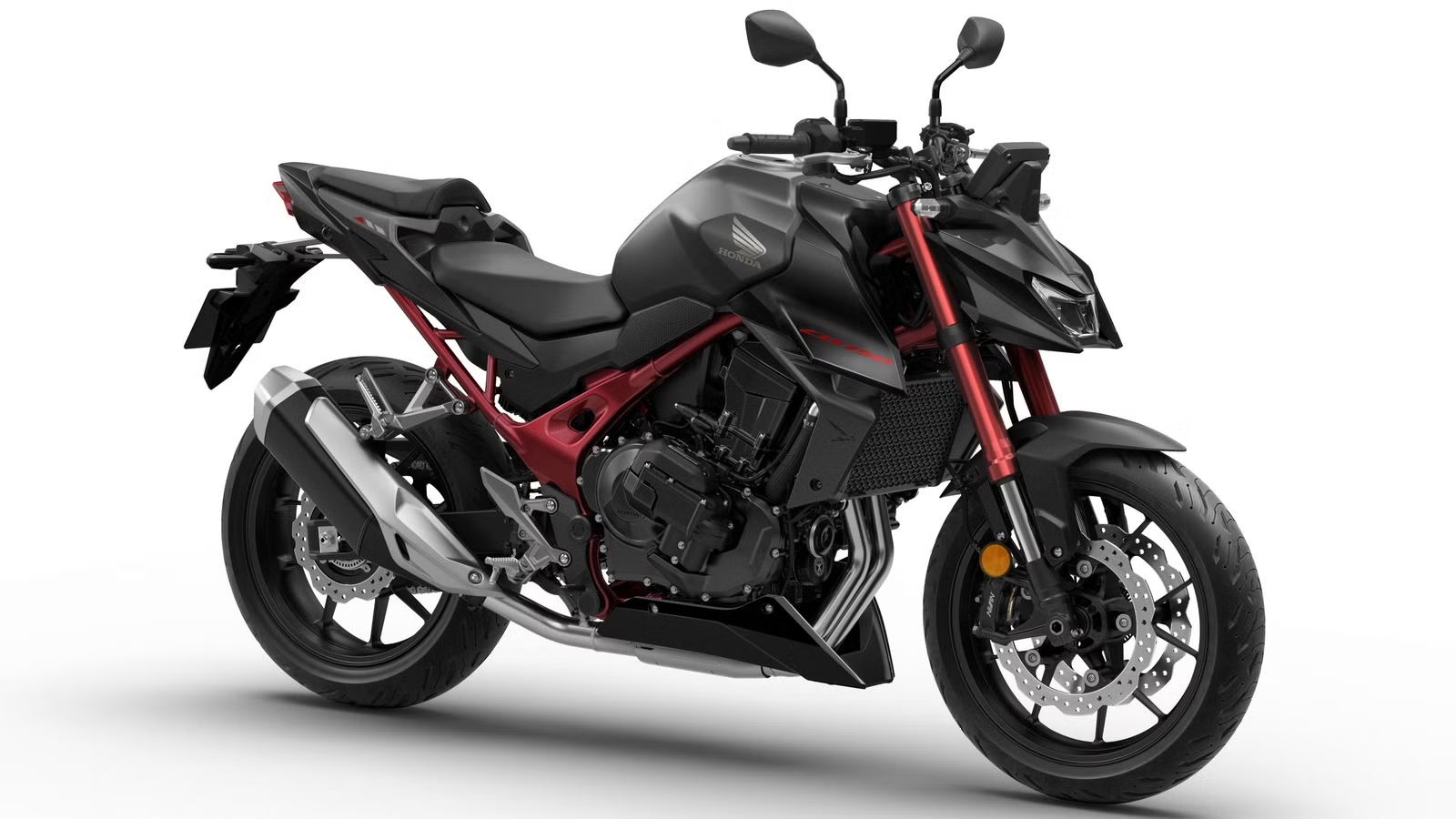
The Honda CB750 Hornet arrived in the United States last season, two model years after its European debut, quickly settling in as a worthy contender within the hotly contested middleweight naked sportbike category. A single calendar year after the mid-sized Hornet’s Stateside arrival, Big Red is replacing the standard-clutch variant with the 2026 CB750 Hornet E-Clutch. Thankfully, what isn’t changing is the competitive $7,999 MSRP.
Same Price, New Hardware

Let’s be clear about what this update is: Apart from the addition of E-Clutch hardware and the additional 10 pounds the servo-assisted clutch brings, the 2026 CB750 Hornet E-Clutch is mechanically identical to last year’s middleweight Hornet. That means we have the same 755cc parallel-twin engine, same steel diamond frame, same Showa suspension, same Nissin brakes and same electronic features as before. The original Hornet recipe hasn’t changed; it added a proven ingredient.
Zeroing in on pricing for a moment, the CB750 Hornet E-Clutch looks like a great value compared to its rivals, only being undercut by the Kawasaki Z650 ($7,699), which is the lone model within the segment still using an old-school non-inverted fork. Meanwhile, the Yamaha MT-07 ($8,599), CFMoto 800NK ($8,699), Triumph Trident 660 ($8,745), BMW F 900 R ($8,995), Suzuki GSX-8S ($9,249), KTM 790 Duke ($9,499), Triumph Trident 800 ($9,995) and Aprilia Tuono 660 ($11,499) all command loftier price tags and without the ease-of-use factor that E-Clutch delivers.
How Honda’s E-Clutch Works
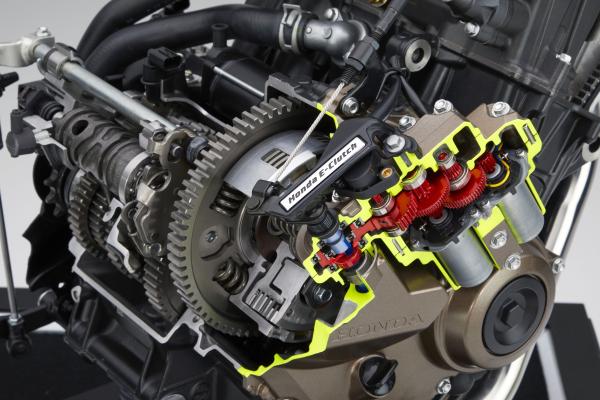
Honda’s E-Clutch is clever both in design and execution, as it can be applied to existing platforms without significant re-engineering. Case in point, Honda’s E-Clutch technology is now standard on CB650R, CBR650R, Rebel 300 and XL750 Transalp models in North America. The clutch and gearbox are completely conventional. Meanwhile, an actuator with two servo motors in the right-hand engine cover physically operates the clutch lever during starts, stops and gear changes. The system factors information such as vehicle speed, throttle position, engine rpm, shift lever pressure and gear position to ensure that actions are as smooth as possible.

The brand’s mission with E-Clutch is simple: simplify the riding experience by removing the clutch from the equation, which can be seen as a major learning hurdle for potential riders. Importantly, it doesn’t remove the clutch as we know it from the equation. Users can still override the system and manually operate the clutch themselves. After waiting five seconds, the E-Clutch system will reengage to resume automated control.
Unlike the brand’s longstanding automatic Dual-Clutch Transmission (DCT) offered on select Africa Twin, Gold Wing, NT1100 and Rebel 1100 models, which is capable of executing gear changes on the rider’s behalf, the E-Clutch still requires the rider to shift manually with the foot pedal. In addition, the CB750 Hornet E-Clutch is equipped with a wholly modern ride-by-wire throttle, allowing the system to rev-match during downshifts. Shifting effort is also adjustable within three pressure settings: Hard, Medium and Soft.
Everything Else Carries Over

The 755cc liquid-cooled parallel-twin engine carries over untouched, using the ever-popular 270-degree crankshaft orientation for a V-twin-inspired character. American Honda rarely cites performance figures, though Honda’s European subsidiaries claim 90.5 horsepower and 55.3 lb-ft of torque measured at the crank. Fuel capacity also remains at 4.0 gallons.
Rider aids are competitive within the segment, starting with three preset riding modes (Sport, Standard and Rain), as well as two customizable modes (User 1 and User 2). Owners can adjust engine power, engine braking and traction control from the 5-inch full-color TFT display. As we’ve come to expect in recent years, Bluetooth connectivity is standard, accommodating navigation and media features.
The CB750 Hornet chassis is light, agile and uses a non-adjustable inverted Showa 41mm SFF-BP fork (Separate Function Front Fork Big Piston) in conjunction with a linkage-type Showa remote-reservoir-equipped shock, featuring preload adjustment only. Suspension travel is 5.1 inches at both ends. While the CB750 Hornet has earned a reputation for its sporty handling, its geometry figures land on the more conservative end of the spectrum within the class, with a 25-degree rake, 3.9-inch trail measurement and 55.9-inch wheelbase.
Comfort, Stopping Power and Availability

Ergonomics follow the established Hornet formula, which, in the most on-brand inclusive Honda language says it was designed for usability of all riders. Seat height is a manageable 31.3 inches, and the upright seating position is combined with casual rear-sets to encourage all-around comfort. Curb weight is a claimed 432 pounds. Honda also revised the E-Clutch mounting structure to protect legroom on the CB750 Hornet, dividing the clutch-lifter shaft in two and adding a gear train that offsets the assembly 1.6 inches away from the rider’s foot.
In the braking department, radially mounted Nissin four-piston calipers clamp onto 296mm petal-style rotors up front, actuated by an axial master cylinder. A single-piston caliper and 240mm disc handle braking duties in the rear. ABS is standard.
The 2026 Honda CB750 Hornet E-Clutch is at dealers now in Matte Nightshade Blue and Black, with a one-year warranty. We’ll reserve judgment until we throw a leg over one, but Honda adding genuinely useful tech without increasing the price is a rarity in today’s marketplace.
2026 Honda CB750 Hornet E-Clutch Photo Gallery:
2026 Honda CB750 Hornet E-Clutch Specifications:
Engine
|
Type |
Parallel-twin-cylinder four-stroke engine w/ 270-degree crank; balance shaft driven off the primary drive gear; Ni-SiC-coated cylinders |
|
Displacement |
755cc |
|
Bore x stroke |
87.0mm x 63.5mm |
|
Maximum horsepower |
90.5 hp @ 9,500 rpm (Honda UK performance figures) |
|
Maximum torque |
55.3 lb-ft @ 7,250 rpm (Honda UK performance figures) |
|
Compression ratio |
11.0:1 |
|
Valvetrain |
SOHC Unicam; 4 valves per cylinder. 35.5mm intake valves cam-operated (9.3mm lift), 29mm exhaust valves rocker-arm-operated (8.2mm lift) |
|
Fueling |
Programmed electronic fuel injection (PGM-FI) w/ throttle-by-wire; 46mm downdraft throttle bodies fed by Vortex flow ducts. Unleaded only, Pump Octane Number (PON) 86 or higher |
|
Exhaust |
Two-into-one. |
|
Cooling |
Liquid |
|
Transmission |
Six-speed manual w/ Honda E-Clutch |
|
Clutch |
Multiplate wet assist/slipper w/ oblique-layout disc segments; Honda E-Clutch automated actuation via twin motors in the right engine cover, clutch lever retained for manual use |
|
Final drive |
#520 chain, 16T/45T ratio |
Chassis
|
Frame |
Steel diamond frame, 36.6 pounds; steel swingarm |
|
Front suspension; travel |
Non-adjustable Showa 41mm Separate Function Front Fork Big Piston (SFF-BP) inverted telescopic fork, damper in one leg and spring in the other; 5.1 inches |
|
Rear suspension; travel |
Spring-preload-adjustable (7-stage) Showa remote-reservoir shock, Pro-Link linkage; 5.1 inches. |
|
Wheels |
Cast aluminum |
|
Front wheel |
17 x 3.5 |
|
Rear wheel |
17 x 4.5 |
|
Tires |
Radial, ZR-rated. |
|
Front tire |
120/70-ZR17 |
|
Rear tire |
160/60-ZR17 |
|
Front brake |
Dual 296mm petal-style discs w/ Nissin radial-mount 4-piston hydraulic calipers |
|
Rear brake |
240mm disc w/ 1-piston hydraulic caliper |
|
ABS |
Standard, front and rear. Cornering function Not Provided By Manufacturer |
|
Electronic rider aids |
Honda Selectable Torque Control (HSTC) w/ integrated wheelie control, switchable off in User modes; three-level engine power and engine braking; throttle-by-wire. Sport, Standard, Rain, and User 1 and 2 ride modes. Five-inch TFT display w/ Honda RoadSync smartphone connectivity |
Dimensions & Capacities
|
Wheelbase |
55.9 inches |
|
Rake |
25.0 degrees |
|
Trail |
3.9 inches (99mm) |
|
Seat height |
31.3 inches |
|
Ground clearance |
5.6 inches |
|
Fuel capacity |
4.0 gallons, including 0.8-gallon reserve |
|
Curb weight |
432 pounds (includes all standard equipment, required fluids, and a full tank of fuel, ready to ride) |
Pricing & Warranty
|
Website |
powersports.honda.com |
|
Price |
$7,999 MSRP |
|
Warranty |
Transferable one-year unlimited-mileage limited warranty; extended coverage available through a HondaCare Protection Plan |
|
Service interval |
Valve clearance inspection every 16,000 miles (25,600 km). Initial service at 600 miles, then scheduled maintenance every 4,000 miles |
|
Color |
Matte Nightshade Blue, Black |
Source: American Honda

Related posts
Latest Post


No Comments