
Toyota’s Only Diesel 4×4 Pickup: The 1985 2L-T Story
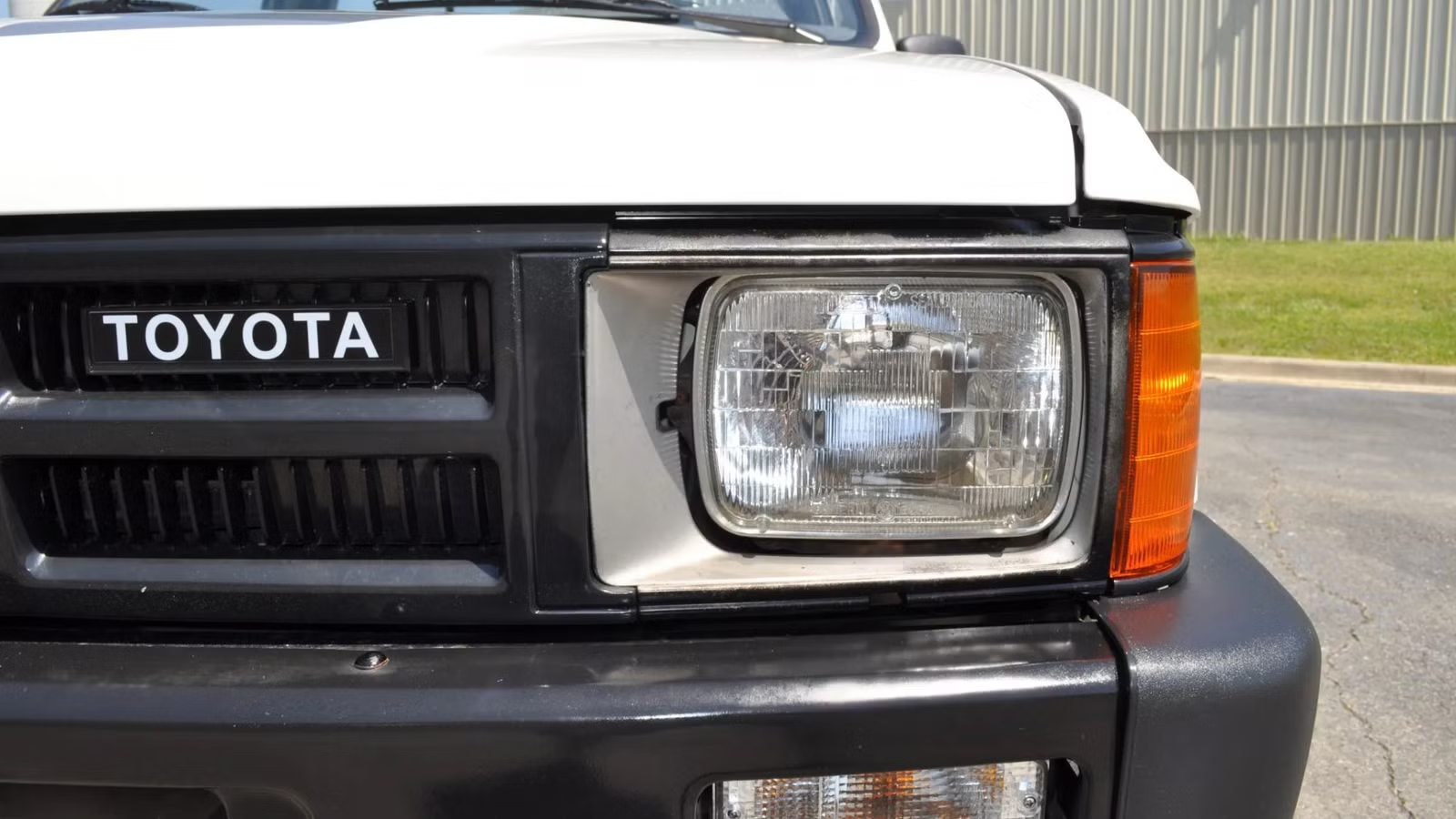
Toyota replaced the solid front axle in its four-wheel-drive compact trucks with Hi-Trac independent front suspension for the 1986 model year. The company wanted better on-road manners for a truck line that was starting to sell to commuters, and it got them.

Everything built before that point was a leaf-sprung workhorse, and everything after it was tuned for pavement. Clean solid-axle Toyotas command real money today because of it.
Lost in the switch was one configuration that Toyota never offered again in America, and it was the toughest version of a truck already famous for refusing to die.
Toyota Changed Its Compact 4×4 Formula After 1985

Every four-wheel-drive Toyota pickup sold in America before 1986 used a leaf-sprung solid front axle, a part-time transfer case, and hubs the driver locked by hand at the wheel. Parts catalogs still sort these trucks by that hardware, listing Aisin’s factory manual hub as the correct fitment for solid-axle Toyota Pickups and 4Runners built from 1979 through 1985.
For 1986, Toyota fitted its Hi-Trac independent front suspension, a system the company credits with improving both ground clearance and ride quality. The 4×4 version used a torsion bar rather than the old leaf packs.
Automatic locking hubs became standard equipment at the same time, and buyers could add a front differential disconnect with a shift-on-the-fly 4×4 HI setting. The goal was a truck that behaved on pavement, and the change worked well enough that independent front suspension stayed on four-wheel-drive Toyota Pickups from 1986 onward.

The 4Runner switched over in the same model year, so this was a decision about the whole platform rather than a tweak to one body style.
The fourth-generation truck arrived in November 1983 with a new body for all four-wheel-drive models, marked by blister fenders front and rear, and it wore that shape until 1988. A 1985 and a 1986 look like the same truck from ten feet away and are completely different underneath.
Toyota Sold This Turbodiesel 4×4 In America For One Year Only

A 2.4-liter 2L-T turbodiesel four-cylinder, a solid front axle, and a pair of Aisin manual locking hubs made up the rarest way to order a 1985 Toyota Pickup. Toyota sold that exact combination for one model year in the United States, and dropping the axle for 1986 ended it.
Output was 84 hp at 4,000 rpm and 137 lb-ft at 2,400 rpm, and the low peak is the whole point of the engine. Torque arriving that early makes a truck easy to place on a rock ledge or a wet boat ramp at walking pace.
Auction listings for these trucks often quote 139 lb-ft, which is the international metric rating converted rather than the figure Toyota published for the US market.

Toyota’s fuel-injected gas four had climbed to 116 hp and 140 lb-ft by 1985, so the diesel was level on torque and well down on power. Buyers were paying for durability and fuel economy rather than speed.
The 2L-T replaced a naturally aspirated 2.2-liter L diesel that made 71 hp, so the turbocharger was a real jump rather than a badge change. It also earned a reputation that outlasted the truck itself.

Survivors are scarce enough that only a limited number of fourth-generation trucks left the factory with the 2L-T. One seller of a surviving example put the US total at a few hundred trucks, which is a claim rather than a production figure, though nothing in the market contradicts it.
The engine alone is not what makes the 1985 truck worth chasing, and the axle underneath it matters a great deal more.
Why A Solid Front Axle Still Beats IFS On A Rock Ledge

A solid axle keeps its lowest point in the same place no matter what the suspension is doing, because that lowest point is the axle tube itself. An independent setup drops the belly of the truck toward the ground every time a front wheel climbs, which is exactly when clearance matters most.
Both front wheels move together on a solid axle, so a tire dropping into a rut pushes the other one down into the dirt instead of letting it hang. That behavior is why rock crawlers and slow, technical off-roaders still prefer the layout over anything independent.

A cast axle housing takes impacts that would bend control arms, swallows bigger tires and more torque without upsetting the geometry, and can be repaired on a trail with hand tools. Independent systems carry more moving parts, and each one is another thing to wear out or break under sustained abuse.
Solid-axle builds work around the housing, while independent front suspension pushed past three or four inches runs the CV joints at angles they were never meant to hold. Getting around that usually means fitting a differential drop kit to pull everything back into range.

Toyota was not wrong to switch, because independent front suspension rides and steers better on pavement. The company points to Hi-Trac as adding ground clearance along with ride quality on the first-generation 4Runner, so the trade ran in both directions.
Torque arriving at 2,400 rpm underneath a solid axle adds up to a crawling drivetrain rather than a highway one.
Toyota Has Not Sold A Diesel Pickup In America Since 1986

Toyota’s diesel compact trucks were gone from American showrooms after the 1986 model year, and the company has never sold another diesel pickup in the United States. Forty years later that is still true, through the Tacoma’s entire run and the Hilux’s continued diesel life everywhere else.
Pickups were turning into personal vehicles rather than tools by the mid-1980s, and the diesel was slow by any measure. Gas had gotten cheap again, which removed the one argument that had carried the engine through the early part of the decade. Diesel had also picked up a bad name in America thanks to a wave of poor engines from domestic brands.

A two-wheel-drive diesel of this era returned roughly 35 mpg in the city and 44 mpg on the highway, against about 25 mpg and 33 mpg for the same truck with a gas engine. That gap was worth real money in 1981 and worth very little by 1986.
Diesel models slid from full-page brochure spreads to a small corner photo and a line on the specification page over the space of a few years. That is how a company advertises something it has already decided to stop selling.

The axle and the engine disappeared for the same reason, which was a market that had changed underneath Toyota. The company built toward quieter, quicker, easier trucks from that point forward, and the road from 1986 runs directly to the Tacoma.
A Clean 2L-T Turbodiesel Now Costs More Than A 22R 4×4

A 1985 Toyota Pickup with the 2L-T turbodiesel and four-wheel drive sold for $16,250 on Bring a Trailer in May 2021, which was strong money for a compact truck at the time. Five years on, that result looks conservative.
Classic.com now puts its benchmark value for a 1985 fourth-generation Pickup 4WD at $20,402 and has it trending upward, against an $18,741 average across every Toyota Pickup model year. That is a benchmark for the whole 4×4 segment rather than a like-for-like comparison with one truck, but it shows where the floor has moved.

Turbodiesel examples sit in their own band, with 30 comparable sales indicating a range of $14,000 to $25,273. A clean one now trades at or above a good gas-powered 4×4 of the same year, despite being the slowest engine Toyota put in the truck.
Rust is what kills these trucks rather than mileage, and the bed and floor pans go first. Parts are the other problem, since 22R components remain easy to find and 2L-T-specific items are not, which makes a complete example worth more than a low-mileage one with pieces missing.

Toyota built the toughest version of its compact 4×4 and then deleted the parts that made it tough, one model year at a time. The buyers who wanted comfort got what they asked for, and the ones who wanted a truck that could sit in the desert for a decade have been paying to get 1985 back ever since.
Sources: Toyota, Bring A Trailer

Related posts




Latest Post


No Comments