
How i-VTEC Evolved Honda’s VTEC System
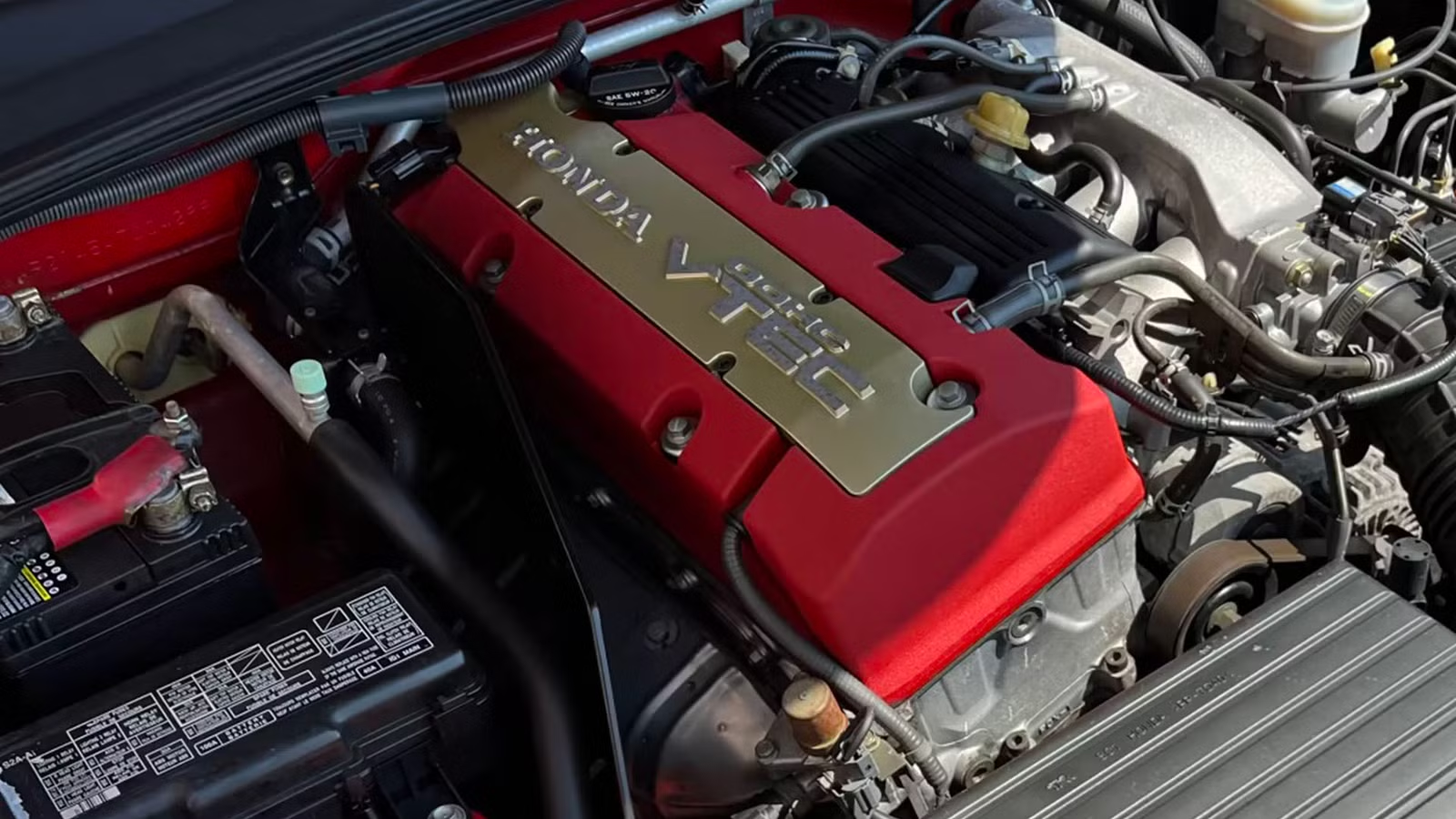
The engine performance war of the late 1980s and 1990s was being fought in a place most drivers never saw, between the camshaft and the valves. The valve timing and lift that helped an engine breathe at 8,000 rpm weren’t necessarily what made it responsive, efficient, or tractable at 2,000 rpm. A fixed camshaft forced engineers to compromise. Honda’s answer was something that turned out to be a legend. Toyota and Mazda attacked the same problem with continuously variable cam timing. Honda eventually let its technology evolve, turning a dramatic mechanical trick into a more flexible valve-control system.
The Engineering Problem That Every Performance Brand Was Racing to Solve

An engine’s valves have to open and close at the right time, but “right” changes with engine speed and load. At low rpm, airflow behaves very differently than it does near redline. A cam profile with relatively modest lift, duration, and overlap can help an engine maintain useful low-speed behavior, while a more aggressive profile can keep the cylinders breathing as engine speed rises.
The problem is that one fixed cam profile has to do both jobs. Honda’s B16A makes the challenge easy to see, but the 100-PS-per-liter target didn’t appear out of thin air. Honda had already been developing a 1.6-liter ZC engine for Group A racing in Japan, where its Civic competed in the under-1,600cc class from 1985. That racing program gave Honda’s engineers practical experience with the valve timing, lift, and other details needed to make a small naturally aspirated engine breathe at high rpm. The Civic became a championship-winning machine from 1986 through 1993, giving Honda a useful laboratory before the technology reached the street.

The road-going B16A took that knowledge in a new direction. Honda shortened the stroke from the ZC’s 90.0 mm to 77.4 mm and increased bore from 75.0 mm to 81.0 mm, creating a more high-rpm-friendly engine while allowing larger valves. The result was a 1.6-liter naturally aspirated four-cylinder capable of 160 PS at 7,600 rpm and an 8,000-rpm redline, while still retaining useful low- and midrange torque. The engineering challenge was no longer simply making a small engine rev. It was making one that could breathe at those speeds without becoming miserable everywhere else.

Honda described VTEC as the world’s first production technology to vary valve timing and lift together. That is why the valve train mattered so much. Honda could build a high-rpm engine mechanically, but the aggressive valve timing needed for that job would work against the low-speed behavior expected from a street car. The racing engine had already shown what the high-rpm side of the equation could look like. VTEC was Honda’s attempt to put both sides into the same engine without asking the driver to choose between them. At low engine speeds, the valve train could favor torque and drivability. At higher speeds, it could switch to the more aggressive cam profile used to improve breathing. The trick was not simply making a better cam. It was making the engine use different cam behavior at different times.
Toyota and Mazda Found Their Own Answers, And Both Chose Smooth Over Dramatic

Honda wasn’t alone in trying to make the valve train less rigid. Toyota announced VVT-i in 1995 as an evolution of its earlier two-step WT system. Instead of switching between two discrete timing positions, VVT-i continuously changed intake-valve timing according to engine operating conditions. Toyota said the system could increase torque and output while improving fuel economy and reducing emissions. Its ECU calculated the desired timing, an oil-control valve managed hydraulic pressure, and the system continuously adjusted the intake cam’s position.
Mazda’s S-VT followed a similar philosophy. Introduced on a 1.5-liter DOHC engine in 1998, it continuously varied intake-valve timing using a vane-type hydraulic actuator that changed the camshaft’s phase relative to the crankshaft. An oil-control valve responded to inputs including engine speed, intake airflow, and coolant temperature. Mazda said the system could improve output and torque while reducing fuel consumption and emissions.

The distinction is important. VVT-i and S-VT primarily changed when the valves operated by continuously phasing the camshaft. They weren’t switching between radically different cam profiles like Honda’s original performance powerhouse. Instead of choosing between a low-rpm cam and a high-rpm cam, a continuously variable cam phaser could keep moving the camshaft toward the timing the engine needed at that moment. There was no single mechanical event for the driver to wait for. The engine simply kept adjusting itself. Honda, meanwhile, was about to make the mechanical switch famous.
Honda’s Answer Was Not One, But Two, And The First One Was A Legend

The B16A arrived in the 1989 Integra with a 1.6-liter naturally aspirated four-cylinder producing 160 PS, or about 158 horsepower, at 7,600 rpm. Honda achieved that output while retaining useful low- and midrange characteristics by giving the engine different cam profiles for different operating conditions. The mechanism is wonderfully simple once you understand it.
The B16A uses three rocker arms for its cam-profile switching. At low and medium engine speeds, the outer low-lift cam lobes operate the valves while the high-lift center lobe rotates without controlling the rocker arms. When hydraulic pressure activates the locking pins, the three rocker arms become mechanically linked. The high-lift center lobe then controls all three, making the valves open earlier, close later, and lift farther.

The transition occurs around 4,800 to 5,200 rpm depending on operating conditions, with the ECU using inputs including engine speed, engine load, and vehicle speed to determine when to switch profiles. At lower rpm, the B16A uses a torque-oriented cam profile with relatively small lift and overlap. Higher in the rev range, the hydraulic mechanism brings in the aggressive profile, increasing valve lift and overlap to improve high-rpm breathing and exhaust scavenging.
The result was more than a specification. The engine genuinely changed personality. And the driver could hear it happen. Honda’s own technical description notes a clear change in engine sound when the B16A switched from its low-lift to high-lift cam profile. Honda describes that sound change as an unintentional feature of the system, but it became one of VTEC’s most recognizable characteristics. The clever part was that the ECU decided when the change should occur, but hydraulic pressure and mechanical rocker arms physically changed which cam profile controlled the valves. Honda had effectively built two valve-train personalities into one engine. Then it added another layer.
What the i-VTEC Transition Gained on Paper, And What It Cost Through the Seat

Honda’s K-series brought i-VTEC around the turn of the century, combining VTEC with VTC, or Variable Timing Control. That distinction matters because i-VTEC did not replace VTEC. VTEC continued to provide variable valve timing and lift, while VTC added continuous adjustment of camshaft phase.

The difference shows up clearly in Honda’s early K20A development. The new 2.0-liter engine produced about 152 hp (113 kW) at 6,500 rpm and about 137 lb-ft (186 Nm) at 4,000 rpm. Its predecessor, the F20B, produced about 147 hp (110 kW) at 6,200 rpm and the same 186 Nm of torque, but at 5,000 rpm. The K20A therefore wasn’t simply chasing a bigger peak number. Honda was using the new valve-control system to reshape how the engine delivered its performance while also improving fuel economy and emissions.
That gave the engine more freedom to manage airflow, overlap, torque, fuel economy, and emissions without relying entirely on one dramatic change in cam behavior. That was more sophisticated. It was also the beginning of the VTEC experience becoming less about one unforgettable event. The old VTEC system made its solution obvious. i-VTEC could still deliver a mechanical change in performance-oriented applications, but continuous cam phasing allowed more of the optimization to happen around that event rather than depending on it.
What VTEC’s Evolution Changed for Enthusiasts, And What Honda Built Toward Instead

Turbocharging changed the equation again. Honda’s VTEC Turbo engines combined variable valve control with direct injection and turbocharging. The 2015 Civic Type R’s 2.0-liter engine produced 310 PS, or about 306 hp, and 400 Nm, or about 295 lb-ft, of torque, with a 7,000-rpm redline. Honda used VTEC on the exhaust valves and VTC to continuously adjust intake and exhaust valve timing. That configuration says a lot about how the engineering problem had changed.
The B16A needed an aggressive naturally aspirated valve strategy to make a small four-cylinder breathe at high rpm. The turbocharged K20C had a different tool available. The turbocharger could force more air into the engine, while continuous cam phasing could manage valve timing across the rev range. Honda therefore retained VTEC where it could provide a useful advantage on the exhaust side rather than simply reproducing the original B16A formula. The result was still unmistakably VTEC, but the technology was no longer carrying the entire burden of making a small naturally aspirated engine produce extraordinary specific output.

VTEC had not disappeared. Its job had changed. Honda didn’t gradually make VTEC irrelevant. It made the technology more flexible, then integrated it with turbocharging, direct injection, and increasingly sophisticated electronic control. What enthusiasts lost was the obvious mechanical theater of the original system. The old VTEC kick was memorable because the engine had to make a choice. Modern i-VTEC and its descendants are interesting for almost the opposite reason. They give the engine more ways to avoid making one.
Sources: Mecum, Bring A Trailer, Honda

Related posts




Latest Post


No Comments