
Pontiac’s Budget Muscle Package Hid A 455 HO The GTO Couldn’t Legally Sell
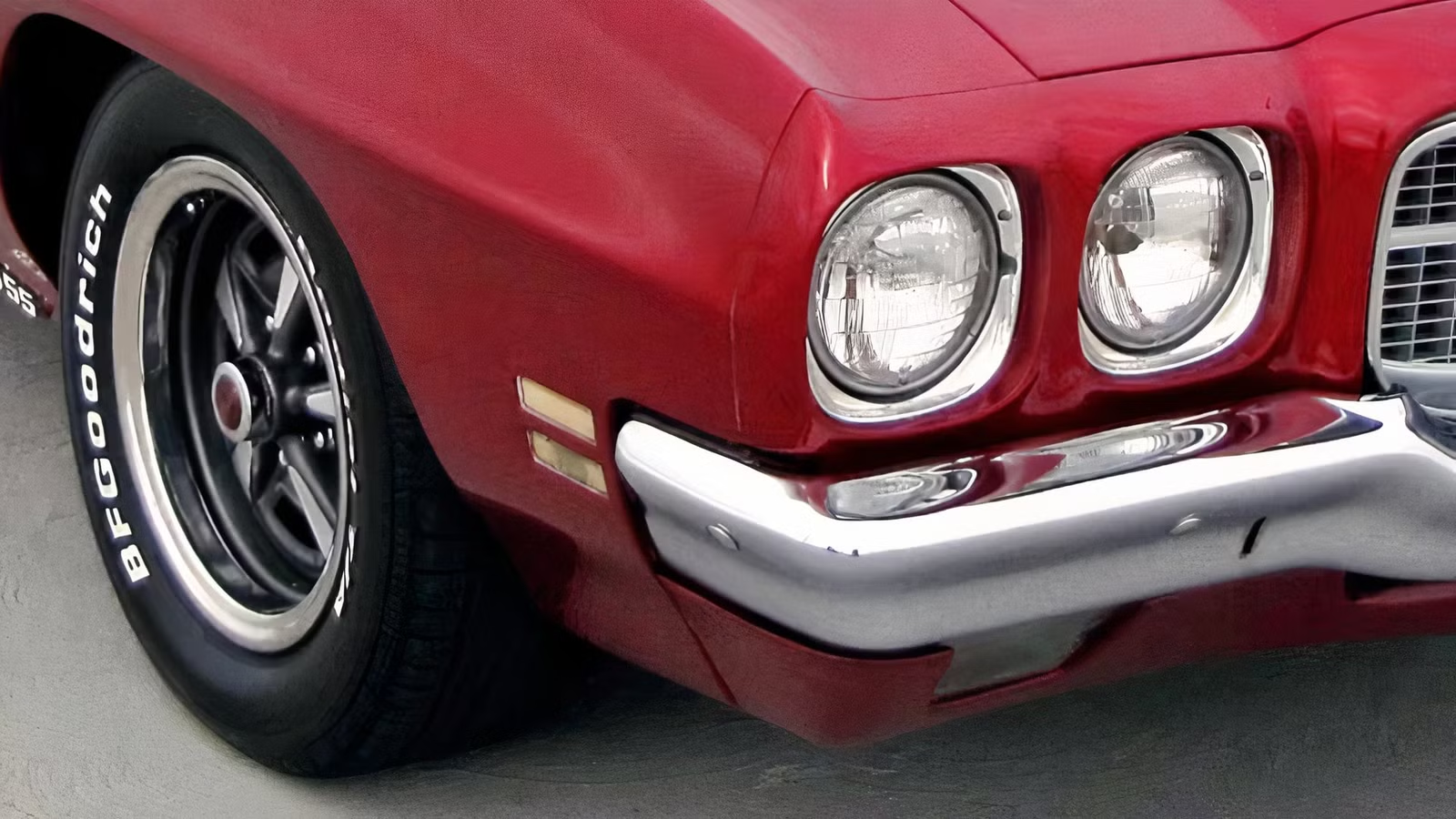
Insurance companies ruin all the fun, especially when it comes to peak muscle car performance. In the 1970s, high-powered cars came under attack as options like the Pontiac GTO were targeted by skyrocketing premiums. Suddenly, the GTO became impossible to afford, but John DeLorean fought back by convincing Pontiac to hide GTO 455 HO power under a different badge. He created an affordable muscle package that secretly hid GTO components, making it the ultimate sleeper car capable of avoiding exorbitant insurance premiums.
The GTO Badge Faced Surging Insurance Costs

In 1970, the Pontiac GTO was a high-powered beast that insurance companies refused to ignore. It was one of the muscle cars that generated an excessive number of severe accidents and expensive injury claims. The muscle car was linked to drivers aged 18 to 35 and a higher rate of accidents among those behind the wheel of big-block mid-size options.
Insurance companies implemented surcharges based on high-performance metrics such as large-displacement engines, high compression ratios, and multi-carburetor setups that were directly linked to street racing and reckless behavior. As a result, increasing premiums made the GTO impossible to afford as the monthly cost either matched or exceeded the owner’s monthly finance payment. Younger buyers were priced out of the market.
But John DeLorean wasn’t about to take that sitting down. He also noticed that the Plymouth Road Runner was a low-cost, budget-friendly muscle car that was stealing market share from Pontiac. So, he figured out a way to craft an affordable competitor to avoid high insurance premiums and win buyers back.

John DeLorean Made The Pontiac GT-37 Happen

Because John DeLorean was obsessed with beating the Plymouth Road Runner, he engineered the creation of the 1970 and 1971 Pontiac GT-37, which was built on the lightweight Tempest T-37 frame to hide high-performance components in a stealthy package. The hardtop coupe T-37 started at $2,805, and going for the high-performance GT package only added another $198 to $237 to the price.
Meanwhile, the 1971 Plymouth Road Runner had an original cost of $3120 to $3,150, and adding the 426 HEMI V8 added about $700 to $800. Also, the 1971 Pontiac GTO started around $3,446 to $3,595, while the fully loaded top-spec GTO “The Judge” trim cost around $4,200 to $4,800. Plus, the GT-37 managed to avoid high insurance premiums, unlike the GTO.

In 1971, the GT-37 was available with the 455-cubic-inch (7.5-liter) High Output V8 with 335 hp and 480 lb-ft of torque. The Pontiac GT-37 455 HO can accelerate from 0 to 60 mph in about 5.4 seconds and complete a quarter-mile in roughly 13.9 seconds at 99 mph with a top speed of around 132 mph.The Plymouth Road Runner 426 HEMI delivers 325 hp and 490 lb-ft of torque. It can accelerate from 0 to 60 mph in around 5.5 seconds and finish a quarter mile in about 13.4 seconds at 106.5 mph, with a top speed of 142 mph. So, the GT-37 was more affordable and highly competitive as the ultimate sleeper build.
The Pontiac GT-37 Had Expert Marketing

John DeLorean didn’t waste any time and immediately let potential buyers know that they could unlock big-block V8 power without high insurance penalties. He marketed the Pontiac GT-37 as the “poor man’s GTO” and “GTO for kids under 30” by pairing the stripped-down T-37 body with heavy-duty drivetrains and GTO styling.
Pontiac marketing brochures pitched the ability to build the stealthy model by emphasizing that people could order any Pontiac V8 from the standard 350 to the 455 H.O. wrapped in a lightweight, spartan package that omitted expensive features included with luxury trims like The Judge.

Promotional materials highlighted its aggressive style adopted from high-end models like the GTO. It was built on the A-Body platform to share the same size and stance as the Pontiac GTO. Plus, it had Judge-inspired multi-color side body stripes, dual sport mirrors, hood pins, and 14-inch Rally II wheels. Also, GTO hardware was hidden under its appearance.
The GT-37 featured a heavy-duty three-speed manual with a Hurst floor shifter, while a close-ratio four-speed manual or Turbo Hydra-Matic automatic transmission was also available. It had the same dual exhaust with splitters and heavy-duty springs as the GTO as well. But the interior was pretty spartan to reduce its weight. It featured a bench seat with foam-padded Morrokide upholstery and rubber floor mats, and a two-spoke deluxe safety steering wheel.
The 1971 Pontiac GT-37 455 HO Exists In Small Numbers

Production of the Pontiac GT-37 was extremely limited because people were drawn to the GTO name over the economy T-37/Tempest platform. Also, it was a mid-year performance package that still struggled against rising emission standards and increasing insurance costs. It was discontinued after 1971 due to weak sales and was replaced by the LeMans.
Roughly 1,419 units were built in 1970, followed by 5,802 units in 1971. Out of those cars, only about 54 to 69 of them got the 455 H.O. V8 engine. It’s a rarer model than the GTO it sourced all of its components from. Models in good or average condition hover around $31,200. But models in pristine condition fetch between $50,000 and over $75,000. Also, models with the smaller engines typically fetch between $15,000 and $24,000.
Meanwhile, 1971 Pontiac GTO 455 H.O. models in project condition sell for between $40,000 and $50,000. Models in average condition cross the auction block for between $60,000 and $75,000, while cars in excellent condition go for about $90,000 to $130,000. Then Judge 455 H.O. models in pristine condition sell for $150,000 to over $180,000.

Don’t overlook the 1971 Plymouth Road Runner 426 HEMI that DeLorean found so formidable. Models in good, driving condition sell for about $115,000 to $182,000. Then models in excellent condition sell for between $205,000 and over $250,000. So, the Pontiac GT-37 continues to serve as a rare, more affordable sleeper muscle car.
Source: Moto Gallery, Hemmings, Hagerty

Related posts






Latest Post


No Comments