Mazda’s CX-50 Hybrid Costs $3,000 More Than The Gas Model — Here’s When It Pays You Back
8 minutes reading
Thursday, 3 Sep 2026 04:00 0 62 autotech
The modern automotive landscape positions hybrid car powertrains as the ideal middle ground between conventional gas engines and full-electric vehicles. Automakers promise substantial fuel savings and extended range, but these efficiency gains come with a higher initial purchase price. Drivers frequently encounter sticker prices that command thousands more upfront than their standard gas counterparts.
Determining whether that initial cost premium translates into real financial benefit requires evaluating long-term fuel savings against real-world ownership data. By calculating exact break-even timelines across competing options, buyers can determine if spending extra at the dealership delivers genuine long-term value.
Mazda maintains a distinct identity in the U.S. automobile market, positioning itself between mainstream high-volume brands and traditional luxury automakers. The Japanese brand focuses heavily on driver engagement, refined vehicle dynamics, and upscale cabin design. That strategy guides its current product roadmap, which prioritizes a steady transition toward premium market tiers.
Central to Mazda’s strategy is the ongoing expansion of its crossover lineup alongside targeted electrification efforts. The brand leverages strategic partnerships to introduce flexible hybrid architectures while developing its own proprietary platforms to support mild-hybrid and plug-in hybrid options. By emphasizing premium interior materials, elegant exterior styling, and standard all-wheel-drive configurations across most utility offerings, Mazda targets buyers seeking an elevated driving experience without luxury-brand price tags.
Domestic sales figures for 2026 highlight the impact of this product direction. Year-to-date performance shows steady consumer demand in the U.S., highlighted by strong individual monthly gains. Record-setting monthly totals in late spring and early summer demonstrate robust interest in the brand’s updated crossover inventory. While overall volume reflects broader market fluctuations, expanded production of electrified variants continues to drive foot traffic, sustaining Mazda’s competitive standing across key suburban domestic markets.
The CX-50 Hybrid’s Appealing Ownership Cost Factor
Front 3/4 action shot of 2026 Mazda CX-50 driving off-roadMazda
The 2026 Mazda CX-50 Hybrid represents a clear shift in Mazda’s electrification strategy. Buyers frequently ask whether paying extra upfront for hybrid technology actually yields significant financial savings. Drivers often see good EPA figures on spec sheets and assume immediate savings. A complete financial analysis requires running the numbers based on daily driving habits.
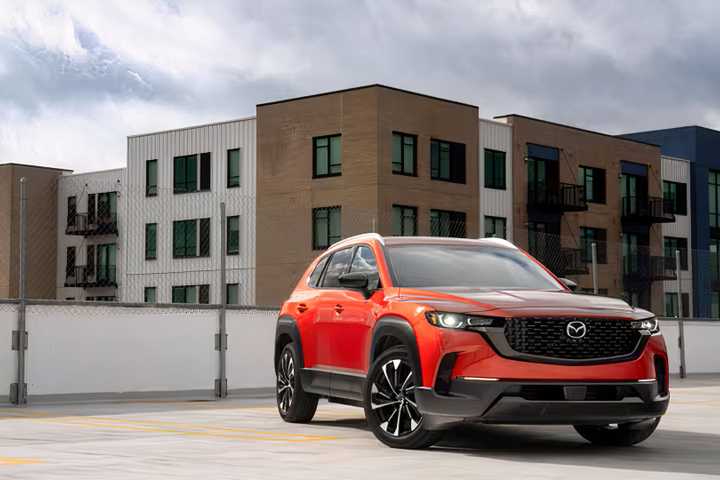
The 2026 Mazda CX-50 Hybrid Preferred trim carries a base price of $36,245, including destination fees. That price represents a premium of roughly $3,000 over the equivalent gas-powered CX-50. For that extra upfront investment, the CX-50 Hybrid delivers an EPA-estimated rating of 38 MPG combined along with a total range of 551 miles.
The non-hybrid gas CX-50 gets between 24 and 28 MPG combined, depending on the chosen trim and drivetrain. Taking the top gas figure of 28 MPG combined, the hybrid model saves about 113 gallons of fuel each year over a 12,000-mile driving distance. Comparing it against the base gas model’s 26 MPG combined rating increases those savings to approximately 145 gallons per year.
How It Optimizes Fuel Costs
2026 Mazda CX-50 accelerating off-roadMazda
Calculations using the national average gas price of $4.10 per gallon illustrate the exact financial payback timeline. Saving 145 gallons of gas annually yields roughly $595 in annual fuel savings. Dividing the $3,000 hybrid increase by $595 in annual savings results in a break-even point of roughly five years. If the comparison uses the 28 MPG gas baseline, annual savings drop to $463, extending the payback window to 6.5 years. Drivers covering only 10,000 miles per year or encountering lower fuel prices face an even longer recovery timeline of 7 to 8 years.
Cross-shopping competitor crossover models highlight key value differences in the market. The Toyota RAV4 Hybrid charges a modest $1,600 premium over its standard gas counterpart while delivering 39 to 40 MPG combined. Using an identical structure, the RAV4 Hybrid recovers its upfront premium in under three years. Conversely, the Honda CR-V Hybrid demands a steep $4,250 premium over its standard gas trim. The CR-V Hybrid achieves 37 to 40 MPG combined depending on the drivetrain, stretching its payback timeline past seven years.
2025 Mazda CX-50 Hybrid front 3/4 shotWilliam Clavey | TopSpeed
Real-world driving conditions further complicate these calculations. Reviewers report fuel economy between 34 MPG and 40 MPG under normal driving conditions. Cold weather testing exposes a sharp decline in efficiency, with fuel economy falling as low as 24.2 MPG in extreme freezing conditions. Northern buyers operating in winter environments face significantly lower fuel savings, pushing the actual break-even mark beyond eight years of ownership.
The Mazda CX-50 Hybrid earns its spot as the enthusiast choice for superior chassis tuning and premium interior feel. Buyers seeking the ultimate spreadsheet victory find faster financial returns in the Toyota RAV4 Hybrid. The CX-50 Hybrid balances driving pleasure with respectable efficiency gains, provided buyers plan to hold the vehicle past the five-year mark.
Additional Ownership Cost Differences
Mazda-CX-50 Polymetal-Gray front 3/4 shotMazda
The CX-50 Hybrid’s overall five-year ownership costs come in at $40,493 for the base Preferred trim. Included in this figure is $4,092 on insurance, $4,918 on maintenance, $754 on repairs, $2,342 on taxes and fees, $7,302 on financing, $14,374 on depreciation, and $6,711 on fuel.
The base Preferred model increases this figure to $41,306. This includes $4,092 on insurance, $4,827 on maintenance, $754 on repairs, $2,148 on taxes and fees, $6,862 on financing, $12,820 on depreciation, and $9,803 on fuel.
CarEdge reveals the average five-year ownership costs for the entire CX-50 range to be $42,429. These costs include $14,944 on depreciation, $10,465 on insurance, $8,250 on fuel, $6,241 on financing, and $2,529 on maintenance.
Mazda’s pricing for its CX-50 Hybrid falls in line with industry standards. Starting at $34,750, it sits in a competitive position, but is fairly more expensive than the $32,400 equivalent naturally aspirated 2.5-liter configuration. Interestingly, it costs a bit less than the flagship turbocharged range. The base derivative features electrically adjustable driver’s seat, front seat heating, and combination leatherette upholstery. The Premium trim includes a panoramic sunroof and a 12-speaker Bose audio system.
Premium Plus trim comes standard with a heads-up Active Driving Display and a host of more aspirational exterior and interior trimmings. In terms of standard features, the Premium and Premium Plus are pretty much identical, so you can consider the latter to essentially be a $2,650 visual package.
The CX-50’s Ownership Experience Is A Mixed Bag
2026 Mazda CX-50 accelerating off-roadMazda
According to J.D. Power, the Mazda CX-50 is a highly accomplished semi-premium hybrid SUV offering, benefiting from a 78/100 consumer-verified overall score. This consists of 72/100 for quality and reliability, 78/100 for the driving experience, 83/100 for resale, and 83/100 for the dealership experience. iSeeCars doesn’t issue the model with a comprehensive rating system, but it does award it 8.2/10 for retained value and 10/10 for safety.
The 2026 Mazda CX-50 Hybrid earns high praise across consumer review platforms, maintaining a strong average rating of 4.5 out of 5 stars. Owners and test drivers highlight the vehicle’s dynamic handling, elevated cabin materials, and striking exterior styling as primary selling points. Standard all-wheel drive, supportive front seats, and an intuitive interior layout featuring physical climate controls add everyday usability. Combining Mazda’s sharp steering feel and upscale design with Toyota’s proven hybrid setup allows the crossover to offer responsive driving dynamics alongside serious real-world efficiency.
A Balanced Set Of Engine Options
Overhead shot of a 2026 Mazda CX-50’s engineMazda
The Mazda CX-50 Hybrid employs Toyota’s HEV drivetrain, which consists of a naturally aspirated 2.5-liter four-cylinder and three permanent-magnet motors that produce a combined 219 horsepower to all four wheels using a direct-drive eCVT system. Because this is a Toyota drivetrain, Mazda doesn’t disclose a combined torque output, but it indicates that the ICE generates 163 pound-feet. According to Toyota’s specifications, we know that the ICE generates 176 horsepower without any electrical assistance.
Mazda positions the three electric motors along the front and rear axles. The front unit generates 118 hp and 149 lb-ft, while the rear section produces 54 hp and 89 lb-ft. Mazda doesn’t supply an official 0 to 60 MPH time or top speed figure. According to the EPA, the Mazda CX-50 Hybrid will return 39/37/38 MPG on the city/highway/combined cycle, while covering 551 miles on a single tank of gas, holding a 14.5-gallon capacity.
2026 Mazda CX-50 towingMazda
The non-hybrid Mazda CX-50 lineup uses two variations of a 2.5-liter four-cylinder engine, both paired with a Skyactiv-Drive six-speed automatic transmission and standard i-Activ all-wheel drive. The base powertrain features a naturally aspirated Skyactiv-G 2.5-liter engine that produces 187 hp and 185 lb-ft of torque. Drivers seeking more output can opt for the Skyactiv-G 2.5 Turbo engine, which utilizes a twin-scroll turbocharger to deliver up to 256 hp and 320 lb-ft of torque when running on 93-octane premium fuel. Using 87-octane regular gasoline lowers those output figures slightly to 227 hp and 310 lb-ft of torque.
Fuel efficiency estimates vary depending on the chosen powertrain. Naturally aspirated 2.5 S models achieve EPA ratings of 24/30/26 MPG. The turbocharged models sacrifice a small amount of efficiency for performance, earning EPA estimates of 23/29/25 MPG. Both non-hybrid engine options utilize a 15.9-gallon fuel tank and provide towing capacities ranging from 2,000 pounds for base models up to 3,500 pounds for turbo variants.










No Comments