
The Forgotten Swedish Two-Stroke That Wrote The Dirt Bike Blueprint 13 Years Before Yamaha
For decades, the origin of the modern lightweight dual-sport has largely been traced to the wave of Japanese trail bikes that arrived in the late 1960s, with Yamaha’s DT-1 often receiving much of the credit for defining the formula.

However, the concept had already taken shape more than a decade earlier under very different circumstances. Rather than emerging from a corporate plan to conquer the off-road market, it was born from an unusual Swedish licensing law that encouraged engineers to build an exceptionally light motorcycle, inadvertently laying the foundations for a new generation of dirt bikes.
A Swedish Law Accidentally Created A New Kind Of Motorcycle
In the mid 1950s, Sweden introduced a licensing rule that allowed 16-year-olds to ride motorcycles weighing less than 75 kg (165 lbs) without meeting the requirements for larger machines. Rather than treating the regulation as a minor legal curiosity, manufacturers recognized an opportunity to reach an entirely new generation of riders.

The challenge was significant, because staying below the weight limit demanded careful engineering rather than simply removing equipment from existing models. Husqvarna embraced the idea from the outset, developing an all-new motorcycle around the regulations instead of adapting one of its conventional road bikes.
By designing every major component with weight reduction in mind, the company produced a purpose-built lightweight platform that satisfied the law while offering performance and durability. That approach ultimately proved far more influential than anyone could have predicted, creating the foundation for one of motorcycling’s most significant off-road success stories.
The Husqvarna Silverpilen Was Built Around Weight Above Everything Else

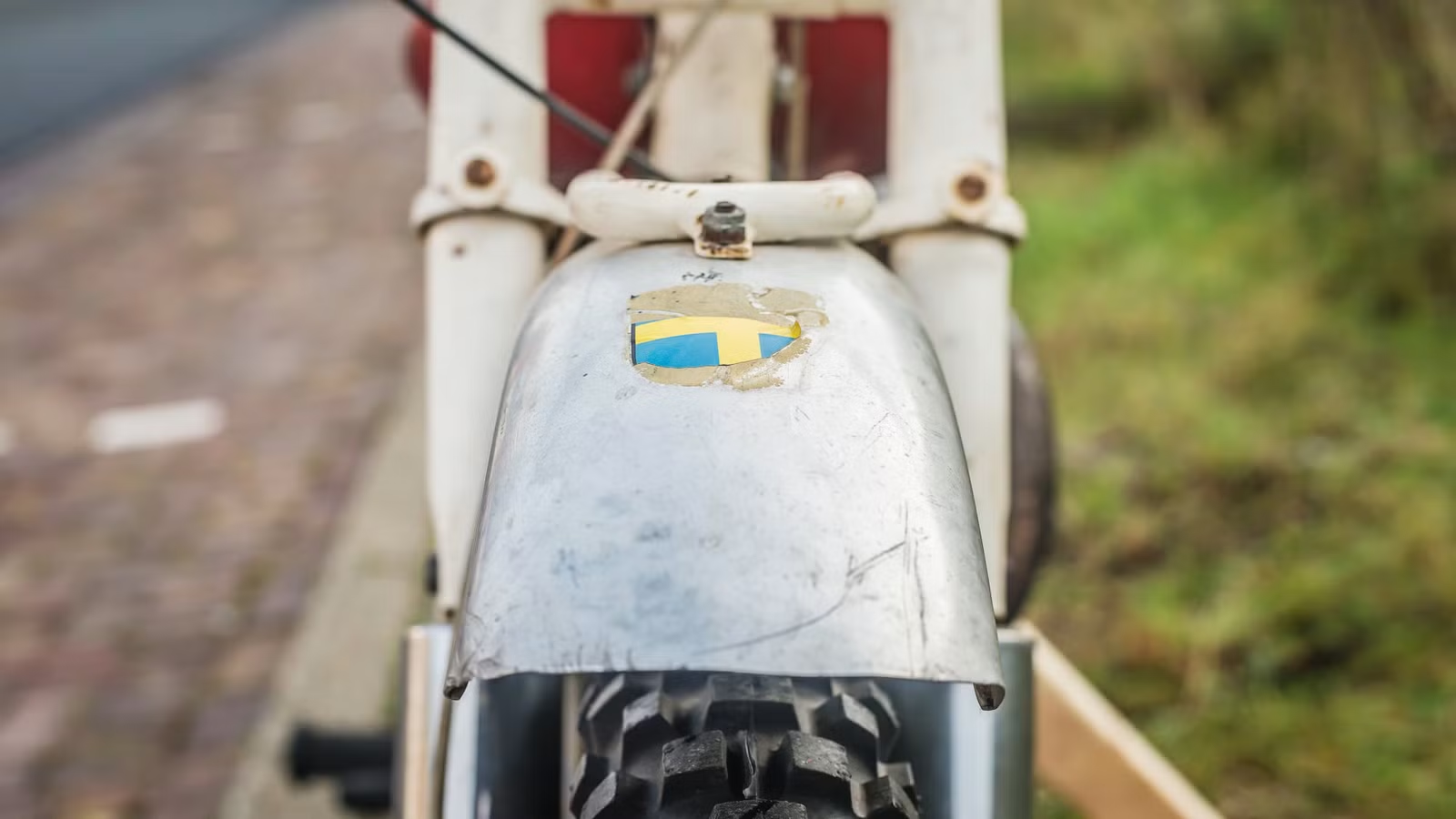
Introduced in 1955, the Husqvarna 175-cc Silverpilen, meaning “Silver Arrow,” was engineered with a singular objective: achieve the lowest possible weight without compromising everyday usability. The finished motorcycle tipped the scales at just under 75 kg (165 lbs), pairing a compact 175-cc two-stroke single-cylinder engine with a simple three-speed gearbox.
Depending on the production year, the engine produced between 9 and 9.5 bhp at around 6,000 rpm, modest figures that were more than adequate thanks to the bike’s exceptionally low mass. Despite its minimalist construction, the Silverpilen was not intended as a competition machine.
It was sold as a fully road legal motorcycle capable of reaching approximately 62 mph, making it practical for commuting, rural transport and weekend riding alike. Its efficiency came not from outright power, but from an obsessive focus on reducing unnecessary weight.

Achieving such a low curb weight required far more than keeping the motorcycle small. Husqvarna selected high strength chromoly steel for the frame, allowing it to remain both light and durable without compromising structural rigidity. At a time when many motorcycles relied on heavier conventional steel construction, this represented a significant engineering advantage.
The company was equally ambitious with the engine, fitting an aluminum cylinder featuring a chrome-plated bore. During the mid 1950s, this was an unusually sophisticated solution that improved heat dissipation while reducing weight compared with traditional cast iron components.
The chrome bore also offered excellent wear resistance, helping maintain performance over long periods of use. Together, these lightweight materials demonstrated that the motorcycle was not merely built to satisfy a legal requirement but was engineered using advanced technology that anticipated many of the design priorities seen on later high-performance off-road machines.
Teenagers Turned A Road Bike Into An Off Road Weapon

Although the Silverpilen was developed as a practical road motorcycle, its lightweight construction made it especially appealing to young Swedish riders looking for affordable competition machines. From the factory, it arrived equipped for everyday use, including road tires, lighting equipment and a horn, allowing it to meet normal street requirements.
However, many owners quickly recognized that the motorcycle’s greatest potential was away from paved roads. Teenagers began stripping away unnecessary components, fitting more suitable tires and modifying their machines for local scrambles and early motocross events. After all, we were all teenagers at one stage and would have done the same!
These unofficial conversions transformed a commuter motorcycle into a capable off-road racer, proving that its basic design had qualities far beyond its original purpose. The growing popularity of these modified machines also caught Husqvarna’s attention, helping influence the company’s future approach to competition motorcycles.
The Factory Used The Same Formula To Build Winning Race Bikes

The lessons learned from modified Silverpilens eventually influenced Husqvarna’s official competition program. Engineers and tuners took the lightweight concept further by increasing engine capacity to around 250-cc, creating far more powerful factory machines designed specifically for motocross competition.
However, rather than abandoning the original design philosophy, Husqvarna retained several key elements that had already proven effective. Most notably, the company’s race bikes continued using the Silverpilen’s three-speed gearbox, even after significant engine modifications. This decision highlighted that the original transmission was not simply a cost-saving measure, but a well-matched component for the broad power delivery required in loose terrain. By refining and developing the existing formula instead of starting from scratch, Husqvarna transformed the ideas behind a small road motorcycle into a foundation for serious international racing success.
This Lightweight Philosophy Helped Build Husqvarna’s Racing Empire

The Silverpilen’s greatest contribution was not simply the motorcycle itself, but the engineering philosophy it introduced. Husqvarna carried the principles of low weight, compact two-stroke performance and simplicity into its factory motocross program, where those characteristics became increasingly valuable as competition intensified.
The company’s racing machines continued to prioritize agility and efficiency rather than relying purely on engine power, creating motorcycles that were easier to control over demanding terrain. According to Husqvarna’s own historical accounts, this approach helped establish the foundation for decades of off-road success.
The manufacturer would eventually achieve 14 Motocross World Championships and 24 Enduro European Championship titles, cementing its reputation as one of the most successful names in dirt bike racing. While the Silverpilen was not a factory racer itself, its design philosophy became closely linked with the competition machines that followed.
It Quietly Reached Thousands Of Riders Before The Japanese Revolution

The Silverpilen was not an obscure experimental machine built in limited numbers. Husqvarna produced approximately 11,300 examples between 1955 and 1965, allowing thousands of Swedish riders to experience its lightweight approach firsthand.
Years later, Yamaha’s DT-1 would introduce a similar lightweight two-stroke off-road concept to a much larger global audience and receive widespread recognition for popularizing the category. However, the Silverpilen had already demonstrated many of the same principles, including a compact engine, low weight and adaptability for mixed road and dirt riding.
Rather than claiming it created every element of the modern dirt bike alone, its importance lies in proving that this formula existed much earlier than many enthusiasts realize.
Why The Silverpilen Never Received The Recognition It Deserved
Despite its importance within Husqvarna’s history, the Silverpilen remained largely unknown outside Scandinavia for decades. Its influence developed through Swedish riders, local competition and the company’s own racing programs rather than through widespread international sales or global marketing campaigns.
As Japanese manufacturers expanded aggressively into overseas markets during the 1970s, their motorcycles reached far larger audiences and became associated with creating the lightweight dual-sport category. This global exposure overshadowed earlier European developments that had established many similar ideas.
However, Husqvarna’s own historical accounts and the company’s later competition achievements provide a strong argument that the Silverpilen played a crucial role in shaping the brand’s off-road philosophy.
Sources: Husqvarna, Motocrossactionmag, Silverpilen.net

Related posts


Latest Post


No Comments