
2027 BMW F 450 GS: First Look
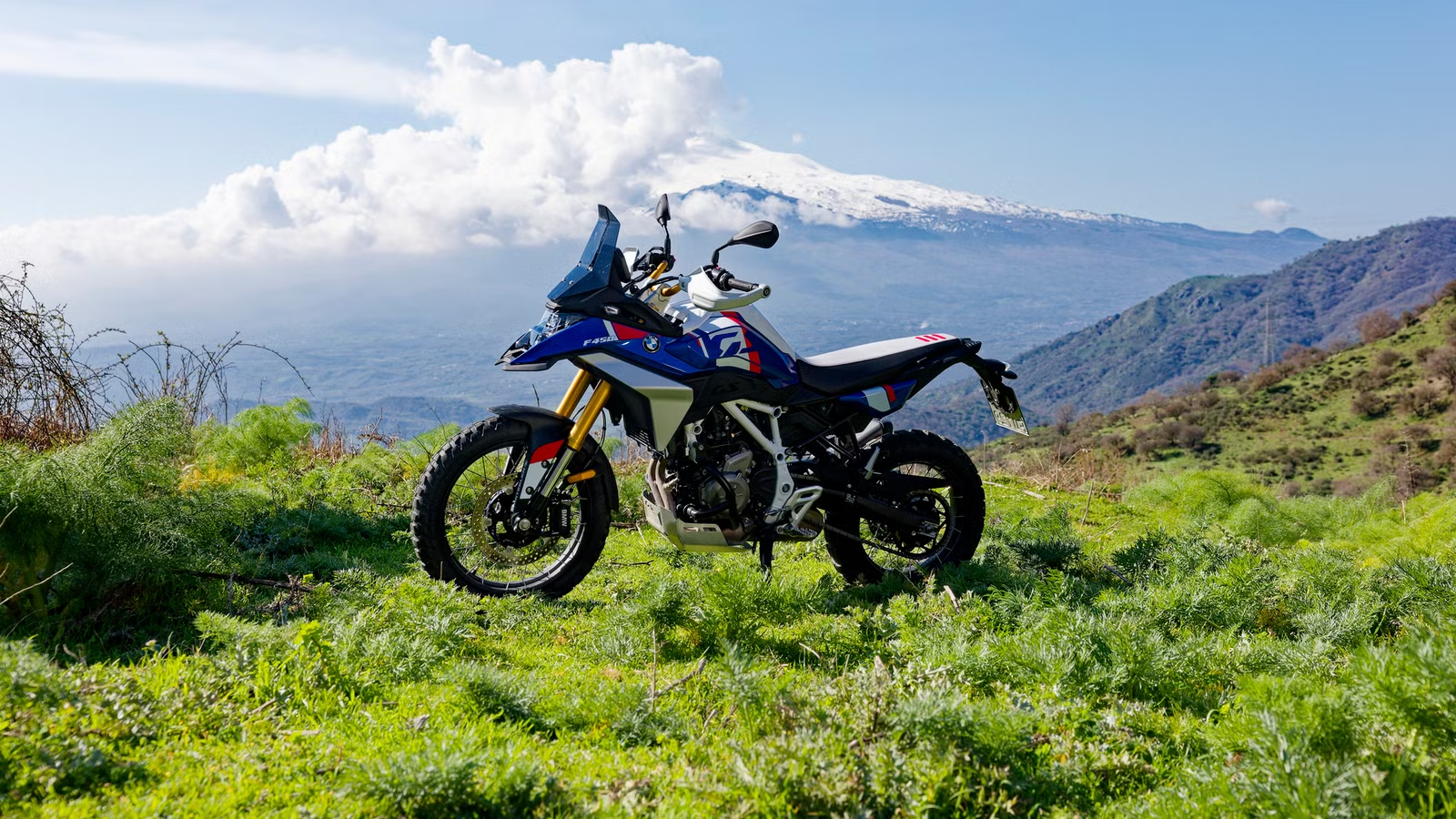
Lightweight adventure bikes are all the rage these days, and BMW is making a more serious push with its newest ADV offering: the 2027 BMW F 450 GS. Unveiled as a production model at EICMA 2025, the F 450 GS is a dynamic all-rounder sub-500cc adventure bike expected to reach BMW dealerships in the US late this year or early next year. While BMW hasn’t revealed the North American MSRP yet, here’s how this new adventure bike fills a gap in the sub-500cc class.
Lightweight Premium ADV With A Playful Character

The sub-500cc ADV segment has a gap: a lack of a premium all-rounder. That’s exactly what the BMW F 450 GS is positioned as. According to Markus Flasch, CEO of BMW Motorrad, the F 450 GS is a genuine GS in the A2 class, where most sub-500 cc ADVs fall. The new GS is powered by a 48-horsepower parallel-twin, bringing proven GS technology and iconic design.

BMW says the new GS strikes a balance between agility and stability and should be impressive both on and off the road, serving as a versatile all-rounder for riders seeking a dynamic, premium riding experience. Compared to the older G 310 GS, the new GS is much more modern, packed with cutting-edge features, and delivers as much performance as A2 homologation allows. For the US, BMW will only offer the top-tier GS Trophy variant.
A New Parallel-Twin Engine Gives The F 450 GS A Different Character

BMW says the F 450 GS combines classic GS spirit with modern accessible performance, and that’s largely down to its newly developed powerplant: a 420cc parallel-twin engine. The engine is rated at 48 horsepower at 8,750 RPM and 32 pound-feet of torque at 4,750 RPM. In addition, it uses a unique 135-degree crankpin and a single balance shaft, which are said to offer plenty of character without compromising smoothness. BMW cites an incredibly economical 60 mpg, resulting in a 217-mile theoretical fuel range out of the 3.6-gallon fuel tank.
Advanced Centrifugal Clutch Is The Highlight Here

The parallel-twin is mated to a 6-speed transmission with Shift Assist Pro, but what makes the F 450 GS unique in the segment is the BMW Easy Ride Clutch (ERC), standard on the GS Trophy variant. It’s a further development of a centrifugal clutch, completely eliminating the need to manually operate the clutch lever while riding. The bike still retains a traditional clutch lever, letting you take control when required. In this sub-500cc space, no other motorcycle offers this.
Newly Developed Chassis And Underpinnings Complement The Engine

The F 450 GS uses a newly developed lattice-tube frame that employs the engine as a stressed member, and BMW says its short wheelbase should offer agile, playful handling. Suspension duties are handled by a 43mm KYB inverted fork, adjustable for rebound and compression damping on up-spec Sport and GS Trophy models. In the rear, a non-link-type KYB monoshock featuring spring-preload and rebound damping adjustment regardless of trim. The suspension setup offers 7.1 inches of wheel travel at either end, which is fairly competitive within the category.

The GS Trophy edition also brings 19/17-inch tubeless cross-spoke wheels. And braking comes from a Brembo 4-pot caliper working on a 310mm floating disc up front and a 1-pot floating caliper gripping a 240mm rear disc. Combined, the underpinnings setup is said to give the bike a balanced power-to-torque ratio, and the bike tips the scales at 390 pounds ready to ride.
BMW Brings Versatile Ergonomics And Serious Tech To The Baby GS

The BMW F 450 GS is also designed to suit a variety of motorcyclists, with 3 seat options: a 33.3-inch flat seat as standard, plus a low seat (32.7-inch) and a high Rallye seat (34-inch). The tapered aluminum handlebar can be raised by 20mm with the available riders, while the hand and foot levers are adjustable. The GS Trophy edition also features wider enduro pegs as standard, with removable rubber grips for better off-road grip. Finally, wind protection is handled by a short Rallye windscreen, with a taller one on offer.
All The Rider Aids You’d Need Are There

The F 450 GS is designed along the lines of its larger siblings, and it also brings some of the GS-proven tech, including the iconic X daytime running lights and a 6.5-inch TFT display. Four riding modes, including Rain, Road, Enduro, and Enduro Pro, let you dial in the riding experience. And rider aids include ABS Pro, Dynamic Brake Control, Dynamic Traction Control (DTC), and engine drag torque control (MSR). BMW also offers plenty of optional extras, including an Akrapovič muffler, protection parts, and luggage options.
The F 450 GS Is The Missing Puzzle Piece In The Segment

According to Astrid Neudecker, Product Manager, BMW F 450 GS, the new Beemer ADV is designed for a wide range of motorcyclists looking for lightweight versatility and riding pleasure without compromising on cutting-edge technology. And that’s what makes the F 450 GS unique in the segment. It’s positioned as a 50-50 adventure bike that balances both on- and off-road abilities, so, in theory, it can handle whatever you throw at it.
Its primary rivals include the parallel-twin adventure tourers from Japan, like the Kawasaki KLE 500 and the Honda NX 500. Both are more on-road focused due to their chassis and engine character, while also lacking similar premium-level electronic features. Meanwhile, the KTM 390 Adventure R and Royal Enfield Himalayan 450 are capable off-roaders but their single-cylinder powerplants won’t deliver the same kind of smoothness associated with parallel-twin engines. The CFMoto Ibex 450 is the most competent rival when comparing specification sheets and will be more affordable.

BMW offers four variants of the F 450 GS in other markets, but the United States will only get the top-spec F 450 GS Trophy edition, at least initially. No pricing information has been made available for North American markets yet, though UK and European pricing suggests it will be on the pricier end of the spectrum when it arrives. This variant brings the iconic Racing Blue Metallic Paint, wider off-road footpegs, hand guards, engine guard, Gear Shift Assist Pro, Easy Ride Clutch (ERC), sports suspension, and cross-spoke wheels.
Expect the F 450 GS to arrive at your nearest BMW dealer later this year or earlier in 2027. Look to this space for more updates on the F 450 GS.
2027 F 450 GS First Look Photo Gallery:
2027 BMW F 450 GS Specifications:
Engine
|
Type |
Water-cooled 420cc two-cylinder, four-stroke in-line (parallel-twin), transversely mounted, with 135-degree crankpin offset and counterbalance shaft |
|
Displacement |
420cc |
|
Bore x stroke |
72mm x 51.6mm |
|
Maximum power |
48 horsepower @ 8,750 rpm (claimed; 35 kW) |
|
Maximum torque |
32 lb-ft @ 6,750 rpm (claimed; 43 Nm) |
|
Compression ratio |
13.0:1 |
|
Valvetrain |
Two overhead camshafts (DOHC), chain-driven; 4 valves per cylinder operated by rocker followers; 29mm intake / 24.3mm exhaust valves |
|
Fueling |
Electronic intake manifold injection, BMS-Z engine management w/ throttle-by-wire (E-gas); 38mm throttle valve; premium unleaded 95 RON / 90 AKI |
|
Exhaust |
Right-side stainless steel system w/ two catalytic converters; closed-loop 3-way catalytic converter, EU5+ compliant |
|
Cooling |
Liquid |
|
Transmission |
6-speed claw-shift constant-mesh gearbox integrated in transmission housing; Gear Shift Assist Pro (GS Trophy) |
|
Clutch |
Multi-disc wet clutch w/ slipper function, cable-actuated; Easy Ride Clutch (ERC) centrifugal engagement standard on GS Trophy, clutch lever retained |
|
Primary drive |
Spur gear, 2.025 ratio |
|
Final drive |
X-ring chain 520 14/48, 3.43 ratio; left-side secondary drive |
Chassis
|
Frame |
Welded steel tubular space frame w/ integrated forged parts and steel tube sub-frame; engine centrally mounted as a load-bearing element; White main frame on GS Trophy |
|
Front suspension; travel |
Rebound- and compression-adjustable KYB 43mm inverted telescopic fork, gold-anodized tubes (Sport Suspension, GS Trophy); 7.1 inches |
|
Rear suspension; travel |
Spring-preload- and rebound-adjustable KYB central shock w/ travel-dependent damping (WAD), directly linked to hollow-cast aluminum twin-sided swingarm; 7.1 inches |
|
Wheels |
Aluminum cross-spoked, tubeless (GS Trophy); forged wheels not offered in the U.S. |
|
Front wheel |
19 x 2.5 |
|
Rear wheel |
17 x 3.5 |
|
Tires |
Not Provided By Manufacturer; tubeless, type approval permits all common tire types including enduro tires |
|
Front tire |
100/90-19 |
|
Rear tire |
130/80-17 |
|
Front brake |
310mm single floating disc w/ Brembo 4-piston monobloc fixed caliper |
|
Rear brake |
240mm single disc w/ 1-piston floating caliper |
|
ABS |
Standard; BMW Motorrad ABS Pro (lean-angle optimized) |
|
Electronic rider aids |
Dynamic Traction Control (disengageable), Engine Drag Torque control (MSR), Dynamic Brake Control (DBC), front wheel lift-off detection; Rain, Road, and Enduro ride modes, plus Enduro Pro via Riding Modes Pro (GS Trophy) |
Dimensions and Capacities
|
Wheelbase |
57.7 inches |
|
Rake |
28.1 degrees |
|
Trail |
4.5 inches |
|
Seat height |
33.3 inches (unladen; standard two-piece seat). Accessory seats: 32.7 inches low, 34.0 inches high Rallye |
|
Ground clearance |
Not Provided By Manufacturer |
|
Lean angle |
Not Provided By Manufacturer |
|
Fuel capacity |
3.6 gallons usable (approx. 0.6 gallon reserve) |
|
Estimated fuel consumption |
61.9 mpg (WMTC) |
|
Curb weight |
392 pounds (DIN unladen, road ready, fully fueled) |
|
Warranty |
Up to 3 years or 36,000 miles, whichever comes first; BMW Motorrad USA new vehicle limited warranty |
|
Service interval |
Ultimate Care Break-In Service at 600 miles (max. 750 miles or 6 months from in-service date); subsequent interval Not Provided By Manufacturer |
|
Color |
Racing Blue Metallic w/ White main frame and Dime Silver Metallic matte side panels (Style GS Trophy, the sole U.S. configuration) |
Pricing and Warranty
|
Website |
bmwmotorcycles.com |
|
Warranty |
Up to 3 years or 36,000 miles, whichever comes first; BMW Motorrad USA new vehicle limited warranty |
|
Service interval |
Ultimate Care Break-In Service at 600 miles (max. 750 miles or 6 months from in-service date); subsequent interval Not Provided By Manufacturer |
|
Color |
Racing Blue Metallic w/ White main frame and Dime Silver Metallic matte side panels (Style GS Trophy, the sole U.S. configuration) |
|
Price |
TBA |
Source: BMW Motorrad

Related posts


Latest Post


No Comments