
When Dodge Built An R/T SUV But Forgot the Hemi
What happens when you take the modern retro styling trend of the 2000s, grab a platform originally intended for something else entirely, and then style it like a hot rod but without a V8 of any kind? Well, you get a good chunk of Chrysler Group’s domestic business strategy in the late 2000s. We tend to associate this era of Chrysler with the PT Cruiser, and given how polarizing it was, it was pretty hard not to. With that said, the PT Cruiser might’ve been the most egregious case of retro styling done poorly, but it was far from the only one. Dodge got in on the action as well, although hardly anyone remembers it today. Mostly because nearly all of them have rusted away or been crushed since then.
The Mopar Retro Styling Craze, Pretty, But Skin Deep

To call the situation at Chrysler and friends in the mid-to-late 2000s “weird” would be putting it lightly. Still in the midst of a partnership with Germany’s Daimler since 1998, it was clear by this point that it was the folks in Stuttgart who were in charge of the people in Detroit, not the other way around. A “merger of equals,” as it was called? Yeah, that was laughable even to the people who claimed it. Yet one of the few things that was going right for the brand at the time was the practice of taking a normal chassis and fitting a body on top that looked straight out of the ’30s and ’40s.
In truth, the idea predated DaimlerChrysler by a few years, in the minds of key decision-makers in Chrysler’s design department like Tom Gale and Bob Lutz. The first production car to result from this practice was the Plymouth Prowler, a V6-powered pseudo hot rodstyled like an early ‘30s Art Deco fever dream. While it certainly looked the part, the lack of a V8, sloppy handling, and a four-speed automatic transmission meant the Prowler underdelivered at every opportunity. The next retro Chrysler, the PT Cruiser, was originally supposed to be a Plymouth, inspired by the mid-’30s Chrysler/DeSoto Airflow. Well, even if the looks were on point, the reliability certainly wasn’t.
Other Chryslers borrowed from the same styling language, most notably the Art Deco Crossfire sports car and the woodie-inspired Pacifica SUV. None of them were exactly fantastic, although the Magnum at least had the courtesy of providing an SRT trim. Yet, there was at least one other, practically lost to history by this point.

A New Kind of Retro Styled SUV, With Jeep Bones

While the Prowler and PT Cruiser leaned heavily into the pre-war coupe and teardrop fender side of things, Dodge took an altogether different approach. Just look at the Magnum, directly influenced by 1950s “Lead Sled” hot rods that came into fashion in the immediate aftermath of World War II. In short, the retro idea was still there, but the era of inspiration was altogether different. Dodge’s unique brand of retro styling was harder, more aggressive, and rooted in an exciting era of American cars from right before the arrival of the muscle car.
Knowing that Dodge had already re-introduced the Charger by this stage, and was preparing to roll out the first new Challenger in generations, the brutish design language was a given. Yet what Dodge was missing from this lineup was an SUV with the same vision in mind. Of course, Chrysler Group was spoiled for choice when picking the underpinnings for such a vehicle. Sitting right under its noses was the unibody chassis of the second-generation Jeep Liberty. Dubbed the Cherokee outside North America, the Liberty’s optional part-time 4WD and heavy-duty live rear axle were tailor-made for the kind of four-wheeling and off-roading that Jeeps were known for. Whether it was any good at spending nearly all of its life on pavement was another matter entirely.
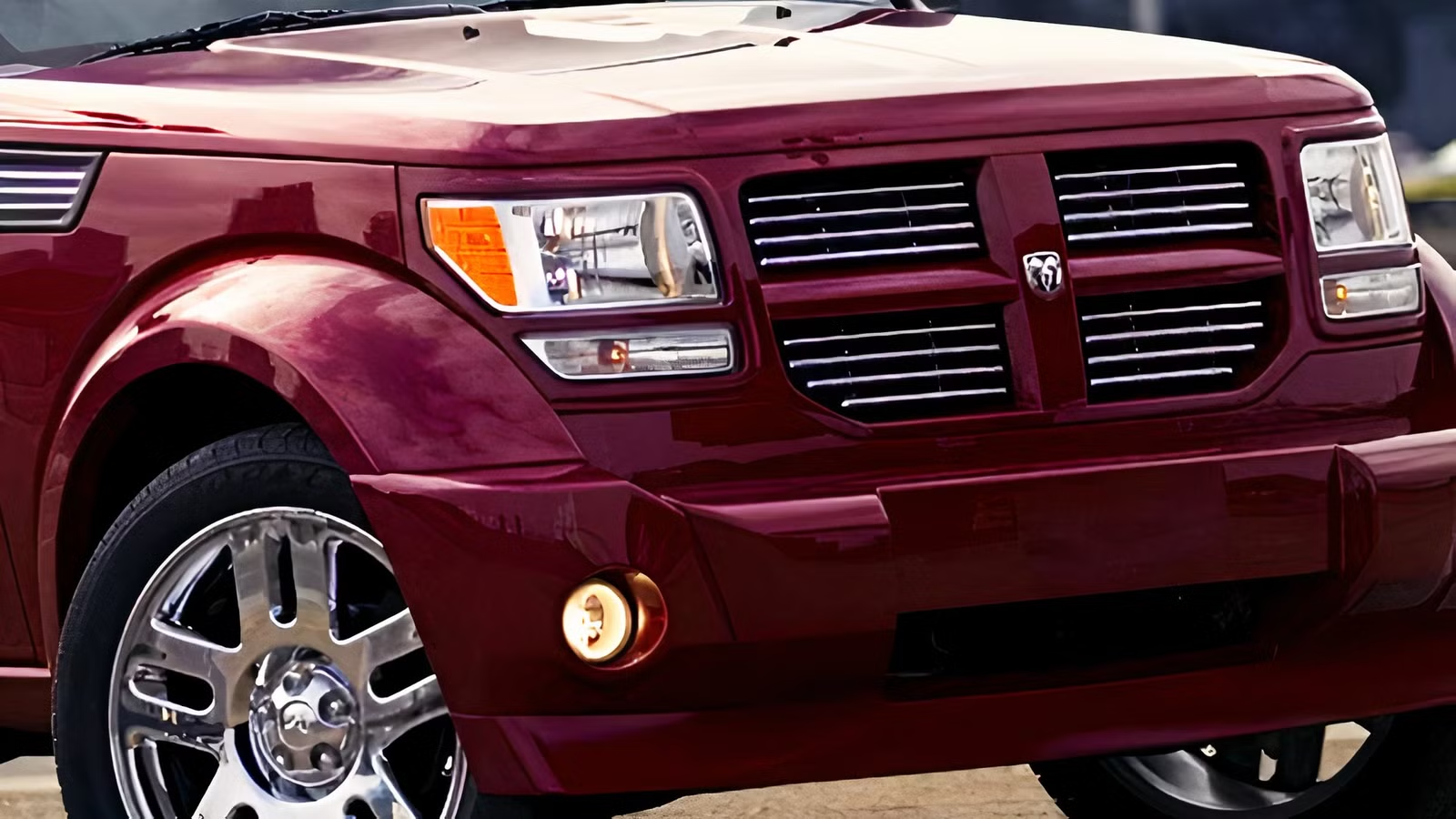
Yet Dodge soldiered ahead with these underpinnings, crafting a body with flared wheel arches, a slammed roofline, and a giant crosshair front grille in line with styling cues from other Dodges of the period like the Charger. To make it competent on the road, the wheelbase was lengthened, stiffer coil springs were fitted, as were beefier shocks and thicker anti-roll bars. Add chrome wheels and DRLs built into where the bumper meets the front wheel arches, and the result certainly looked like a retro-styled Dodge should. Still, whether it was any good at, well, being a reliable SUV was a question yet to be answered.
The Dodge Nitro: Looking the Part, But It’s All Skin-Deep

All this development and styling prowess culminated in 2007 with the unveiling of the Dodge Nitro R/T. Stout and muscular to the core, the Nitro certainly looked like it was itching for a drag race, even when parked. That was the thing, however, because it most certainly wasn’t. Like just about every sporty-looking new-retro car from Chrysler, the Nitro’s looks weren’t backed up by sporting credentials even slightly. Under that bulging hood, you’d expect nothing less than a 5.7-liter Hemi V8. It’s only natural, seeing how bold and assertive Dodge’s new SUV looked.
Alas, that couldn’t be further from the truth. All trims beneath the flagship R/T came standard with a 3.7-liter, single overhead-cam V6 making a measly 210 horsepower. How they managed to coax that few horsepower out of that many CCs is anyone’s guess. Seriously, there were four-cylinder Hondas and Toyotas around at the same time that made nearly as much power. The flagship R/T’s engine wasn’t much better: just 300 CCs bigger, still a V6, and churning out 260 hp paired to a five-speed automatic. Granted, towing capacity was a respectable 5,000 pounds with the optional Trailer Tow Prep Group package, and the totally flat “Load ‘N Go” rear cargo floor was pretty neat, but that’s about where the advantages ended.

Compared to other SUVs in its segment, like the Toyota RAV4 or Honda CR-V, the Nitro was woefully inadequate. Even worse, the Nitro was prone to electrical gremlins, poor build quality with cheap plastic body panels, and rust issues that took it out of commission years before the competition. In every way that mattered besides its looks, the Nitro was a profoundly underwhelming five-seat SUV. This was reflected in the sales data: Honda and Toyota outsold the Dodge Nitro by a factor of over four to one and over six to one, respectively, between 2006 and 2011, when the Nitro was discontinued. The Nitro continued into 2012 strictly for fleet use, and by 2026, seeing one of the nearly 196,000 Nitros sold is exceedingly rare. Put simply, most of them went to the crusher a decade ago.
A Hemi Would’ve Made the Nitro Great, and SEMA Proved It

It goes without saying, adding a 5.7-liter Hemi to the engine bay of a Nitro would’ve transformed it from a forgettable SUV into a real show-stopper. In fact, Dodge itself proved this nearly 20 years ago when it unveiled a one-off custom Hemi-swapped Nitro at the 2006 running of the annual SEMA Expo in Las Vegas. There, christened with chrome wheels and an even bigger bulge in the hood, Dodge showcased what the top-of-the-line Nitro should’ve been all along.
In a word, it was brilliant, and it’s hard to imagine a single Mopar enthusiast who would’ve disagreed with that sentiment. Hope was high at the time that Dodge might put it into production, as unlikely as that sounds. Yet, it was clear Dodge saw the Nitro’s market segment as being a RAV4 counterpart, a position it was woefully ill equipped to handle. Suffice it to say, a role as a legitimate Hemi-powered hot rod would’ve suited it far better. If only, but not to be.
Sources: Dodge, Chrysler Forum

Related posts





Latest Post


No Comments