
The Japanese Motorcycle That Captures Harley’s Spirit In A Different Way
Cruiser bikes perfectly capture the American spirit of motorcycling — and American manufacturers have long defined what that means. Yet Japan has never stopped trying to match, and occasionally beat, America’s finest cruisers. The results have ranged from fully liquid-cooled six-cylinder heavyweights to stripped-down factory choppers that give enthusiasts a ready-to-ride alternative to building one from scratch. One machine in particular has been doing exactly that for well over a decade: a thoroughly Japanese motorcycle that channels the soul of a Harley-Davidson chopper with a conviction few expected from the world’s largest bikemaker.
Bobbers Have Long Defined The Spirit Of Custom American Cruiser Bikes

Post World War II, custom American V-twin cruisers became ardent symbols of freedom, rebellion, and individuality. Back alleys and garages were packed with creative minds that transformed heavy V-twin machines from Harley and Indian into personalized bobbers and legendary long-fork choppers. Much of this work was done by returning veterans with mechanical skills and a relentless desire for nonconformity.
But Factory Choppers Have Always Been Rare

Later in the 1960s, there was a shift in the custom cruiser scene as bobbers evolved into radical choppers with stretched-out frames and extended forks. The focus of customization shifted entirely from a balance of form and function to a “loud” form only. The word “chopper” comes from the fact that the frame is literally chopped — the steering neck is cut and re-welded or replaced to create an extreme rake angle and stretch out the front end. Choppers achieved broader cultural penetration thanks to their starring roles on the big screen. The earliest and most iconic example is the 1969 film Easy Rider, which showcased a custom 1950s Harley-Davidson Hydra-Glide Panhead chopper with the now-famous American-flag-painted gas tank. Orange County Choppers later built custom choppers for celebrities, corporations, and charities, and documented the drama on the hit TV show American Chopper.

Japan eventually recognized the market potential of such bikes and launched its own custom-style cruiser offensive. Some of the results were genuinely surprising — none more so than a machine that commits fully to the chopper formula with an insane rake angle, a massive front wheel, and an extra-wide handlebar. And it comes from the world’s largest bikemaker.

The Honda Fury Captures Harley’s Spirit Distinctively
Price: $11,499

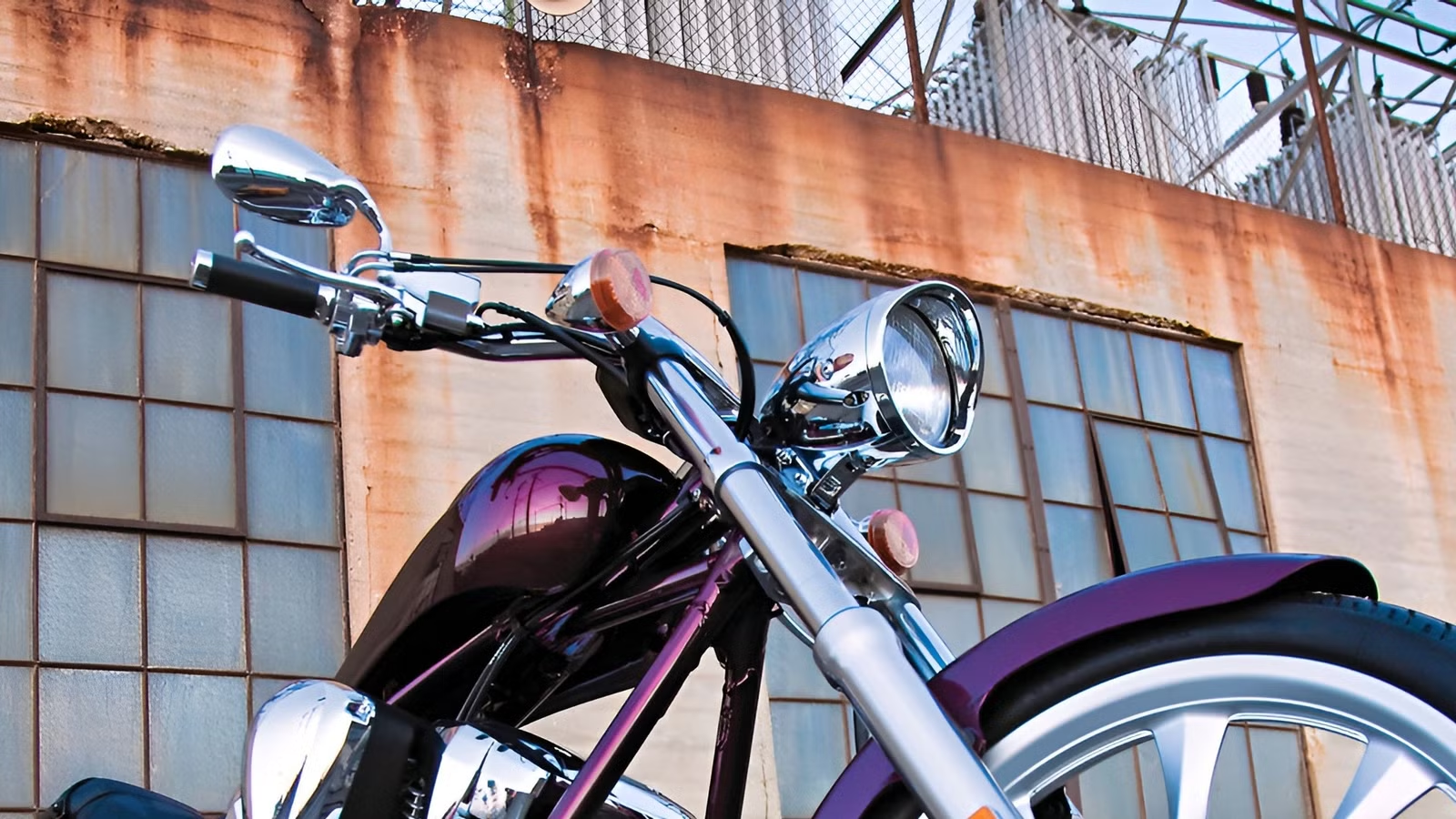
The Honda VT1300CX Fury arrived as a 2010 model, right at the peak of the chopper craze. Even as that craze cooled, Honda held its ground and kept the factory chopper in the lineup. Visually, the Fury is spot on, and no stock Harley or Indian can come close to matching its custom charisma. With virtually no updates across its lifespan, the Fury has quietly become a timeless classic.
This Is The Closest Thing To A Factory Chopper From Japan

The design is intriguingly both loud and minimal, thanks to clean lines and curvy body panels. The Honda Fury stays true to the chopper formula with a sweeping flyline, a raked-out front end, an elongated fuel tank, and a large exposed V-twin. Up front, a 21-inch wheel wears a slim tire; out back, the contrast is dramatic — a wide 200-section tire wraps an 18-inch wheel. Chrome is generously spread across the motorcycle, covering the two-into-two exhaust, the cylinder heads, and the distinctively elongated headlamp enclosure.

Throughout, Honda maintains a clean, minimal aesthetic with a subtly mounted radiator that preserves the bike’s lines while neatly routing wiring and hoses. The passenger seat and footpegs can be easily removed for a clean solo look. That makes the Fury something of a blank canvas — add a tall sissy bar, a colorful seat, complementary handlebar grips, and a flame decal kit on the tank, and you have a chopper that looks straight out of a custom shop rather than a factory floor.
Powered By A Dramatic-Looking But Highly Reliable V-Twin

The Fury is powered by the biggest V-twin engine in Honda’s arsenal. It shares its lineage with the humble Honda Shadow but was future-proofed with fuel injection and liquid cooling. Beyond those additions, it’s a straightforward engine with an old-school SOHC valvetrain running two intake and one exhaust valve per cylinder. The 1,312 cc mill carries a modest compression ratio of 9.2:1, making clear that outright performance is not the priority. Output stands at 57 horsepower at 4,250 RPM and 79 lb-ft of torque at 2,250 RPM. Power reaches the rear wheel through a five-speed manual gearbox and a low-maintenance shaft drive.
Complemented By Traditional Underpinnings With A “Chopper” Twist

The Honda Fury rides on a fairly conventional double-downtube frame that cradles the engine and gearbox — the same basic layout used in the smaller Shadow. But true to the chopper-building ethos, Honda raked the steering head to produce a stretched-out stance and an eye-popping 71-inch wheelbase. Super-long 45 mm telescopic front forks with 5.1 inches of travel reinforce the look, while the rear end keeps things simple with a hidden monoshock offering 3.7 inches of travel.

Braking is handled by a 336 mm disc with a two-piston floating caliper up front and a 296 mm disc with a single-piston caliper at the rear. The rake angle is 32 degrees with 3.6 inches of trail. Despite the wild proportions and the obvious limitations in tight urban settings, the Fury’s ergonomics are more accommodating than they look. The seat sits just 26.7 inches from the ground, and the ape-hanger handlebar keeps the rider upright, while forward-set footpegs complete the relaxed riding position.
Barebones Feature List Helps It Be Minimal And Timeless

The instrument cluster is minimal and analog, and the only electronic rider aid is dual-channel ABS. Otherwise, the Honda Fury is as barebones as it gets. Honda does, however, offer a concise accessories list to personalize the bike, including a windscreen, chrome grips, a passenger seat kit, and a passenger backrest. Given how long the Fury has been on sale with minimal changes, aftermarket support is strong — making further modifications straightforward.
The Fury Is About Following Your Heart

A common criticism about the Fury is that, despite the bold design, color options are very limited. Honda currently offers only one color option — Adventure Green — with no decals or badging. That’s actually a feature, not a flaw: the Fury is practically begging to be customized, just like the original choppers. Rather than arriving with a personality baked in at the factory, this bike invites you to create one yourself.
Honda even offers a range of optional accessories for those who’d rather not get their hands dirty, including a leather front pouch, sissy bar, passenger kit, custom grips, a windscreen, and more. As a long-running model, it also benefits from solid aftermarket support, and the decal-free finish makes it a ready canvas for a wild paint job. If you want to go deep on customization without sacrificing reliability, the Fury is one of the best starting points in the cruiser segment.
Source: Honda Powersports

Related posts
Latest Post


No Comments