
A Corvette Just Sold For More Than A Brand-New Bugatti, And Its Racing History Is Why
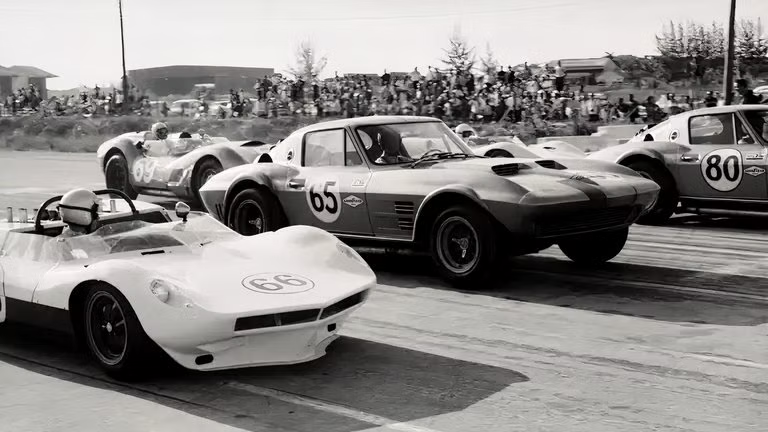
At Monterey Car Week 2026, a 1963 Chevrolet Corvette Grand Sport — chassis 003 — sold for $18,705,000 at RM Sotheby’s, setting a new all-time Corvette auction record and surpassing the price of any production Bugatti ever sold at auction. For context, a 2025 Bugatti Mistral fetched $8.8 million at the same event. The Grand Sport more than doubled the previous Corvette record of $7.705 million, set just last year by the Corvette SS Project XP-64.

The result places chassis 003 third on the all-time list of most expensive American cars sold at auction, behind only the 1935 Duesenberg SSJ ($22 million) and the 1964 Shelby Cobra Daytona Coupe ($42.905 million). That company alone tells you this is not a collector-car curiosity. It is one of the most significant American racing machines ever built — and the price reflects exactly that.
Why Only Five Grand Sports Exist, And Why That Changes Everything
Zora Arkus-Duntov conceived the Grand Sport to beat Carroll Shelby’s Cobra on track, operating in the grey area of GM’s official withdrawal from factory racing. Only five were ever completed before corporate pressure shut the program down. Three of those five were coupes, making chassis 003 one of just three examples in that body style — rarer by production count than the Ferrari 250 GTO (36 built) and the Shelby Cobra Daytona Coupe (six built).

Scarcity at this level is not merely a collector talking point. It is a practical matter of access. Historic motorsport’s most prestigious events — Goodwood Revival, the Rolex Monterey Motorsports Reunion — operate on invitation and eligibility. Owning one of three surviving Grand Sport coupes is effectively a standing ticket to those grids, competing alongside 250 GTOs and E-Types. The same logic applies to concours fields at Pebble Beach and Salon Privé. Being one-of-three in a field of historically significant machinery is a position that money alone cannot manufacture.
The Engineering That Made Chassis 003 A Genuine Cobra Eater
The Grand Sport shared almost nothing with the production Corvette beneath its skin. Where a standard 1963 model weighed roughly 3,200 lbs, the Grand Sport came in at approximately 1,900 lbs — a 1,300-lb reduction achieved through a purpose-built tubular chassis, ultra-light fiberglass bodywork with broad fenders sized to accept Halibrand magnesium knock-off wheels, plexiglass windows, and the elimination of every non-essential component the engineers could identify.
The engine fitted during chassis 003’s restoration is an all-aluminum 377-cubic-inch V8, built to original Grand Sport specification, producing more than 600 horsepower and 600 lb-ft of torque. Four large Weber carburetors sit on an aluminum cross-ram intake. A close-ratio four-speed manual sends power to the rear wheels. The resulting power-to-weight ratio was, by any era’s standards, extreme — former driver Delmo Johnson reportedly described a big-block version as capable of lifting its front wheels in all four gears.
A Racing Résumé Built By Foyt, Hall, And American Racing Royalty

Chassis 003’s competition record spans 1963 through 1965 and reads like a who’s-who of American motorsport. Dick Doane drove it to three SCCA class victories in 1963, and it was central to Mecom Racing’s campaign at the 1963 Bahamas Speed Week. At the 1964 12 Hours of Sebring, A.J. Foyt started 62nd and reportedly cut through approximately 50 cars in the opening lap alone. He and co-driver John Cannon finished second in class despite mechanical trouble and a blocked pit exit. The car returned to Sebring in 1965 and claimed third in class.
The driver roster over those years includes Jim Hall, Augie Pabst, Dick Thompson, John Cannon, and Delmo Johnson alongside Foyt — names that defined American sports car racing in the early 1960s. After its active campaign ended, chassis 003 went into long-term storage in 1969, a circumstance that proved fortunate for its preservation.
Originality And A 23-Year Restoration Sealed The Record Price

When a California collector acquired chassis 003 in 2003, the car retained its original tubular frame, fiberglass body, dashboard, and seats — a level of survival almost unheard of for a car that had been raced competitively at this level for three full seasons. Most period competitors were driven until they couldn’t be reassembled from a single set of parts.
The subsequent restoration consumed more than 4,000 labor hours over 23 years and reportedly approached $1 million in cost. Critically, the work was carried out to the car’s authentic 1964 Sebring specification — not a cosmetic refresh, but a mechanical reinstatement of a racing car to the condition it would have competed in. In the collector market, originality functions as authentication: cars are only original once, and for something this rare, provenance that can be traced through an unbroken physical record commands a premium that no replica or heavily modified example can approach. Superformance builds an officially licensed Grand Sport replica starting at $220,000 — roughly 1.2% of what chassis 003 just fetched. The gap between those two numbers is the price of the real thing.
The $18.705 million result is remarkable, but it is not irrational. Chassis 003 is a documented, original, race-winning example of one of the rarest American factory racing cars ever built, restored by someone who understood what they had. In the upper tier of historic motorsport collecting — where 250 GTOs and Daytona Coupes set the benchmark — the Grand Sport has now established itself as a peer. Someone paid hypercar money for a 63-year-old Corvette, and the car’s history makes a compelling case that they got fair value.
Source: RM Sotheby’s

Related posts





Latest Post


No Comments