
KX500 VS CR500: The Legendary Two-Strokes That Took Things Entirely Too Far
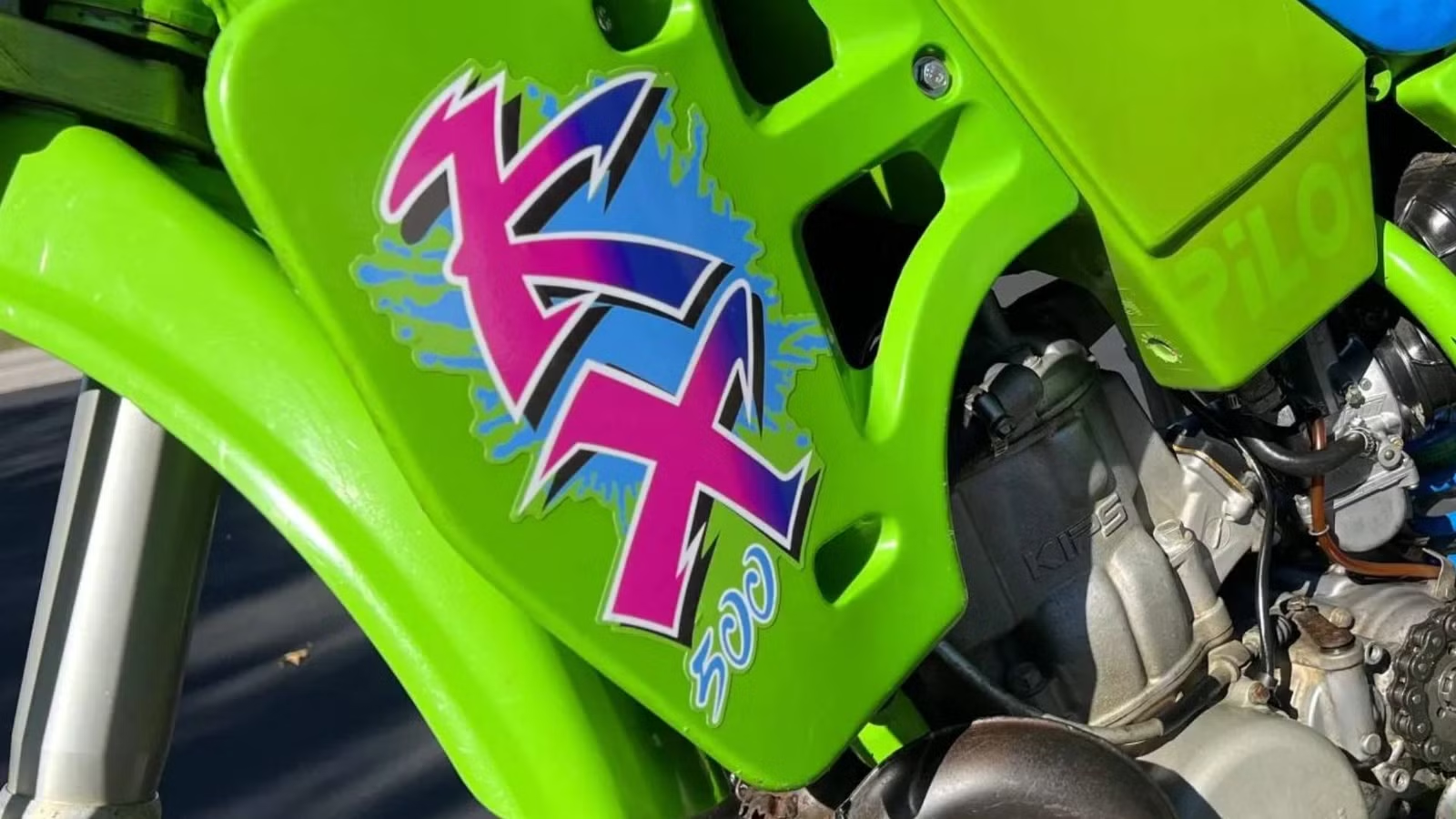
They say competition is good for more than just business. It fuels innovation, progress and growth. Competition is good, but having a rival is even better. Where would Coke be without Pepsi? The Ford Mustang without the Chevrolet Camaro biting at its heels? In the era of two-stroke 500cc motorcycles, two brands fought for decades over who could push their dirt bike and rider farther across wide open terrain. The Kawasaki KX500 and Honda CR500 were two dirt bikes that earned their legendary status through torque and victory until the world told them to stop.
The Kawasaki KX500, the Wild Card on Two Wheels

Born in 1983, the Kawasaki KX500 was a two-stroke motorcycle destined for motocross and desert racing victory, but legends aren’t built in a day. The bike’s origin story began with a dramatic review in the June 1983 issue of Dirt Bike Magazine, calling the KX500 “unrideable” and “violent.” Its first-generation air-cooled 499cc engine, while powerful, had problems with its combustion chamber, resulting in unpredictable performance.
Kawasaki engineers spent two years refining the KX500 until it debuted in 1985 with a new liquid-cooled 499cc engine, an improved chassis, and suspension. By 1987, the KX500 was in its third generation, and its two-stroke, single-cylinder engine was developing 64 horsepower and nearly 50 lb-ft of torque. It kept its weight down to around 220 pounds (dry) to achieve a top speed in excess of 90 mph using a five-speed transmission.
The KX500 dominated desert racing events, claiming its first victory at the 1986 National Hare and Hound, winning two events with Donnie Griewe. It followed up by winning the National MX Championship in 1989, 1990, and 1992. This was followed by an unbroken string of victories, winning every Desert National Championship from 1995 to 2001. It was also the go-to dirt bike for desert riders in the Baja 1000, earning riders victories from 1988 through 1996. When Kawasaki ended production on the KX500 in 2004, it was the last 500cc standing, outliving the CR500 by three years.

The Honda CR500, the Precision Animal

Like the KX500, the Honda CR500 was introduced in 1984 with an air-cooled two-stroke engine. When the bike officially entered production, the 1985 Honda CR500 featured a liquid-cooled 491cc two-stroke engine. The dirt bike immediately developed a reputation as a winner straight from the factory. It was aggressive and is still considered one of the most powerful 500cc motorcycles ever produced.
During its early years of production, 1985–1986, the CR500 was a racing contender for experienced riders, but a handful for casual riders. Honda had to de-tune the CR500 with longer silencers and restrictive porting to tame its 65 hp and 53.3 lb-ft of torque. In 1989, Honda introduced the second generation of the CR500 with refinements, including a redesigned engine to make kick-starting the bike easier for the rider.
The secret to the CR500’s performance was its large 38mm, flat-side carburetor, which kept the single-cylinder engine topped off with fuel to develop hard-hitting acceleration no matter the gear. An experienced rider could pop a wheelie on a Honda CR500 in fourth or even fifth gear. This lightning-quick acceleration resulted in the Honda CR500 dominating the American Motorcyclist Association (AMA) Motocross Championship in 1986, 1987, and 1988.
Its third and final generation lasted from 1993 until the end of its production life in 2001, partly due to the 500cc class of AMA Motocross having ended in 1993.
Wheel-to-Wheel Comparison of the KX500 and CR500

Arguably, comparing two legends with winning records leads to no contest because any debate will ultimately come down to each individual’s personal preference. Or it will whittle down to the most niche details and specifications that won’t achieve anything other than proving one number is larger than the other. This comparison is not intended to decide which dirt bike is better. It is meant to showcase their similarities in strength and what made these two-stroke motorcycles legends in their class, and memorable decades after being discontinued.
Both the Kawasaki KX500 and Honda CR500 started their production life in the early 1980s using air-cooled two-stroke engines. Both bikes immediately switched to liquid-cooled engines, although the KX500’s 499cc engine was slightly larger than the CR500’s 491cc engine. Both dirt bikes used a five-speed transmission and could reach a top speed of over 90 mph.
Comparing dry weight, the CR500 tips the scales at 222 pounds compared to the KX500’s 220 pounds. Noticeable differences appear in performance, with the Kawasaki KX500 remaining consistent over its production life, developing 63–66 hp. The Honda CR500 started strong with 65 hp, but steadily declined over the years until ending in 2001 with 56 hp. This was because Honda continuously tinkered with the CR500’s brutal performance to make it more user-friendly for casual riders.
The Rise and Fall of Two-Stroke Motorcycles

The heyday of two-stroke motorcycles was during the 1960s and 1970s. By the time the KX500 and CR500 were making headlines and earning podiums during the 1980s and 1990s, two-stroke engines were starting a steep decline in popularity.
Two-stroke engines are praised for their simplified design, lightweight construction, and great power-to-weight ratio. Three qualities that make them ideal for powering a chainsaw, a jet ski, or a motorcycle. Yet two-stroke motorcycles, while still available, are far from the mainstream. But why?
The simple answer is efficiency and emissions. A two-stroke engine requires oil to be mixed directly with gasoline to lubricate its internal components. The ratio varies depending on engine size, age, and manufacturer recommendations. Common fuel-to-oil ratios range from 50:1 to 25:1. That means two-stroke engines literally burn oil, and not efficiently.

Each time air and fuel are loaded into the combustion chamber, part of it leaks through the exhaust port. This can lead to smoky exhaust and oily residue. As emission standards improved during the 1990s and into the 2000s, two-stroke-powered motorcycles started to lose popularity in favor of four-stroke engines. Modern two-stroke engine motorcycles have incorporated innovations like direct injection and improved combustion chambers to help make them more environmentally friendly.
Modern Problems Crave Analog Solutions

What’s outdated one day can be considered nostalgic the next. Today, the Kawasaki KX500 and Honda CR500 are old enough to be classics. With their stacked racing pedigree and performance that still holds up against modern equivalents, these two-stroke dirt bikes have managed to hold their value.
Hagerty values a 1986 Kawasaki KX500 at $6,900 for a good-condition model, with prices going up to $14,200 for concours condition. It’s a similar story with the CR500. Hagerty values a 1986 Honda CR500 at $6,300 for good condition and up to $17,400 for pristine examples. On Bring a Trailer, a 1991 Kawasaki KX500 sold in 2023 for $13,500. For comparison, Kawasaki recently announced the new KX327, a 327cc two-stroke, fuel-injected motorcycle for 2027 with a retail price of $9,099.
Part of the reason why the KX500 and CR500 have stayed in the hearts and wallets of riders could be a growing fatigue with modern technology. As vehicles become more laden with advanced and expensive electronics, some buyers are retreating to more analog solutions. These are vehicles and motorcycles that owners can fix with hand tools rather than software. A few years ago, people were buying vinyl records. Now it’s vintage two-strokes.
Source: Bring a Trailer, Hagerty, Dirt Bike Magazine, Kawasaki, Honda

Related posts

Latest Post


No Comments