
The Motorcycle Built To Cross Hundreds Of Thousands Of Miles
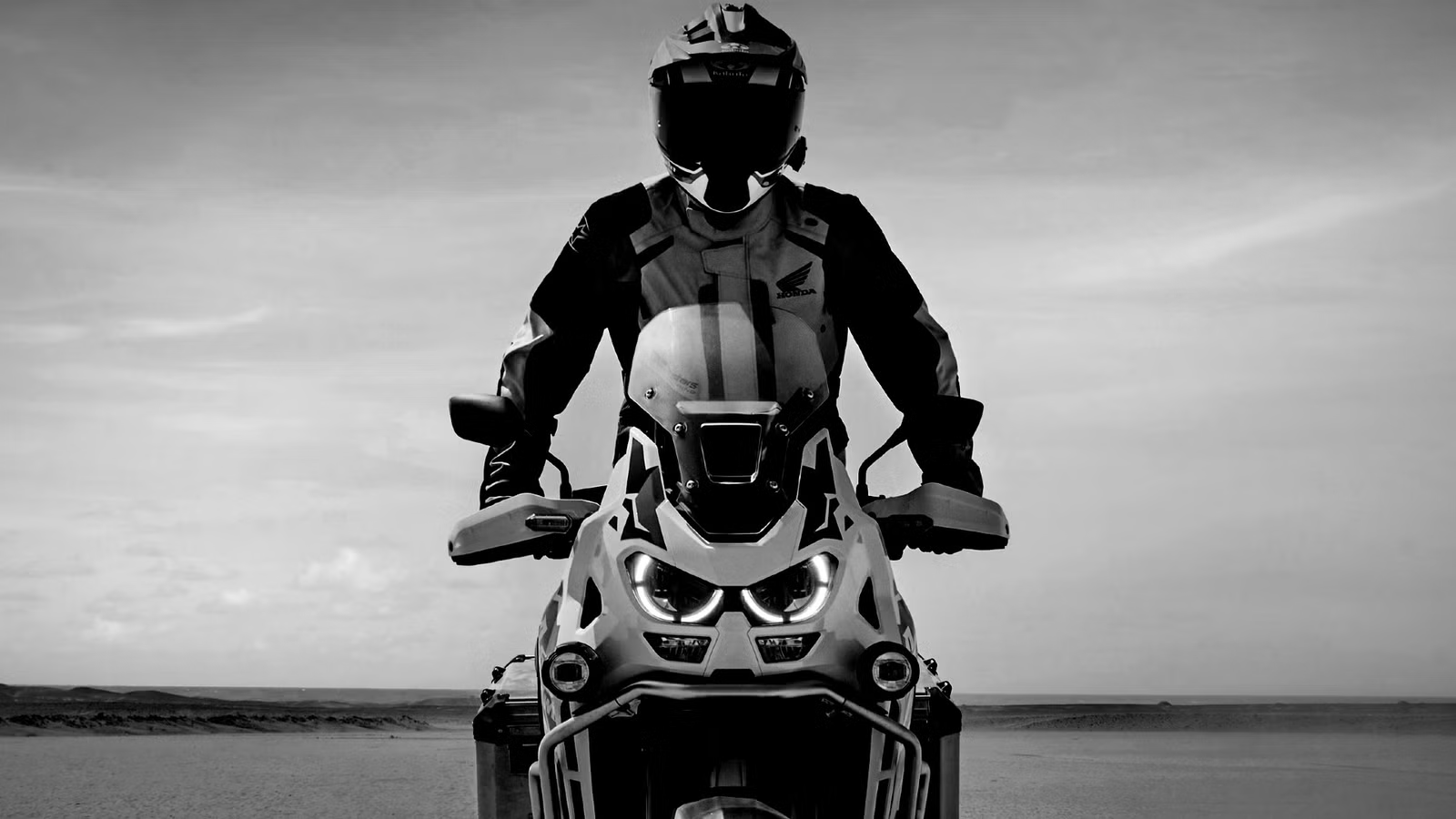
Crossing thousands of miles across rough terrain requires a machine that’s built for survival. When you are two days away from civilized pavement in remote mountains, sportbike-like horsepower numbers mean very little if an oil line bursts or an electrical harness fries. Long-distance adventure riders learn quickly that real performance, especially adventure bike performance, can only be measured in the real world.

Overland capability relies on a chassis and powertrain capable of enduring endless vibration, questionable fuel quality, and heavy cargo loads. Most modern touring motorcycles look impressive on a showroom floor or in photos, but they quickly reveal their weaknesses once exposed to severe washboard tracks and deep mud pits.
A proper long-distance rig must balance low-end torque with manageable curb weight while keeping its sensitive mechanicals tucked safely away from flying rocks. Setting out on a cross-continental trek requires trusting that your machine will start every single morning without throwing fault codes in the middle of nowhere.
Reliability Takes Center Stage When Covering Hundreds Of Thousands Of Miles

Long-term mechanical endurance is the single most critical factor for any vehicle designed to haul heavy loads across vast distances. Honda established its global dominance by building engines with ultra-tight manufacturing tolerances and bulletproof internal valvetrains. When a motorcycle manufacturer designs an engine around thermal stability and low stress on internal moving parts, the result is a powertrain capable of ticking past 100,000 miles with only basic oil changes.
Buyers heading into remote corners of the map need that exact level of engineering peace of mind. According to long-term ownership data, service records almost always favor simple mechanical designs. Building a resilient engine will always require minimizing potential failure points and focusing on better cooling.

Honda built its reputation on this exact blueprint, ensuring that vital engine components remain lubricated even when tilted at extreme angles during technical off-road climbs. That relentless focus on build quality explains why so many high-mileage globetrotters trust Japanese engineering above all else.
The Adventure Bike Quadrant: Why No Adventure Bike Can Win On All Four Fronts — And Why That’s The Point

The adventure bike itself is an interesting problem that can never truly be solved. In a perfect world, it would feel like a Gold Wing on the highway, handle like a lightweight dirt bike while off-roading, be so reliable you could ride it on the rim of a volcano in the peak of summer, and it wouldn’t overheat, and even if it should break down, you could repair it with a kitchen knife and a bit of rusty wire anywhere in the world.
There is no bike that could ever capture all four of these. Comfort adds weight and complexity; reliability can mean sealing all the parts up so tightly that they can only be serviced with special tools; and making an engine simple and reliable often affects how well it performs on the highway. With this in mind, it’s a good idea to look at all adventure bikes as what works for you and your particular needs rather than what is the best overall. Certain models will be exceptionally good at one or two things while others are more rounded. So where does today’s focus model land on this quadrant — and how deliberately does Honda make its trade-offs?
How The Africa Twin Deliberately Trades Apex Carving For Cross-Continental Survival

When viewed through the lens of the Adventure Bike Quadrant, the Honda Africa Twin clear-headedly chooses its battles. First introduced with a rally-bred pedigree, the modern CRF1100L strikes a deliberate balance between dirt agility and cross-country durability. With nine inches of front suspension travel and 8.7 inches in the rear, it glides over deep trail ruts that would bottom out standard road bikes.
Its narrow frame profile measures just five inches between the legs, allowing riders to plant their feet firmly on the dirt when navigating slick, technical sections. Of course, achieving that level of off-road ground clearance and weight distribution comes with trade-offs on the pavement.

The soft, long-travel suspension that swallows rocks can cause the front fork to dive hard under braking, making it less of an apex-carver on paved twisties than a stiffly sprung road competitor. Yet Honda deliberately tuned the bike this way because extreme off-road survival and rider fatigue take priority over sports-car handling. But durability on the trail is only half the story — the engineering under the tank is where Honda’s philosophy becomes truly radical.
The Unstoppable Parallel-Twin Engine Architecture

The Africa Twin is built around a 1,084cc parallel-twin engine engineered specifically for tank-like torque rather than top speed. The parallel-twin produces 101 horsepower and delivers it smoothly without demanding constant gear shifting. The engine utilizes a 270-degree crankshaft orientation, which mimics the uneven firing order and rumble of a classic V-twin. This firing layout improves rear wheel traction on loose gravel surfaces by giving the tire micro-pauses to dig for grip between power pulses.
To keep the engine compact, Honda uses a specialized Unicam system that runs a single intake cam to actuate both intake and exhaust valves via rocker arms. Slanting the cylinder head downward lowers the center of gravity, making a 510-pound machine feel surprisingly light between your knees. It might lack the top-end rush of high-revving European twins, but this working-class engine is built to run on low-octane pump fuel anywhere on earth while keeping maintenance simple.
How Honda’s Ergonomics And Electronics Turn 500-Mile Days Into Routine

A motorcycle that can run for 100,000 miles is useless if the rider breaks down first. Rider fatigue is one of the biggest enemies of long-distance motorcycle travel, often forcing riders to stop long before their fuel tanks run empty. Broad wind protection, neutral seating ergonomics, and low handlebar vibration are essential features that keep a rider comfortable sitting in the saddle.
Upright seating geometry relieves pressure from the wrists and lower back, while wide footpegs offer a solid platform when standing up through rough trail sections. Reducing physical strain allows riders to cover 500 miles in a single stint without feeling completely wrecked at the end of the day.

To aid long-distance comfort, Honda packed the handlebars with a six-axis IMU driving lean-sensitive ABS, traction control, and multi-stage engine braking modes. However, leaning hard into the tech quadrant introduces its own set of real-world quirks. Navigating 36 nested computer menus via a multi-button switch cluster can feel clunky while wearing heavy winter gloves, and the dual-screen touchscreen layout requires a wired connection for smartphone projection. But once set up for the highway, these safety nets operate quietly in the background, keeping fatigue at bay when weather conditions turn nasty.
The High-Tech Advantage Of The Dual Clutch Transmission

Honda is no stranger to adding automatic transmissions to its motorcycles, though the concept didn’t last long when the company introduced it in the ’70s; it is back again as an optional Dual Clutch Transmission on its flagship overland rig. This automatic setup uses two independent clutch packs—one controlling odd gears and the other controlling even gears—to execute seamless gear changes in milliseconds.
Riders can choose fully automatic shifting modes or take manual control using handlebar-mounted paddle triggers. Eliminating the clutch lever completely removes left-hand cramping during slow-speed traffic crawls or technical off-road climbs. Adding an automatic gearbox certainly adds pounds to the spec sheet and is an odd decision for an off-roading bike at first glance. However, the reduction in physical effort is a worthwhile trade-off for some riders.

The DCT system monitors throttle position, wheel speed, and engine rpm to execute shifts far smoother than humanly possible. On steep dirt inclines, the transmission shifts without interrupting power delivery to the rear wheel, preventing the bike from stalling or losing momentum. For cross-country riders spending long days in the saddle, the lack of constant clutch pulling translates directly into less physical exhaustion.
Adventure Sports Version Brings Electronic Suspension And A Larger Fuel Tank

For riders who prioritize long-range highway comfort over aggressive singletrack, the Adventure Sports trim shifts the bike further toward the touring side of the quadrant. Starting at an MSRP of $18,599 in North America, this upgraded model adds semi-active electronic suspension that adjusts damping forces on the fly. The system automatically firms up under heavy braking to reduce fork dive and softens over rough pavement to soak up sharp bumps.
A 19-inch front wheel replaces the dirt-focused 21-inch rim, providing quicker steering response and superior high-speed stability. Long-distance capability gets a much-needed boost thanks to a larger 25-liter fuel tank that extends riding range between gas station visits.

Paired with a fuel economy average of around 48 MPG, riders can easily cover well over 300 miles on a single fill-up. The Adventure Sports model also features a taller, five-position adjustable windscreen, tubeless spoked wheels for easy roadside puncture repairs, and factory-heated grips as standard equipment. It trades away a bit of lightweight trail agility to gain maximum highway luxury.
The Real-World Cost Of Overland Travel

Budgeting for a major overland journey involves much more than calculating daily fuel costs and camp fees. Routine maintenance, replacement tires, drive chains, and insurance premiums quickly add up over thousands of cross-country miles. Choosing a machine with long service intervals and widely available spare parts is the best way to keep ownership costs under control.
According to industry valuation data from sources like Edmunds and JD Power, total cost of ownership is where sensible Japanese engineering shines brightest against temperamental European competition.Resale values stay high on these bikes because buyers who are looking for this kind of machine know the engines are barely broken in at 30,000 miles.
When you drop an Africa Twin on a rocky trail, replacement plastics, air filters, and brake pads are cheap and easy to track down globally. You won’t need to hook the bike up to a $5,000 dealer diagnostic computer just to reset a service light after a routine oil change. You can do basic maintenance on a gravel driveway with a standard socket set, avoiding the brutal labor markups typical of European shops.
Oil Changes Every 8,000 Miles And Valve Jobs You Can Do In Your Driveway

Maintaining a flagship Japanese adventure motorcycle over 100,000 miles is remarkably straightforward compared to high-strung sport bikes. Oil change intervals are spaced generously at 8,000-mile increments, while valve clearance checks are required only every 16,000 miles (which is fortunate, because they aren’t easy to access).
Valve adjustments are simplified by the Unicam system, which combines traditional shim-under-bucket intake adjusters with simple screw-and-locknut adjusters on the rocker arm side. This hybrid design allows competent home mechanics to perform complete valve services right in their own garage. Long-term durability reports confirm that these parallel-twin engines routinely cross six-figure mileage totals with minimal warranty claims or engine failures.

The robust steel trellis frame resists flex under heavy luggage loads, while heavy-duty wheel bearings and swingarm pivots handle constant dirt exposure without seizing. Key components like the alternator, water pump, and starter motor are over-engineered for extreme service life. Spending less time wrenching in the driveway means spending more time out on the open highway.
After 10 Years And 100,000-Mile Track Records, The Africa Twin Still Has No Real Rival

Deciding on the ultimate cross-country motorcycle comes down to accepting that no single bike can excel at everything. The Africa Twin does not try to be a lightweight 450 dirt bike, nor does it try to match a 160-horsepower tarmac missile on a racetrack. Instead, after more than 10 years in continuous global production, this platform occupies the sweet spot of the Adventure Bike Quadrant: incredible thermal reliability, excellent off-road clearance, and supreme long-distance highway comfort.
Investing $18,000 or more in a premium touring motorcycle makes sense when the machine promises a decade of trouble-free global exploration. Its minor flaws—like complex switchgear or soft front forks—are easy to forgive when you realize they are the necessary trade-offs for bulletproof reliability and fatigue-free touring. Current market values confirm that these bikes retain high trade-in figures and remain in high demand on the used market. For true globe-trotters ready to explore the far edges of the map, this machine remains the ultimate two-wheeled travel investment.
Sources: Honda, JD Power, Edmunds

Related posts




Latest Post


No Comments