
5 Cheap Factory Engines That Are Begging For A Turbo Upgrade
Like it or not, most engines these days are turbocharged. That gives you some positives and some negatives when it comes to a powertrain. The positives are pretty obvious: they allow for more power with less fuel consumption. You can have the same kind of maximum output that you would come to expect from a naturally aspirated V6 or V8 of yesteryear. The downside to these engines, on the other hand, is that they end up getting overstressed and overworked. This typically results in more failures than not, and could potentially be costly in the long run.

When it comes to what they’re actually made to do, deliver power, they also lag behind some sometimes after you press the gas. Turbo lag is not the only problem. It’s also the fact that a lot of automakers have switched to electronic throttle body. Therefore, there is room for plenty of lag. There are, of course, some naturally aspirated engines out there that do the job just fine. Even cars like the brand-new Mazda CX-5 dropped the turbocharged variant and now offer only a naturally aspirated 2.5-liter inline four-cylinder and a hybrid option.
Every engine has its limits, but there are, of course, some better candidates than others for this type of modification. What qualifies an engine as a good candidate for this type of modification is: a well-made, strong block, a market built for turbocharging that block, and a proven track record. Many of these are engines that you already know and love, made by automakers that you also know and love, like Honda, GM, and Toyota.
Engines are listed based on how much horsepower you could realistically get out of it, from the lowest to the highest.

Nissan VQ35DE
Maximum Power: 400–420 HP
What do the Infiniti G35 and the Nissan 350Z have in common? Why, it’s the Nissan VQ35DE, of course! The VQ engine has been around since 1994 and is still in use today. It is a 60-degree V6 engine that has seen displacement from as little as a 2.0-liter all the way up to a 4.0-liter. The Nissan VQ35DE, however, has a displacement right in the middle at 3.5 liters. Some honorable mentions are the Nissan Altima and Maxima. From a stock perspective, this can make between 228 horsepower and 300 horsepower.
Engine Specifications And Applications

The Nissan VQ35DE is specifically considered the more modern variant. It has variable valve timing and is known for its well-manufactured pistons that have lower friction than most. This engine can handle between five and eight psi with a boost kit. That gives it a maximum capacity of 400 horsepower. The kits can cost anywhere between $3,800 and $8,500 or more. One of the biggest concerns about this engine, however, is its heavy oil consumption.
- Production Years: 2001 to 2024
- Displacement: 3.5 liters
- Noteworthy Applications: Infiniti M35, Nissan Skyline, Nissan 350Z
Toyota 2JZ-GE
Maximum Power: 400–450 HP

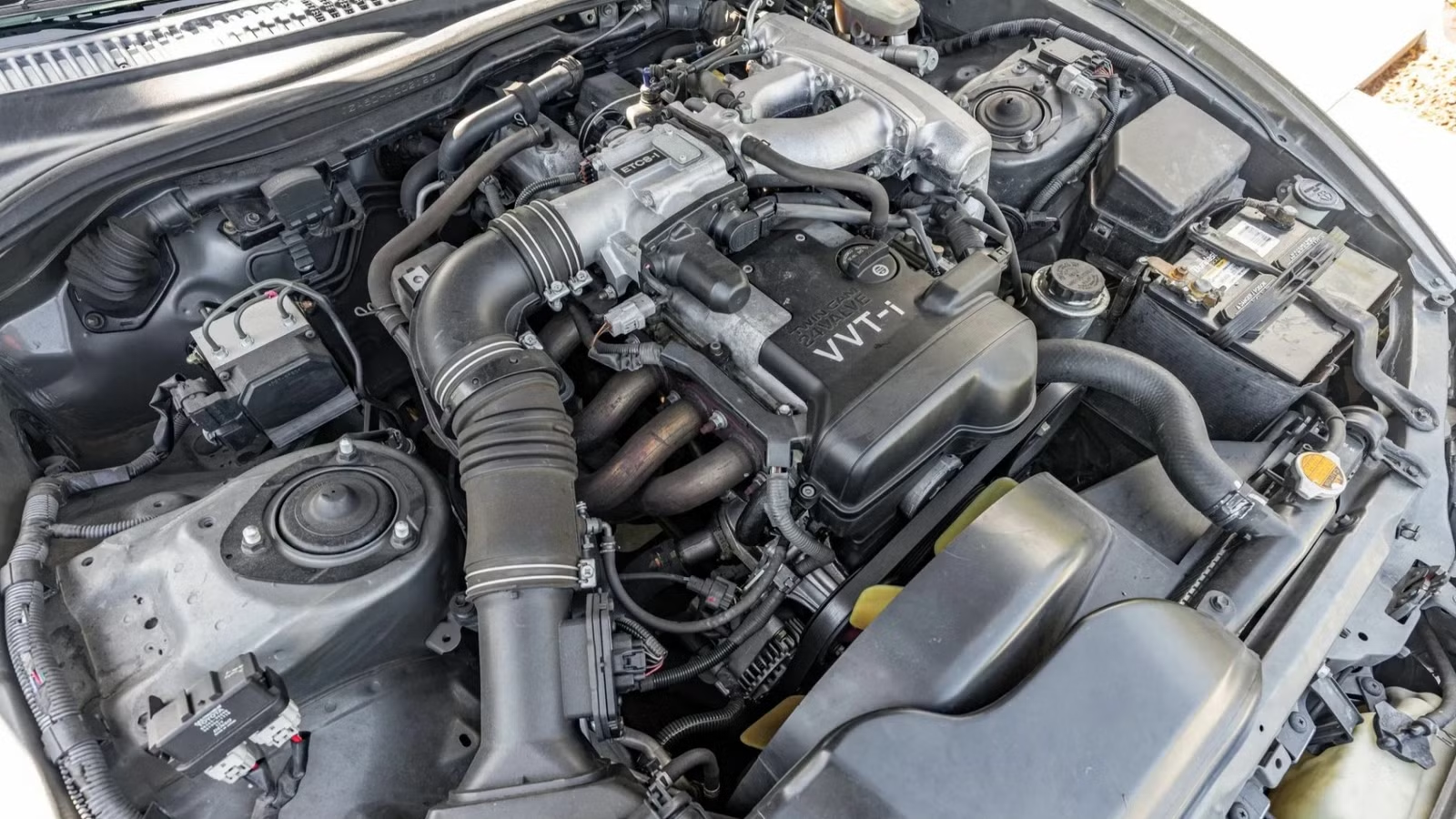
If there was ever an engine that was an icon, it would be the JZ engine. While the JZ engine had been in production for quite some time, the Toyota 2JZ-GE really put it on the map. This thing is a legend in the tuner community and in general, as it’s one of the most iconic Toyota engines ever made. Surprisingly, it’s a naturally aspirated 3.0-liter straight-six engine. It initially makes between 215 and 227 brake horsepower. However, because it produced relatively modest horsepower in stock form, it is unsurprising that enthusiasts are easily able to tune it.
Engine Specifications And Applications

The advantage this engine has over some others on the list is that it was built with a forged crank and seals. You are able to boost this engine between eight and 10 psi. That gives it double the horsepower, up to about 400. There are, of course, some variants that can make 1,000 horsepower, but those are rare. Boosting the Toyota 2JZ-GE engine can cost anywhere between $2,000 and $10,000 or more.
- Production Years: 1991 to 2007
- Displacement: 3.0 liters
- Noteworthy Applications: Toyota Supra, Lexus SC 300
Honda K-Series (K20/K24)
Maximum Power: 500 HP

Don’t get us wrong, this Honda engine has seen a turbocharger plenty of times. They often come stock with a turbocharger. However, if you have one of these engines without a turbocharger, adding one becomes that much easier. By itself, most of these K20 series engines make between 200 and 220 horsepower. These engines have also gone through so many iterations and appear in so many Honda and Acura products that they are plentiful.
Engine Specifications And Applications

These engines have also been around since 2001, so they are time and performance tested. If you fully build a K20 with the proper parts, you could get it up to about 1,000 horsepower. However, we don’t recommend that and that is not done simply with a turbocharger. The manufacturer has been able to push it into the 300s with performance cars like the Honda Civic Type R. There are some pitfalls to this engine that you should be aware of, such as stretched timing chains, exhaust camshaft lobe wear, and VTEC valve issues.
- Production Years: 2001 to Present
- Displacement: 2.0 to 2.4 Liters
- Noteworthy Applications: Any number of Honda/Acuras
Mazda 13B Rotary
Maximum Power: 400–500 HP

This is one of the longest-standing engines on the list, but it’s also one that has not been in production since the early 2010s. One could also say that this is one of the oddest iterations of an engine ever made, as it has a twin-rotor Wankel set up, not standard pistons. The engine also received a factory turbocharged treatment via the 13B-REW variant. The 13B could make anywhere between 135 horsepower and 255 horsepower maximum.
Engine Specifications And Applications

Perhaps the most notable use case in the modern era was the Mazda RX-8. It was also the very last model Mazda made with this engine. With a single turbocharger, this engine can output up to 500 horsepower maximum. However, because this engine has such an unusual Reuleaux triangular shape, it wears down components at a much faster rate and causes compression issues. This is, however, one of the more affordable engines to turbocharge, as the kits cost between $1,500 and $5,000 or more.
- Production Years: 1973 to 2012
- Displacement: 1.3 liters
- Noteworthy Applications: Mazda RX-7
GM LS (5.3 Vortec and LS1)
Maximum Power: 1,000 HP

If you’ve ever heard the phrase “Let’s LS swap,” then you’re an automotive enthusiast who is familiar with GM’s small-block V8s. The LS1 was introduced in 1997 in the Corvette that featured a 5.7-liter aluminum block. This was swiftly added to all of GM’s trucks and SUVs, like a Chevrolet Tahoe. The 5.3-liter Vortec (LM7) was the engine of choice for this one. There are a million and a half of these engines lying around, giving them the nickname “Junkyard King.” You can easily pick one up for between $500 and $1,000.
Engine Specifications And Applications

What makes these engines so amenable to boosting? The 5.3-liter iron engine block is incredibly durable. It also features a much smaller factory compression ratio, around 9.5:1. Therefore, a stock Vortec can produce 500 to 600 horsepower with ease. With a single turbocharger, you’re looking at 1,000 horsepower. You will need some additional modifications, such as gapped piston rings, upgraded valvetrain components, and head studs. Knock sensors fail all the time on these, so be careful.
- Production Years: 1997-Current
- Displacement: 5.3 liters
- Noteworthy Applications: Chevrolet Tahoe, Chevrolet Suburban, Chevrolet Corvette, Cadillac Escalade
Sources: Mazda, Chevrolet, Toyota, Honda, RepairPal

Related posts



Latest Post


No Comments