
BMW’s Next X5 Will Offer Five Powertrains—Including Hydrogen—And The M Performance Version Is The Real Story
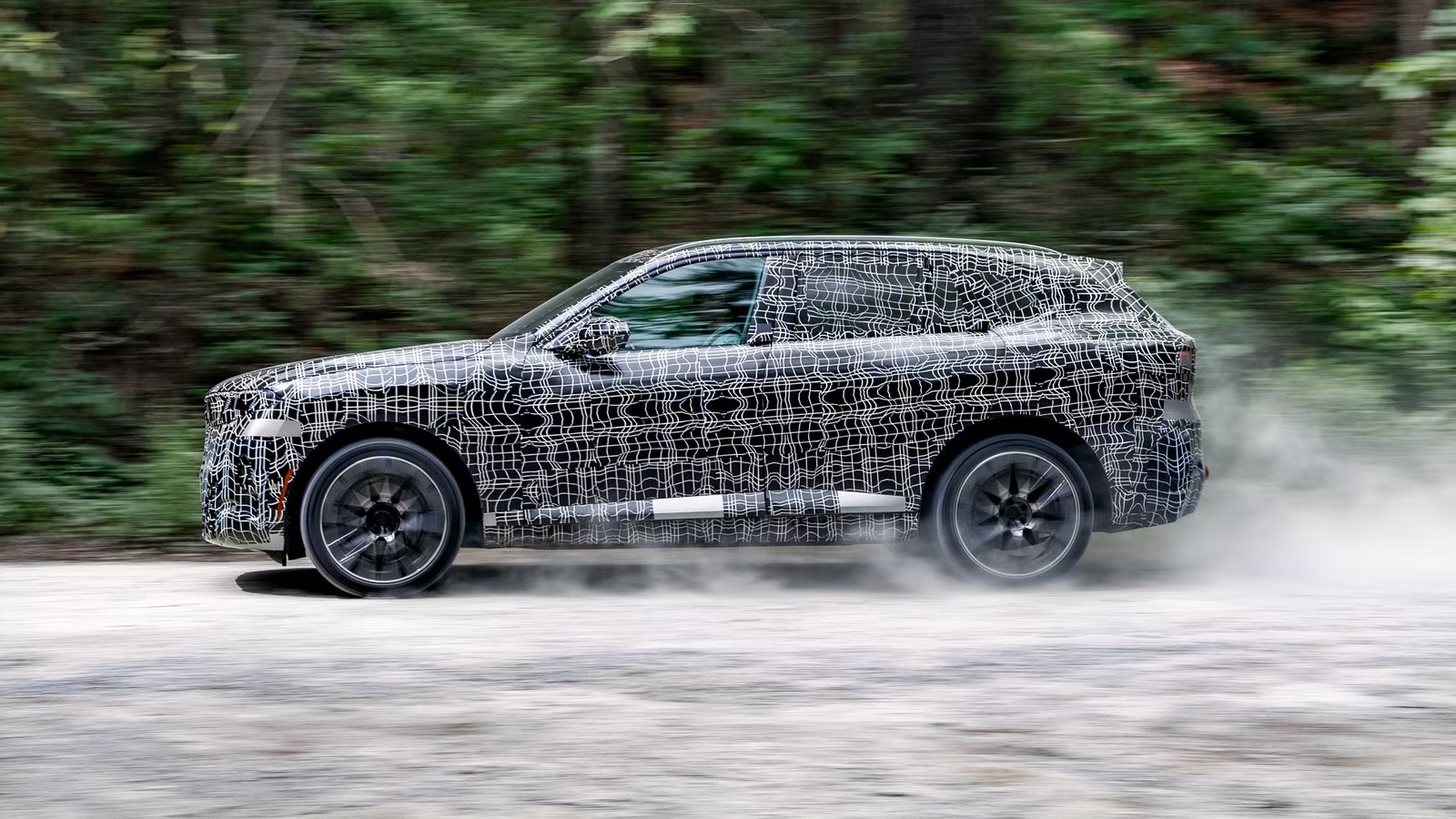
BMW confirmed this week that the next-generation X5, expected as a 2027 model, will arrive with five distinct powertrain options: gasoline, diesel, plug-in hybrid, fully electric, and hydrogen fuel-cell. That breadth is genuinely unprecedented for a single luxury SUV nameplate. But the headline figure of five powertrains is almost beside the point—the question that actually matters to M buyers is whether BMW’s performance division can engineer an M50 and a full M variant that feel like proper M cars when the underlying platform has been stretched to accommodate hydrogen storage, full battery integration, and a fuel cell stack.

That is not a trivial engineering problem. Every powertrain variant imposes different demands on the platform’s structure, weight distribution, and thermal management. The M division has always worked from a performance-first architecture. Now it has to work from a platform optimized for maximum powertrain flexibility first, and extract M-level dynamics from whatever space and weight budget remains. Car and Driver drove an early fifth-generation X5 prototype in June 2026 and confirmed the multi-powertrain architecture is real and already in development—which means the M variants are being engineered in parallel, not after the fact.
What The Five-Powertrain Platform Actually Demands From M Engineers
Building a single body structure around five fundamentally different energy systems requires compromises that a dedicated performance platform never would. A hydrogen fuel-cell variant needs high-pressure tank packaging—typically routed through the transmission tunnel and under the rear floor—which directly affects where suspension components can mount and how low the center of gravity can sit. A full-battery EV variant requires a flat floor with a large skateboard pack, which raises the seating position and shifts mass distribution compared to a combustion model. A PHEV sits somewhere between the two, with a smaller battery supplementing a gasoline or diesel engine.


For the M507—historically the performance-tuned PHEV or petrol variant in the X5 lineup—the concern is whether the shared platform allows M’s engineers to tune suspension geometry, subframe rigidity, and steering calibration independently of the base X5. On the current generation, the M50 uses adaptive air suspension with M-specific tuning and a sport-biased AWD torque split. Replicating that on a platform that also has to accommodate fuel-cell plumbing and EV battery rails is a genuine packaging challenge, not a marketing one.
The M Badge Is Under More Pressure Than Usual Here

BMW’s M division has navigated electrification carefully. Reports from June 2026 indicate the next-generation M3 will use an evolved S58 engine—dubbed M Ignite S58—paired with an EV option, with hybrid and PHEV routes ruled out. That suggests M is willing to go straight from combustion to full electric without a hybrid middle step on its performance sedans. The X5 M situation is more complicated because the SUV’s customer base is broader and the powertrain menu is wider.
The full M variant of the X5—not the M50, but the X5 M proper—has always been defined by a high-output twin-turbo V8 and a chassis tuned to the edge of what a two-ton SUV can do. If that V8 disappears in favor of an electric powertrain on the next generation, BMW will need to demonstrate that the electric output, torque delivery, and chassis behavior genuinely match or exceed what the S63 engine delivered. The Porsche Cayenne Turbo E-Hybrid has already shown it’s possible—739 combined horsepower and a 0–62 mph time under 3.5 seconds—but Porsche built that car on a platform designed with electrification in mind from the start. BMW is asking its engineers to hit a similar ceiling while simultaneously supporting hydrogen.
How Mercedes-AMG And Porsche Have Handled The Same Problem

The competitive context is instructive. Mercedes-AMG’s GLE 63 S has stayed committed to a 4.0-liter twin-turbo V8 with a 48-volt mild-hybrid assist—enough electrification to satisfy emissions targets, not enough to fundamentally change the driving character. That is a conservative strategy, and it has preserved the GLE 63’s identity at the cost of falling behind on pure efficiency metrics. Porsche went the opposite direction with the Cayenne Turbo E-Hybrid: a full plug-in system with a large battery, electric-only capability, and a combined output that exceeds the outgoing Turbo GT’s combustion-only figure. The result is a car that feels faster and, in some dynamic respects, more capable—but it is also heavier and more complex.
BMW’s challenge with the next X5 M is that it cannot simply choose one of those paths. The five-powertrain platform forces the M division to work within a framework that neither AMG nor Porsche has had to manage. Whether BMW’s engineers can thread that needle—preserving the X5 M’s handling sharpness and power ceiling without the freedom of a dedicated performance architecture—is the real story behind this week’s announcement.
For M buyers, the answer won’t come from a press release. It will come from the first back-to-back comparison between the next X5 M and a Cayenne Turbo E-Hybrid on a real road. Until then, the five-powertrain announcement is best read as a statement of ambition—and a significant test of whether M’s identity can survive a platform built for everyone.
Sources: drive.com.au, Car and Driver, autoevolution

Related posts





Latest Post


No Comments