The Hyundai Hybrid SUV That Gets 10 MPG Less Than Its Sticker Claims
10 minutes reading
Thursday, 18 Jun 2026 14:00 0 123 autotech
Hybrid SUVs have become the default choice for many modern families. Buyers want improved fuel economy without fully committing to electric vehicles, and car manufacturers have responded by flooding the market with hybrid crossovers promising impressive efficiency alongside everyday practicality.
But as hybrid technology becomes increasingly common, one important reality is becoming harder to ignore: EPA fuel economy figures do not always reflect what owners experience in the real world. And to be frank, one Korean SUV has recently become a perfect example of that disconnect.
Why EPA Fuel Economy Numbers Don’t Always Match Reality
Real-World Driving Often Tells A Completely Different Story
Dynamic shot of a 2026 Toyota RAV4 Hybrid LimitedToyota
But before diving into the mystery SUV in question, it is worth quickly understanding how EPA fuel economy testing actually works first. EPA fuel economy testing remains useful for comparing vehicles under standardized conditions, but it does not always accurately predict how vehicles perform during everyday driving. Factors such as highway speeds, passenger loads, weather conditions, terrain, driving style, wheel size, and powertrain calibration can all dramatically influence real-world efficiency. Hybrid vehicles are especially sensitive to those variables because different hybrid systems prioritize efficiency differently.
Some automakers aggressively tune their hybrids around maximizing EPA test-cycle performance, while others place more emphasis on refinement, drivability, power delivery, towing capability, or packaging practicality. That distinction becomes far more important once real owners begin living with these vehicles outside controlled testing environments. While certain hybrids easily match — or even exceed — their official EPA estimates in everyday driving, others can fall surprisingly short once highway trips, passengers, cargo, and real-world conditions enter the equation.
The Japanese Hybrid SUV With The Highest Driving Range In 2026
As SUV owners seek to put off gas pump visits as long as possible, this Japanese hybrid shines for its ability to go 600+ miles between fill-ups.
The 2026 Hyundai Santa Fe Hybrid Falls Short Of Its MPG Claims
Multiple Long-Term Tests Revealed Fuel Economy Closer To 26 MPG
2025 Hyundai Santa Fe Hybrid — ProfileCraig Cole | TopSpeed
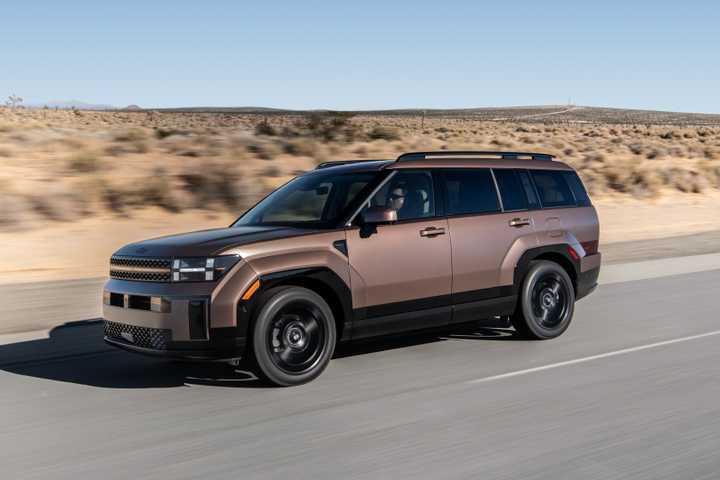
That brings us directly to the 2026 Hyundai Santa Fe Hybrid. On paper, Hyundai’s latest three-row hybrid SUV appears remarkably competitive from an efficiency standpoint. EPA estimates suggest the Santa Fe Hybrid can achieve between 34 and 36 MPG combined, placing it reasonably close to several efficient midsize hybrid SUVs. Combined output from the turbocharged hybrid system also remains respectable at 231 horsepower and 271 pound-feet of torque, giving the Hyundai strong everyday performance for a family SUV.
Base Trim Engine
1.6L Smartstream I4 Hybrid
Base Trim Transmission
6-speed automatic
Base Trim Drivetrain
Front-Wheel Drive
Base Trim Horsepower
178 HP @5500 RPM
Base Trim Torque
195 lb.-ft. @ 1500 RPM
Base Trim Battery Type
Lithium ion (Li-ion)
Make
Hyundai
Model
Santa Fe Hybrid
Segment
Midsize SUV
But once independent long-term testing began, a very different real-world story quietly started emerging. Edmunds averaged just 26.7 MPG over more than 11,000 miles in its long-term Santa Fe Hybrid test vehicle — nearly 10 MPG lower than Hyundai’s EPA estimates. MotorTrend observed similar results during its long-term testing, recording roughly 26.2 MPG combined, while Car and Driver also reported real-world figures hovering around 26 MPG. That consistency across multiple publications makes the gap difficult to ignore.
2025 Hyundai Santa Fe Hybrid — Front Three-QuarterCraig Cole | TopSpeed
To Hyundai’s credit, not every outlet experienced disappointing results. Consumer Reports managed to achieve roughly 34 MPG overall in its own testing, closely matching the Santa Fe Hybrid’s official EPA estimates. Still, the broader trend across several independent long-term tests suggests many owners may struggle to replicate Hyundai’s advertised fuel economy consistently in real-world driving conditions.
That Changes The Entire Conversation Surrounding The Santa Fe Hybrid
2025 Hyundai Santa Fe Hybrid badgeCraig Cole | TopSpeed
Once you stop viewing the Hyundai purely as an MPG champion, something else becomes clear: the Santa Fe Hybrid may actually work better as a spacious, comfort-focused family SUV that simply happens to be hybridized rather than a true fuel-economy leader.
2025 Hyundai Santa Fe Hybrid Specs
EPA Fuel Economy
34–36 MPG combined
Real-World MPG
26–27 MPG observed
Seating Capacity
6 or 7 passengers
Third Row
Standard
Cargo Capacity Behind Third Row
14.6 cubic feet
Cargo Capacity Behind Second Row
40.5 cubic feet
Max Cargo Capacity
79.6 cubic feet
Starting Price
Roughly $38,000
Key Strengths
Spacious cabin, comfort, refinement, traditional driving feel
Key Weakness
Real-world MPG often falls well below EPA estimates
12 Hybrid SUVs That Make Fuel Stops Feel Like A Memory
These long-range hybrid SUVs prove that families no longer have to compromise on space in order to stretch out the distance to the next fuel stop.
The 2026 Toyota RAV4 Hybrid Still Sets The Benchmark
Toyota’s Hybrid System Continues To Dominate In Real Driving
Front 3/4 view of a 2026 Toyota RAV4 Limited parkedIsaac Atienza | TopSpeed
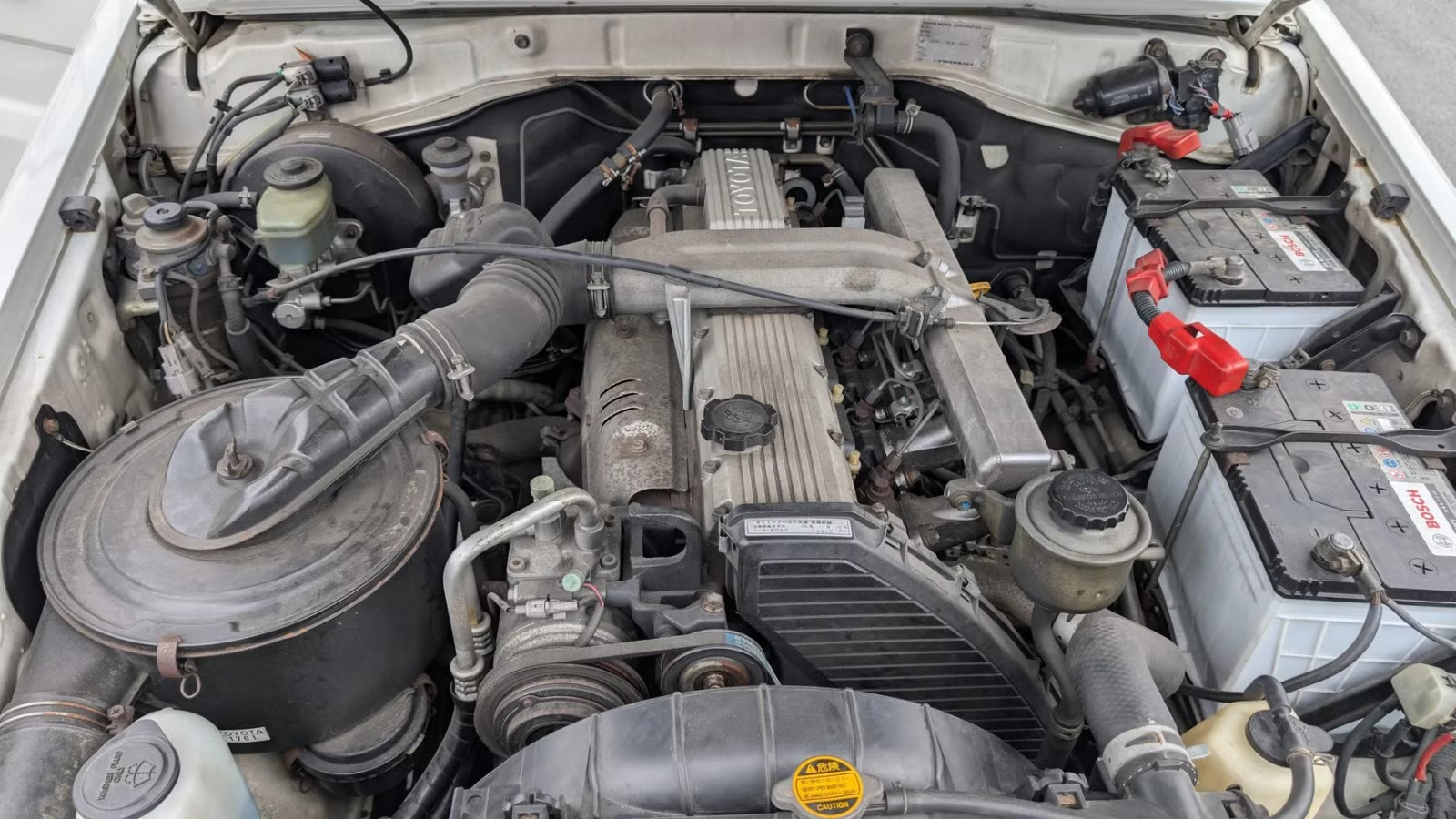
If the Hyundai Santa Fe Hybrid exposes the limitations of EPA estimates, the 2026 Toyota RAV4 arguably reinforces why Toyota remains the benchmark for hybrid efficiency. Unlike Hyundai’s turbocharged setup, the RAV4 uses a naturally aspirated 2.5-liter four-cylinder engine paired to Toyota’s proven hybrid system and electronically controlled continuously variable transmission. Combined output sits at 226 horsepower for the FWD version and 236 for the AWD.
2026 Toyota RAV4 engineToyota
On paper alone, the Toyota already holds a significant advantage. EPA estimates place the 2026 RAV4 between 41 and 43 MPG combined, substantially higher than the Santa Fe Hybrid before real-world testing even begins. But perhaps more impressively, the Toyota consistently achieves those numbers in practice.
Rear 3/4 shot of a 2026 Toyota RAV4 HEV XLE Premium Ruby Flare PearlToyota
InsideEVs observed fuel economy figures approaching 47 MPG during testing, while The Autopian recorded roughly 42.7 MPG combined in real-world driving conditions. Unlike the Hyundai, the Toyota RAV4 routinely meets or exceeds its official EPA estimates rather than falling dramatically short of them.
Less refined driving feel, smaller interior, eCVT character
That consistency remains one of Toyota’s biggest strengths. The RAV4 may not feel particularly exciting, luxurious, or especially refined, but buyers generally know exactly what they are getting: dependable efficiency that translates directly into lower running costs over time. Few automakers currently execute hybrid systems better than Toyota.
The SUV That Feels Like A Tech Upgrade, Not A Compromise
This popular Japanese SUV takes technological refinements to the next level.
Why Some Families May Still Prefer The Santa Fe Hybrid
More Space, Better Comfort, And A More Natural Driving Feel
Despite its disappointing real-world MPG performance, dismissing the Hyundai Santa Fe Hybrid entirely would still miss the bigger picture. While Toyota dominates outright fuel efficiency, the Santa Fe quietly counters with strengths that matter enormously to many families.
The most obvious advantage is space. Unlike the five-seat Toyota RAV4, the Hyundai Santa Fe Hybrid offers a standard third-row seating configuration alongside significantly better overall interior volume. The Santa Fe’s boxier design also creates a far more open and airy cabin environment, giving the SUV a noticeably more premium and spacious feel than many compact hybrid rivals.
Side profile of a 2026 Hyundai Santa Fe Hybrid CalligraphyIsaac Atienza | TopSpeed
And honestly, the difference feels substantial. In many ways, the Santa Fe Hybrid almost approaches certain luxury SUVs in terms of cabin packaging and passenger space. The upright proportions, large glass area, and squared-off styling help maximize interior usability in ways many sleeker crossovers simply cannot match.
The Driving Experience Also Differs Considerably From That Of The Toyota
2025 Hyundai Santa Fe Hybrid Exterior DrivingHyundai
Thanks to its traditional six-speed automatic transmission, the Hyundai avoids much of the eCVT “rubber-band” sensation still associated with many hybrid vehicles. Car and Driver noted that the Santa Fe Hybrid feels more natural and conventional to drive than many hybrid rivals, while the turbocharged powertrain delivers strong low-end torque and smoother acceleration response during everyday driving.
Several reviewers also praised the Santa Fe’s overall refinement levels. Car and Driver noted that the Hyundai feels quieter and more composed during highway cruising than many compact hybrid rivals, while its larger footprint and softer ride tuning further reinforce the SUV’s comfort-focused character compared to the Toyota RAV4.
Interior of a 2026 Hyundai Santa Fe Hybrid CalligraphyIsaac Atienza | TopSpeed
And for some buyers, those qualities may matter more than chasing every last MPG figure possible. Once you start regularly carrying multiple passengers, road-tripping with family, or prioritizing long-distance comfort, the Santa Fe Hybrid begins making a very compelling case for itself — even if its fuel economy ultimately disappoints.
10 High Quality Hybrids That Will Stand The Test Of Time
You’ll get the best value for money by considering these well-put-together hybrid vehicles.
The Real Lesson Behind The Santa Fe Hybrid’s MPG Disappointment
Why Livability Sometimes Matters More Than Fuel Economy Alone
The rear of a 2025 Hyundai Santa Fe Hybrid.Hyundai
Fuel economy alone does not automatically determine which vehicle works best for every buyer. Yes, the Toyota RAV4 remains the undisputed efficiency champion here. Its real-world MPG performance continues to validate Toyota’s hybrid expertise, and buyers prioritizing maximum fuel savings will almost certainly still gravitate toward the RAV4.
But the Hyundai approaches the segment from a very different angle. Rather than obsessing over maximizing every possible MPG figure, the Santa Fe Hybrid prioritizes space, comfort, refinement, and family practicality.
2025 Hyundai Santa Fe Hybrid — InteriorCraig Cole | TopSpeed
Unlike the smaller five-seat RAV4, the Hyundai offers standard third-row seating, a significantly roomier cabin, and a far more premium interior presentation overall, complete with dual 12.3-inch displays, available Nappa leather upholstery, ambient lighting, and a more upscale design philosophy.
The Santa Fe Hybrid also starts at $36,400, compared to $31,900 for the 2026 Toyota RAV4, though much of that pricing difference reflects the Hyundai’s larger size and additional equipment. JD Power data paints a fairly encouraging picture for both SUVs, with the Hyundai Santa Fe earning an 82/100 consumer rating compared to the Toyota RAV4’s 79/100 score. While neither figure tells the full reliability story, it does suggest owners have generally responded positively to both vehicles.
That Distinction Matters To Buyers Not Obsessed With EPA Numbers
2025 Hyundai Santa Fe Hybrid Exterior Front ShotHyundai
While the Santa Fe Hybrid may disappoint buyers expecting Toyota-level fuel economy, it quietly excels in several areas many families arguably care about more during everyday ownership. The lesson here is not that the Hyundai Santa Fe Hybrid is a bad SUV. Rather, it is a reminder that EPA figures only tell part of the story. And sometimes, the best family vehicle is not necessarily the one consuming the least fuel — it is the one your family actually enjoys living with every single day.
Sources: EPA, Edmunds, Motortrend, Car And Driver, InsideEVs, The Autopian, J.D. Power, Kelly Blue Book, Hyundai, Toyota












No Comments