
The Overlooked Dodge Muscle Car Still Priced Below Chargers After 40 Years
Genuine Mopar muscle has gotten expensive enough to turn ownership into a financial decision instead of a driving one. One of Dodge’s compact performance cars never got that memo. It looked ordinary enough to disappear into a suburban driveway, yet Dodge built enough V8 hardware into it to make it a serious threat at the strip and on the street. More than half a century later, that same anonymity is exactly why it remains one of the more interesting ways into old-school Mopar performance, and one of the more affordable ones.
Genuine Mopar Muscle Doesn’t Come Cheap Anymore

Real Mopar muscle is not cheap anymore, and it is not getting cheaper. A clean 1970 Dodge Charger R/T sold for $74,025 Get the right car with the right paperwork and the number climbs fast. Road Runners and Challengers from the same era have followed the same trajectory, driven by the same nostalgia chasing a supply that only shrinks. That creates a problem for enthusiasts who actually want to drive these cars, not just own one.
The appeal of a classic Mopar is mechanical, not decorative. It’s the V8, the transmission, the noise, the rear tires, and the slightly absurd sensation of driving something engineered around horsepower rather than fuel economy. Collector values make that experience increasingly expensive. Here’s what most coverage skips, though. The market has not treated every factory Mopar performance car equally. The Charger has a famous shape, a famous name, and decades of cultural reinforcement behind it.

Other Mopars have become equally desirable. But some factory performance cars never acquired that same halo, even when their engineering made them genuinely entertaining. That gap between reputation and capability, ignored for decades, is where the real bargains still live. That leaves an opening for the buyer who cares more about what the car does than how recognizable it is at a cars-and-coffee gathering. To find it, though, you have to look at a platform that was never supposed to carry this much muscle in the first place.

The Budget Platform That Wasn’t Built for a Big-Block V8

The basic idea sounds easy. Take a compact, affordable car and put a large V8 in it. The mechanical reality was considerably less tidy. Dodge’s A-body platform was small, and the 383 big-block was not a dainty engine. It was built to live in Coronets and Chargers, cars with room to spare under the hood. Once engineers wedged it into that tighter bay, they inherited a new set of problems. More weight, more power, less room to deal with either. Bolting on motor mounts and calling it done was never going to be sufficient. The big-block application received heavier torsion bars, a larger front anti-roll bar, and six-leaf rear springs.
The performance compact weighed less than 3,000 pounds, which helps explain why the suspension needed to be taken seriously. This was a light platform being asked to deal with power normally associated with larger Mopars. A handful of special drag-racing Darts pushed the idea even further, with Hurst-Campbell fitting 440s and 426 Hemis into the A-body and stripping some Hemi cars of interior equipment to reduce weight. Packaging created another headache. The 383 occupied enough space that factory power steering and air conditioning were not available with the big-block combination.

That sounds like a minor inconvenience until you remember what it says about the car. Dodge had pushed a compact platform hard enough that there simply was not room for some of the equipment buyers might have expected. It was a trade a compact-car buyer wasn’t necessarily prepared to make. From the outside, none of that was obvious. The car could still look like an inexpensive compact. Underneath, though, the recipe was becoming much more serious. That tension is what makes the eventual performance versions interesting. The platform did not begin life as a purpose-built muscle car. Dodge had to turn it into one.
The Dodge Dart GTS Made the Impossible Fit

That compact was the Dodge Dart, and the GTS is where the story stops being theoretical. Dodge introduced the Dart GTS late in 1967, and the A-body only got more serious about performance from there. For 1968, the GTS could be ordered with the 275-hp 340 small-block or the 300-hp 383 big-block. The two engines should not be treated as equivalent choices. The 383 was the straight-line brute. It brought big-block torque and serious acceleration to a body considerably smaller than the B-body cars normally associated with that engine.
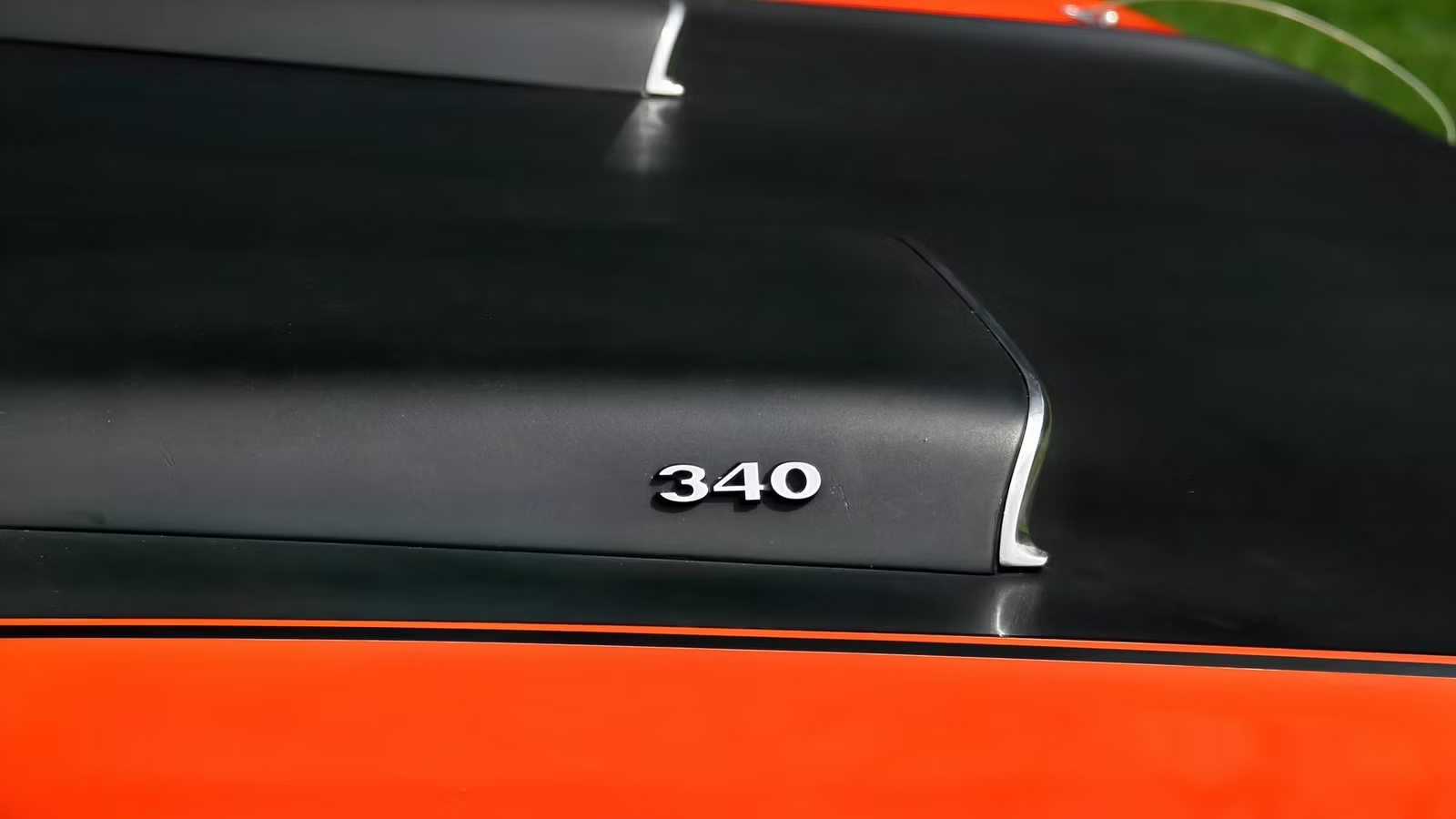
By 1969, the Dart GTS 383 was rated at 330 hp, only five hp below the 335-hp version used in the hottest B-body applications that year. But the 340 was the more interesting driver’s engine. It was a purpose-built performance small-block with a four-barrel carburetor and dual exhaust, and at roughly 90 pounds lighter than the 383, it put less mass over the front axle. In a compact car, that matters. The 383 gave the Dart the bigger number and the bigger bragging rights; the 340 made a stronger argument for balance and response. Then there was Grand Spaulding Dodge in Chicago. Dealer Norman Kraus, better known as Mr. Norm, had a 383-powered Dart built through his dealership before the factory combination became available.

Dealer’s garage to factory option sheet is the real arc of this story. It would be too strong to claim Mr. Norm single-handedly forced Chrysler to build it, but his cars helped prove the combination was viable. By 1969, the factory GTS 383 finally had the hardware to match the engine. Its torsion bars grew to 0.89 inches, while the front anti-roll bar increased from 0.88 to 0.94 inches, backed by six-leaf rear springs to keep all that extra weight in line. Packaging limitations remained. Dodge had not merely found a way to fit the engine. It had made the chassis deal with it.
The Swinger 340 and Demon 340 Kept the Formula Alive

The 340 formula became even more compelling when Dodge made it cheaper. For 1969, the Dart Swinger 340 put the high-performance small-block into a simpler two-door hardtop with Rallye suspension, dual exhaust, performance equipment, and a price of $2,836 when new. Dodge built 16,637 of them that year and another 13,785 for 1970. Not exotic numbers, but enough that most people still have no idea the car existed at all, let alone what it could do.
That difference matters. The Swinger 340 was not trying to imitate a Charger. It used the advantages of the smaller A-body instead. With the lighter 340 up front, the car could make better use of its chassis than the heavier 383 version. The result was a factory hot rod that looked relatively modest and could be driven accordingly. The formula survived into the early 1970s as the Demon 340, riding on the same bones as the Plymouth Duster, which had quietly bumped the Swinger nameplate out of the lineup. Dodge offered the Demon for 1971 and 1972, with the 340 serving as the performance centerpiece.

By then, the classic muscle-car environment was changing quickly, with emissions requirements, insurance costs, and shifting consumer priorities putting pressure on high-performance cars. This was not a new idea. It was the last chapter of the same one. It kept the same basic philosophy alive. Small car, serious V8, enough suspension and drivetrain hardware to make the power useful. Line the GTS, the Swinger 340, and the Demon 340 up together and the progression becomes obvious. The GTS proved the platform could handle real power, and the Swinger and Demon packaged that power for buyers who wanted performance without the bigger, pricier Mopar names attached.
Why It Still Costs Less Than a Charger

That brings the story back to the modern market. A 1970 Swinger 340 sold for $27,825 on October 2, 2025. That’s a real transaction, not a hopeful asking price, and it proves genuine factory-built A-body muscle still trades in the high-$20,000s. The comparison becomes clearer beside the Charger. That $74,025 sale sits more than $46,000 above the Swinger’s result, and the $99,000 sale from January shows the gap can run even wider.
These aren’t identical cars, and one auction result can’t set a universal market value. But the gap is wide enough to make the point. Some of the Dart’s affordability comes down to what it never became. The Charger developed an enormous cultural identity. Its shape, movie appearances, racing associations, and legendary engines turned the name into a collector-car brand of its own, one that sells on recognition as much as on specification. The Dart remained associated with being a compact Dodge, even when it carried a serious performance engine. For a buyer who wants to drive rather than display a Mopar, that anonymity can be useful.

The money goes toward the mechanical package instead of entirely toward the badge and cultural status. A well-equipped Dart can still deliver the sound, feel, and rear-wheel-drive attitude that made classic Mopar muscle appealing in the first place, minus the six-figure buy-in. That doesn’t make every Dart a bargain, or every example a smarter buy than a Charger. It makes the GTS, the Swinger, and the Demon outliers in a market where six-figure Charger sales are becoming routine. A 1970 Swinger 340 still changes hands for $27,825, while its Charger counterpart keeps climbing past six figures. The car nobody bothered to remember is still the most honest way into the real thing.
Sources: Mecum, Bring A Trailer, Classic.com, Hagerty

Related posts


Latest Post


No Comments