
Good Luck Out-Muscling This Ultra-Rare 375-HP Cop-Engined Mopar Wagon
Some cars get famous for what they were built to do. This one got interesting for what it was never supposed to do at all. A cheap barn-find wagon, dragged out of storage and handed a nickname that sounds more like a monster truck than a family hauler, turned out to be sitting on hardware that had no business under wood paneling. Chrysler built it that way on purpose, and almost nobody noticed for decades.
The Family Hauler Nobody Suspected

Big American wagons from the late 1960s get lumped into one lazy category: slow, heavy, and built for hauling groceries and kids, not for doing anything quick. That reputation was earned by plenty of six-cylinder Fords and base-trim Chevrolet sold to families who wanted space over speed. Nobody cross-shopped a nine-passenger wagon against a muscle car, and nobody expected one to hide serious drivetrain hardware under its floorboards.
That assumption is exactly what made a certain Roadkill Garage find worth a second look. The crew picked up a full-size wagon for next to nothing, the kind of price that usually signals a rust bucket destined for the parts pile rather than a runner worth keeping. It carried factory options that had nothing to do with grocery runs, and the more the team dug into it, the less it behaved like a typical land yacht from the era.
A Bargain Price With Hardware That Didn’t Add Up


The number that got this wagon its nickname was the purchase price. Roadkill Garage bought it for just $1,800, cheap even by barn-find standards, and dubbed it the Gargantuwagon on the spot. At that price, most buyers would expect a tired six-cylinder cruiser with a weak automatic and drum brakes all around, not something with heavy-duty underpinnings.
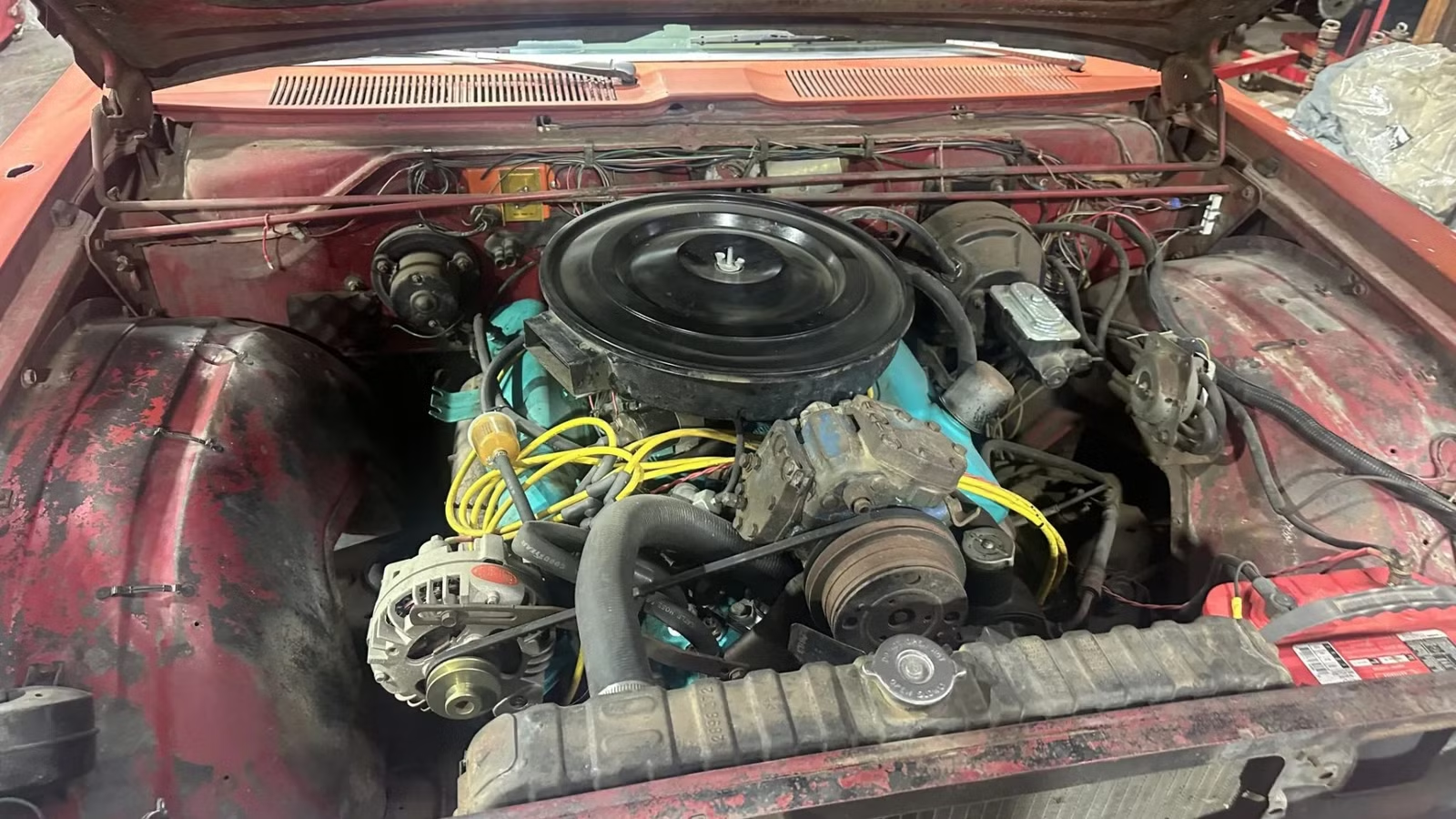
Instead, the crew found a car built on the kind of running gear normally reserved for full-size performance models. The engine bay carried a big-block V8 far beyond what a standard family wagon needed, paired to a transmission built to handle serious torque rather than gentle commuting. Nothing about the spec sheet matched the wood-paneled, three-row exterior wrapped around it, and that mismatch is where the real story starts.
Wagons of this size were rarely ordered with anything beyond base engines, since most buyers cared about seating capacity and cargo room over anything resembling performance. Whoever spec’d this particular Town and Country clearly wanted something different, and Chrysler’s order sheet let them have it without raising a single eyebrow at the dealership.
This 1968 Chrysler Town and Country Hid Interceptor DNA Under Its Wood Paneling

The wagon is a 1968 Chrysler Town and Country, and its factory engine explains everything about that mismatched spec sheet. Under the hood sits a 440-cubic-inch RB-series big-block, factory rated at 375 gross horsepower in this high-performance four-barrel configuration, a figure Chrysler reserved for its most serious full-size applications that year. That output ran through a TorqueFlite 727 three-speed automatic, a transmission built specifically to survive big torque loads without shredding itself, bolted into a wagon that also carried power windows, factory air conditioning, and seating for nine.
Curb weight tells part of the story too. Loaded with luxury equipment, this wagon tipped the scales at roughly 4,775 pounds, closer to a modern full-size SUV than to anything resembling a muscle car. A 440 with that much power was not there to chase quarter-mile records in a car this heavy. It was there because Chrysler built its full-size lineup on shared hardware, and that decision is what turned an ordinary family wagon into something else entirely.
The Shared C-Body Platform That Linked Wagons And Police Cruisers

Chrysler’s C-body platform underpinned nearly everything in its full-size range during the late 1960s, from luxury New Yorkers down to fleet-spec police cars. That shared architecture meant the same 440 big-block, the same TorqueFlite 727, and the same Torsion-Aire front suspension setup could show up in a highway patrol interceptor one week and a suburban driveway the next. Dodge built its Polara Pursuit package on this exact platform for law enforcement fleets, using the identical 375-hp 440 and heavy-duty running gear that Chrysler also offered on family wagons through the regular dealer network.
That is the part commentators tend to skip past when they cover finds like this. A 1968 family buyer walking into a Chrysler dealership with the right options list could drive home a drivetrain built for state trooper duty, wrapped in wood-grain paneling and stuffed with nine-passenger seating. Nobody advertised it that way, and nobody needed to. The parts bin did the work quietly, and buyers who checked the right boxes ended up with genuine interceptor-grade hardware without ever knowing the badge on their wagon and the badge on a patrol car shared a parts catalog.
What The 440 And Its Driveline Meant On The Road

Numbers from a mechanically comparable C-body police car put the real context behind this wagon’s drivetrain. A 1969 Dodge Polara Pursuit running the same 375-hp 440 Magnum with 3.23 rear gears posted a 14.3-second quarter mile at over 99 mph, a genuinely quick time for a full-size sedan built in that era. That figure belongs to the Polara, not the wagon, since the Town and Country carried extra weight from its longer body, third-row seating, and luxury equipment that the stripped-down cruiser never had to haul. What the two cars shared was the hardware doing the work underneath, not an identical track time.
For comparison, a 1968 Ford LTD Country Squire’s range-topping 428 FE big-block made 360 horsepower, a close rival on paper but one that never carried a documented pursuit-spec lineage the way Chrysler’s 440 did. Ford’s full-size wagon buyers got a strong engine option. Chrysler’s buyers got the same drivetrain state police departments were ordering by the fleet, just wearing a different body.
The TorqueFlite 727 And Torsion-Aire Suspension Behind The Numbers

The suspension side matters just as much as the numbers above. Torsion-Aire used front torsion bars instead of coil springs, a setup Chrysler leaned on across its full-size range because it held up better under sustained heavy loads, whether that load was squad car equipment or a station wagon full of passengers and cargo. Combined with the TorqueFlite 727’s reputation for durability, the drivetrain underneath this wagon was engineered to survive abuse that a typical family car never faced, which is exactly why it also worked so well wearing a badge.
That durability is also why so many of these drivetrains survive in running order today. Torsion-Aire and the 727 were built to shrug off fleet-duty mileage, and the same toughness that kept patrol cars on the road for years is a large part of why a $1,800 barn find could be brought back to life at all.
From Barn Find To Auction Block

The Gargantuwagon’s second act says more about where this market is heading than the Roadkill Garage episode alone ever could. David Freiburger held onto the car well beyond its television debut, and after passing through his hands again years later, the wagon sold at auction for $15,000 on May 18, 2026, more than eight times its original $1,800 purchase price. Other 1968 Town and Country wagons have traded hands for similar money on the open market recently, which suggests this one’s result was not a fluke tied to its television history alone.
Those numbers point toward something bigger than one lucky flip. Sleeper-spec full-size wagons built on shared police-fleet hardware are starting to draw real collector attention, not just from muscle car buyers chasing badge-name performance but from people who understand what a shared parts bin actually meant in period. A wagon that once sold new alongside patrol cars is no longer just a curiosity sitting in a barn. It is becoming its own quiet corner of the collector market, and prices are starting to reflect that.
Sources: Bring a Trailer, Chrysler, Roadkill Garage

Related posts
Latest Post



No Comments