
The “Slow” Sports Bike That Teaches You To Ride Like A Pro
Every year, new riders make the same expensive mistake: they skip the learning curve entirely and go straight for a liter-class superbike, convinced they’ll grow into it fast enough to justify the cost. The reasoning sounds logical — why spend money on a beginner bike you’ll outgrow in a season? But the moment that throttle snaps open on a 200-horsepower machine, the flaw in that plan becomes brutally obvious. Starting on a liter bike isn’t bold; it’s just a slower way to learn a faster lesson. The smarter path is to find a bike that genuinely teaches you to ride — one that’s capable enough to push your limits but forgiving enough to let you make mistakes without destroying your gear or your confidence. That bike exists, and it might surprise you.
Why Starting Slow Matters To Master Track-Riding

In the U.S., the moment you get a license, nothing is stopping you from buying a liter-class superbike, heading to your nearest track, and wringing its throttle to your heart’s content. But if you’re new to the sport, it’s easy to predict what will happen. You’ll either be at the back of the pack, being lapped by more experienced riders, while you struggle to control the bike’s power or figure out how to lean into a corner that’s constantly trying to get out from under you. Or, if you have bigger guts than brains, you’ll end up sliding across the gravel at the first fast corner.

As the saying goes, with great power comes great responsibility — and that holds especially true with high-powered sportbikes. They demand a much higher skill level and, critically, they offer very little margin for error. Make one mistake and they won’t hesitate to put you on the ground. Modern superbikes have become so capable — whether accelerating, turning, or stopping — that they’re genuinely risky for beginners, even with electronic rider aids doing their best to keep things in check.
That is exactly why the smartest track-day bike is not always the fastest one — it is the one that lets riders make mistakes without turning every mistake into a lesson learned the hard way.
Starting On Sub-500cc Sports Bikes Makes More Sense


That’s why it’s wiser to start on something that is forgiving. What does that mean? When you’re trying to master sports riding, you’re going to make many mistakes. We’ve all been there: entering corners too hot, not accelerating hard enough on the exits, or simply misjudging the powerband. A forgiving sportbike will let you work through those errors without testing your expensive riding gear. And typically, that forgiving nature comes packaged in a smaller-displacement machine.

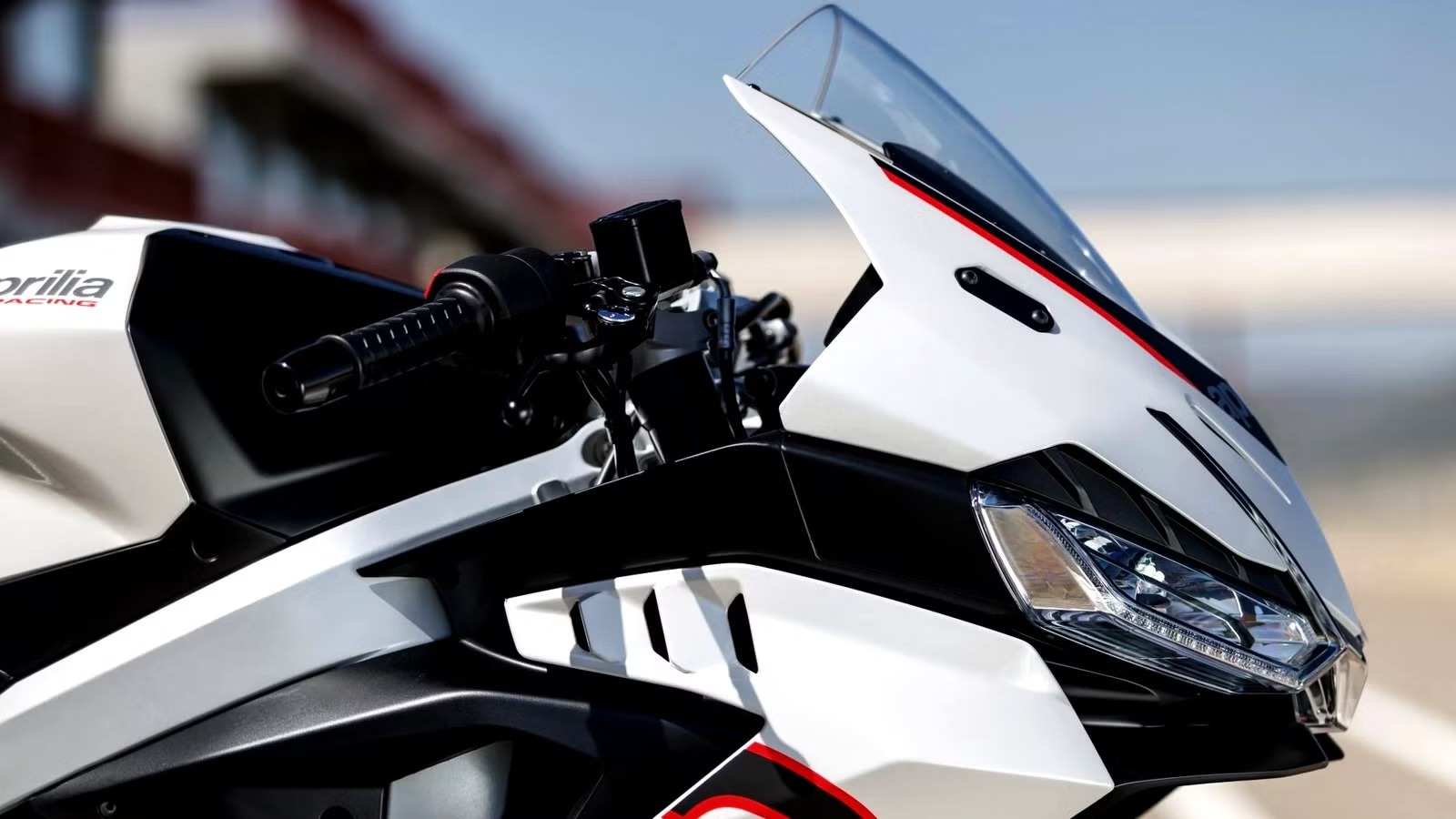
That doesn’t mean you have to master pro riding on a tiny beginner bike. The sub-500cc sportbike segment in the U.S. has grown considerably, and there are now several strong options to choose from. These bikes strike the right balance — forgiving enough to allow mistakes, yet capable enough to push your skill level and genuinely teach you things. One long-standing example is the KTM RC 390, but a newer contender has entered the arena and does it all better than the orange single: the Aprilia RS 457. This Aprilia walks the fine line between being highly capable and reassuringly forgiving.
The Aprilia RS 457 Is The “Slow” Sports Bike That Teaches You To Ride Like A Pro

Obviously, we had to look at the entry-level segment in the U.S. to justify the ‘slow’ in the title. At the same time, we had to take into account the overall riding dynamics and experience, since this would be your stepping stone to becoming a pro. Taking these factors into account, we think the Aprilia RS 457 is the perfect pick here. The driving force is its class-leading aluminum perimeter chassis.

This is something full-sized liter bikes possess — even most modern mid-weight bikes still rely on steel frames — which helps you get accustomed to the feel and feedback a bigger bike would provide. You’ll learn how the bike behaves under trail braking, how the rear steps out if you’re too aggressive with the throttle, and how the chassis responds to various inputs and weight shifts. The adjustable suspension adds another layer to that learning experience.

Beyond the chassis, the RS 457 also introduces you to the kind of electronics you’d find on a larger bike. You can start with ABS fully active: if it triggers, that’s immediate feedback that your initial brake application is too abrupt and needs refinement. As your technique improves, the 457 lets you reduce ABS intervention and switch it off at the rear entirely. The traction control serves the same purpose for the rear wheel, teaching you how smoothly and progressively you need to feed in the throttle.
That makes the RS 457 more than a beginner sportbike, but its bigger surprise is how neatly it fits into the return of motorcycles that are fun on track without being miserable everywhere else.
The Return Of The Everyday Sportbike

For years, riders looking for a fully faired sportbike faced a difficult choice. Entry-level machines often prioritized affordability over excitement, while supersports became increasingly focused on outright performance. The result was a shrinking middle ground for riders who wanted sharp styling and engaging dynamics without committing to a high-strung, high-maintenance machine.

That gap has largely disappeared over the past few years. Manufacturers have recognized the growing demand for motorcycles that deliver a genuine sportbike experience while remaining practical for everyday use. Models such as the Kawasaki Ninja 500, Yamaha R3, KTM RC 390, and Aprilia RS 457 have created a segment that blends performance, comfort, fuel efficiency, and reasonable ownership costs.
The RS 457 stands out because it arrives at a time when riders are increasingly prioritizing usability over headline-grabbing horsepower figures. Modern electronics, longer service intervals, improved build quality, and competitive pricing have made smaller-displacement sportbikes more appealing than ever. Rather than serving merely as stepping stones to larger machines, many of these bikes are becoming long-term ownership choices for enthusiasts who value real-world riding enjoyment over outright speed.
But the RS 457’s real test is whether it can justify costing more than several familiar rivals in a segment where value matters almost as much as lap times.
The Aprilia RS 457 Sells For $6,799

Let’s talk about pricing first. The Aprilia RS 457 starts at $6,799 in the U.S., while the MotoGP-inspired Racing Stripes livery costs $100 more. At that price, it sits above the Honda CBR500R and the Kawasaki Ninja 500 SE ABS. We think the premium is well justified given what this motorcycle offers — particularly the aluminum chassis — and the extra features only strengthen its value proposition further.
But the RS 457’s real advantage is not only in the price or spec sheet — it becomes clearer when you stack it against the bikes most riders will cross-shop first.
Stacking Up Against The Rivals In The U.S.
Other than the 457, the Kawasaki Ninja 500 deserves a mention, too. Unlike the 457, this Ninja is all about getting the bare basics right. It has a much simpler package — telescopic forks, a trellis frame, and an even-firing parallel-twin engine — so it will serve you well as a foundation for learning the fundamentals. That said, we think you’ll hit a plateau with it sooner than you would with the RS 457. The same applies to the Honda CBR500R, which simply lacks the finesse needed to push your limits and help you become a meaningfully better rider.

The KTM RC 390 remains an excellent contender in the U.S. for getting your basics right. It features a high-revving single-cylinder engine known for its punchy top-end, underpinned by a sharp trellis frame and WP Apex suspension. The RC 390 is still a capable mini-supersport, but the thumper engine gives it a gruff character, and the platform is starting to feel its age — especially given that the rest of the 390 lineup has already moved to an updated architecture. That’s the primary reason we’ve picked the RS 457 over any other small-displacement sportbike currently available in the U.S.
How The RS 457’s 385-Pound Weight And Adjustable Suspension Make It A Better Track Teacher

On track, the RS 457’s biggest advantage is how clearly it communicates weight transfer, braking load, and tire behavior without overwhelming the rider. Its 41 mm USD fork and adjustable monoshock give riders room to fine-tune the setup as pace improves, while the aluminum chassis helps the bike feel more stable and responsive than many entry-level sportbikes built around simpler hardware.
The main track-day limitation is brake fade during repeated hard laps in hot conditions, especially once riders begin braking later and carrying more speed into corners. Riders planning regular track use can address that weak point with Aprilia’s official race pads, which are sold as an accessory. That matters because the RS 457 is not just trying to feel sporty for a test ride; it is built to give newer riders repeatable feedback as they learn braking markers, corner speed, throttle timing, and body position.
The Aluminum Frame Helps Keep The Weight Low

From a distance, the RS 457 looks like a full-sized motorcycle — and it feels that way from the cockpit, too. But the aluminum frame keeps the wet weight down to just 385 pounds. That is almost 40 pounds less than the Honda CBR500R and only marginally more than the Kawasaki Ninja 500 SE ABS.
There’s No Lack Of Punch On The Aprilia RS 457

While this is an entry-level bike, the RS 457 has enough punch to keep experienced riders entertained as well. The 457cc parallel-twin engine uses a 270-degree crankshaft to spread its 47 horsepower and 32 pound-feet of torque across a wide rev range. That translates to strong tractability on the street and the ability to carry a gear higher through tight corners without sacrificing drive on the exit.
In comparison, a Ninja 500 — with its conventional firing order — needs to be revved harder to generate the same drive. The spec sheet confirms it: the RS 457’s torque peaks nearly 1,000 RPM earlier than the Ninja 500. There’s no shortage of top-end performance either, with the RS capable of reaching 124 miles per hour.
Class-Leading Electronics Keep You Safe

All that torque can get away from you quickly when grip is limited, so Aprilia has equipped the RS 457 with a genuinely impressive electronics suite. The package includes ride modes, engine maps, an anti-wheelie system, traction control, and dual-channel ABS with two levels of intervention. All of it is accessible through backlit switchgear and a crisp five-inch TFT instrument cluster. No other bike in this segment comes close to matching that electronic package.
Source: Aprilia

Related posts



Latest Post



No Comments