
100,000 Miles Is Nothing For These 10 Unbreakable Motorcycles
With most cars having relaxed engines with multiple cylinders and low compression ratios, 100,000 miles feels like a common occurrence in the four-wheeler world. But in the two-wheeler world with compact engines and high redlines, this is a rare feat only a few motorcycles can proudly promise. Japan obviously leads the way in this regard, owing to its manufacturing know-how. So most bikes on this list hail from there. But some British, European, and American examples aren’t far behind. Oh, and there’s even a superbike in there!
Suzuki V-Strom 650
Price: $9,299

The V-Strom 650 has been in production since 2004, while its 645cc V-twin engine debuted in 1999. Since then, the bike and the engine have remained largely unchanged. That means you’re getting an old package here with barely any new-age elements to excite you. What that also means is that reliability is mind-boggling.

100,000 miles are common for the ADV (and for its naked SV sibling) with regular maintenance and original engines. Plus, should you face any issues, there’s extensive aftermarket support for easy fixes. You need to hurry up, though, as the V-Strom 650 finally seems to be bowing out of production (with the 2027 SV-7GX taking over duties).
Honda Rebel 1100
Price: $9,699


Research ownership forums and you’ll realize 50,000 miles is no big feat for the Rebel 1100. Add to that the fact that this is running an even less-stressed engine from the Africa Twin, and 100,000 miles seem like a piece of cake for the cruiser. That’s why it’s here.

What also works in its favor is its high-value proposition. There is no other over-1,000cc cruiser under $10,000 today, and whatever you do get in the 900-1000cc range feels a bit dated overall. In comparison, the 1100 just received an update last year, where it gained a new seat, a TFT, and some other nitty-gritty tweaks.
Triumph Bonneville T120
Price: $13,995

Triumph is Britain’s largest bikemaker, and credit for that legacy just might go to the Bonneville in context. This moniker harks back to 1959, always focusing on simplicity and reliability rather than chasing extremes. That approach is what helps the T120 last forever, with ownership portals backing that up.

Yes, the latest-gen machine does have more tech than ever before, comprising a six-axis IMU and electronic aids. Those might seem like added failure points, but the crux of the matter remains proven. You get the highly proven 1,200cc parallel-twin mill, a sturdy double-cradle chassis, and simple KYB suspension. So dependability is still solid as ever.
Honda Africa Twin
Price: $15,199

If you want a full-size ADV that will keep on going longer than you, the Africa Twin is the answer. Much of the credit here goes to its brilliant 1,084cc parallel-twin engine, which has been honed for over a decade with incremental updates. It’s in its most polished form right now, promising more torque than ever.

*Adventure Sports shown
You can also say that about the DCT. Although a unique inclusion in the ADV space, Honda has improved its dual-clutch gearbox over the years to practically last forever. There are several DCT-equipped Africa Twins regularly crossing 100,000 miles on forums, and one owner even took this to over 500,000 miles. All with regular maintenance!
Suzuki Hayabusa
Price: $19,699

An over-190 HP hyper bike lasting over 100,000 miles feels borderline cuckoo. Yet, that’s exactly what the second-gen Hayabusa did repeatedly. You can even find owners with over 200,000 miles with the original engine! The latest Hayabusa deserves the hype, too, as it has that same engine, but tweaked with new internals and a slight drop in power to reduce the stress. So you’d better believe this will happily do six-digit odometer figures with ease.

However, you should know that the price of admission is higher than ever. Suzuki has steadily hiked the price since the gen-3’s debut, and it currently stands close to $20,000. That is $3,000 pricier than a couple of Japanese liter-class superbikes and in the ballpark of European superbikes like the 220-HP Aprilia RSV4.
Honda Gold Wing
Price: $25,500

Since its debut, the Gold Wing has been the gold standard of flagship touring bikes. The six-cylinder engine has been the focal point here, and in its current avatar, this really is in its most refined form. So much so that high mileage is simply not a big deal on owner forums.

100,000 miles is a regular occurrence, with a few riders breaching that figure in merely two or three years of ownership. This also goes to prove just how trustworthy the rest of the mechanical package is, even though the suspension and chassis are very different to its rivals. All this while, the price tag is still considerably lower than its American rivals.
Indian Roadmaster
Price: $34,999

Indian has some solid engines on offer today, many of which are fully liquid-cooled to stand out in the American V-twin space. However, if you want effortless 100,000 miles, the Thunderstroke 116 is the way to go. This mill has been one of the most trustworthy air-cooled V-twins in the touring bike space, with several owners breaking into the six digits.

Oh, and with the Roadmaster, you also get a machine that is built for these long journeys. Right from the massive two-up perch to the large fairing, all elements here want to keep you going for hours in comfort. We also dig the heavy chrome usage here–something that’s absent on the PowerPlus variants.
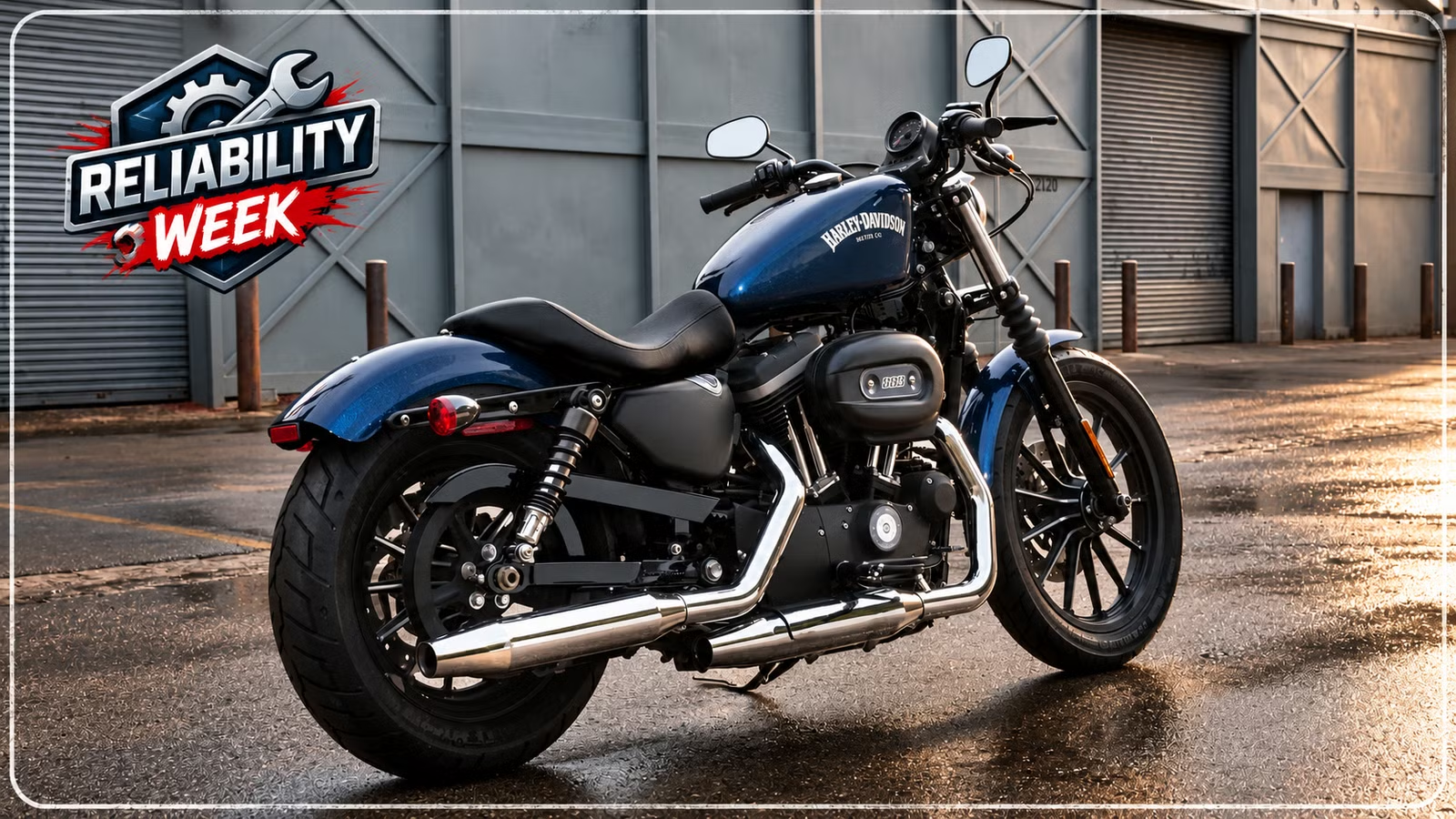
Harley-Davidson Iron 883
Used Price: ~$7,000

The Milwaukee-Eight is good, but the Evolution is the OG reliable Harley engine, with its origins dating back to the late 1980s. Over the years, Harley improved the mill repeatedly, and the Iron 883 was truly the finished product. That’s why these simple engines keep on going practically forever, well beyond six-digit odometer figures.

In addition to simplicity, this is a really understressed powertrain as well. Despite having two cylinders and near 900cc of capacity, the output is just 50 horsepower and 50 pound-feet. The former is in the ballpark of a single-cylinder, 399cc KTM 390 Duke!
BMW R 1250 GS
Used Price: ~$14,000-18,000

As good as the R 1300 GS is, it is a new bike, with a largely overhauled powerhouse featuring more new tech over its predecessor. So there isn’t enough high-odo ownership data yet, which means if 100,000 miles is your goal, the R 1250 GS still gets our vote. Ownership portals are full of high-mileage examples running fine with simple maintenance and no mechanical issues whatsoever. You will even find owners who have covered over 200,000 miles in just two or three years.

A not-so-nice countereffect, though, is the used bike value. These bikes hold their prices well, meaning you can expect to pay an average of $15,000 for a clean 2021 R 1250 GS. That is just ~$4,000 less than a new base-spec R 1300 GS.
Harley-Davidson Road Glide 114
Used Price: ~$19,000

The Milwaukee-Eight engine has proven to be really reliable since its inception, and the 114 just might be the gold standard in terms of dependability. Several American owners have over 100,000 miles on 114-powered machines, most commonly among which are the baggers like the Street Glide and Road Glide. The dependability is further boosted by the simple package.

Harley’s focus on tech was much lower during these times than it is today, with barely any failure points and largely analog equipment. We would, however, recommend frequent oil changes and staying on top of maintenance if you want your Milwaukee-Eight to reach six digits.
Source: Various Manufacturers, KBB

Related posts


Latest Post


No Comments