
The Plymouth Muscle Car That Quietly Turned Into A Blue-Chip Classic
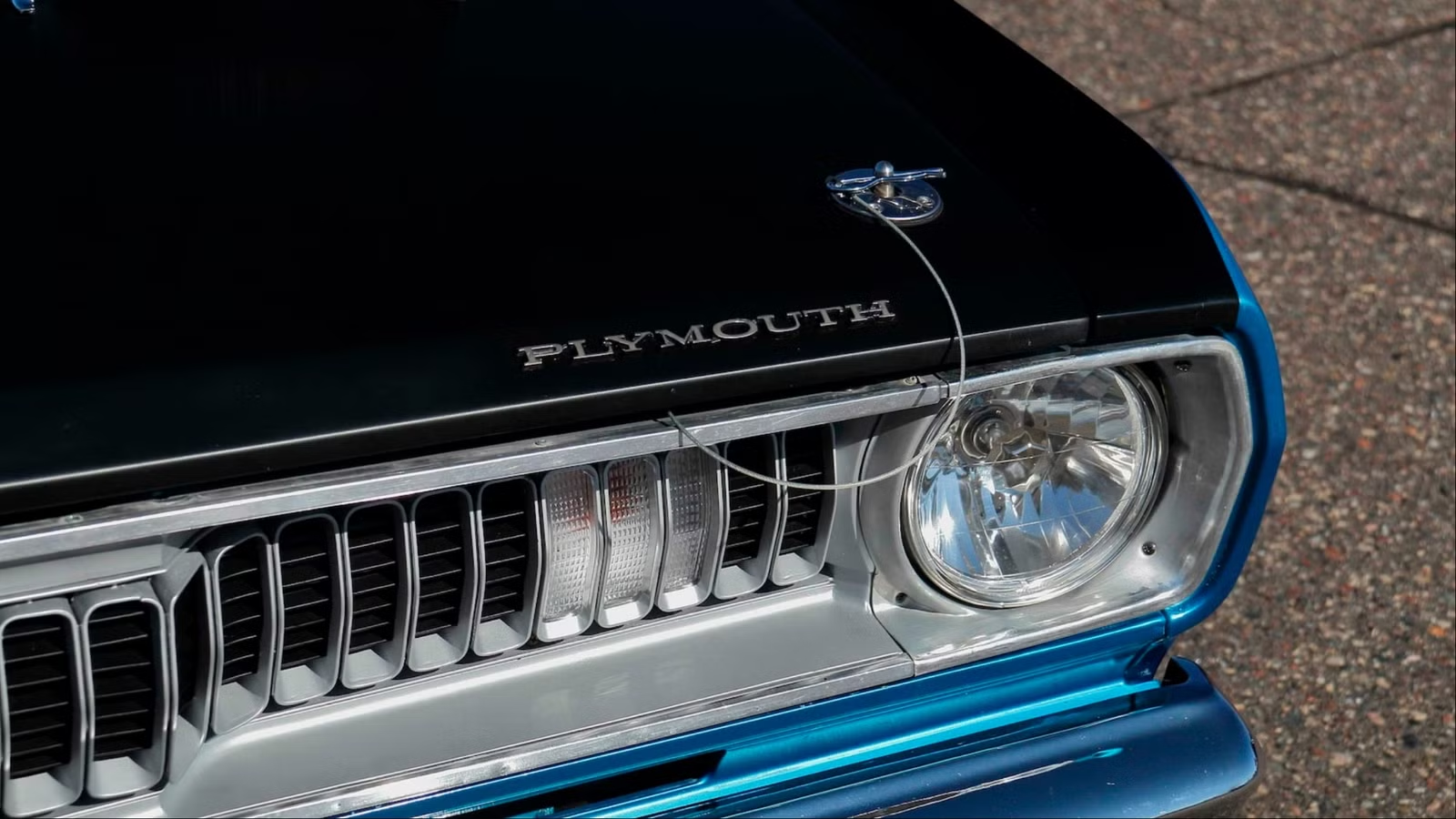
From the beginning, classic era Mopar muscle cars were recognized as the coolest of the Golden Age and potentially collectible. From the second the ’69 Dodge Daytona or ’70 Plymouth Hemi ‘Cuda hit the dealer lots, people knew they were keepers with massive upsides in value for the future. Even rides like the second-gen Charger or first-gen Road Runner seemed important beyond their time, and owners tended to take care of them with an eye on a lucrative long-term flip.

Not all Mopars, however, were tagged as collectible and didn’t get that A-list star treatment, being relegated to the bargain bin. B-bodies like the third-gen Charger and second-gen Road Runner were ignored by collectors until just recently, and now they are among the most valuable classics on the market. There are others that have also turned things around in dramatic fashion, including a slept-on Plymouth that has quietly become an auction dynamo and surprise big-money collectible.
Mopar Muscle Car Royalty
The 1968-1970 Dodge Charger R/T wasn’t just the King of the Mopars, but the Grand Poobah of the entire Golden Age of American Muscle with killer styling and lethal big-block performance. Give yourself five extra HotCars points if you got the Flintstones reference. Rounding out the Royal Court of Mopar was the upscale Plymouth GTX as well as the divine E-body Dodge Challenger Hemi R/T and Plymouth Hemi ‘Cuda. That’s how things stood back in the day, but the third-gen Charger and second-gen Road Runner have more recently claimed their share of the royal Mopar bloodline, and now stand with the titans as the most desirable and valuable classic muscle cars.
Million-Dollar Mopars


Classic muscle cars have become serious collector items, but classic Mopar muscle is getting into the realm of vintage European sports cars in terms of dollars needed to land one at auction. Except for a 1970 Pontiac GTO Judge Ram Air IV convertible that sold recently for $1.1 million, no regular production Ford or GM muscle car has come close to cracking the million-dollar threshold. Mopars, on the other hand, crack it and shatter it with record-setting gavel drops. A 1970 Plymouth Superbird sold for $1.65 million, a 1970 Dodge Challenger Hemi R/T convertible crossed the block at $1.8 million, and a 1970 Daytona blew it up with a $3.3 million sale. As impressive as those are, the 1971 Plymouth Hemi ‘Cuda convertible is the real star of the show with a $3.3 million sale, a muscle car best $3.5 million showing, and a $4.8 million bid that failed to hit the reserve.
Dodge D-List and Peripheralized Plymouths

Not all classic Mopars share the spotlight, and the Dodge Coronet R/T is a prime example of a killer ride that simply doesn’t get the respect it deserves. While not exactly slumming it, the Coronet R/T, especially the amazingly styled 1970, is only half as valuable as its higher-profile contemporaries. The Dart, however, is a low car on the totem pole as the most dismissed Dodge classic. The first-gen Plymouth Road Runner, despite being built with Mopar awesomeness, suffers a similar lack of recognition as the Coronet R/T from collectors, being the most affordable classic Mopar. Then there are the basement-dweller first, and second-gen Barracudas that are practically free on the used market, as well as the Plymouth Duster, but that last one has been rising in profile and price for the muscle car feel-good story of the decade.
The Most Criminally Overlooked Mopar Muscle Car
Chargers and ‘Cudas were kings of the streets back in the day, but this forgotten Mopar definitely earned a spot in the muscle car hall of fame.
Criminally Slept-on 1970 Plymouth Duster

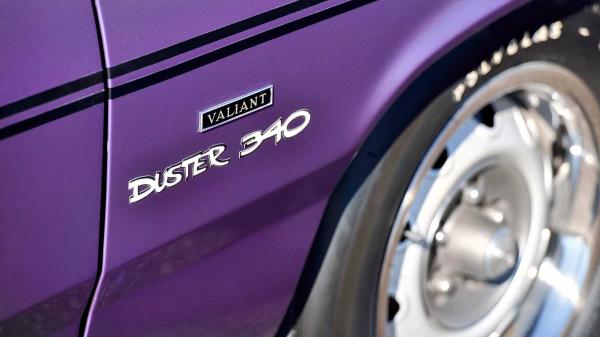
For the most part, Plymouth got Dodge hand-me-downs, as the Road Runner and GTX were their versions of the Coronet, and even the gonzo third-gen Barracuda was an E-body version of the Challenger. In 1970, Plymouth got something of their own in the Duster, which was built on the A-body Dart/Valiant platform, but instead of boxy blandness, had incredible Coke bottle and fastback styling. The Duster 340 came with an optional black-out hood with twin scoops and an aggressive stance that almost looked raked. While a compact with a small-block, the ’70 Duster 340 was as capable as any intermediate Mopar muscle car.
The ’70 Duster 340 was available in all the wildest Mopar High-Impact paint codes and had very cool stripes and decals to really make it a looker. Plymouth had tried to license the Tasmanian Devil from Warner Bros. like they did with the Road Runner cartoon character for the Road Runner, but the price was too steep, so they came up with a tornado logo and never looked back. The Duster, in general, was a smash success, and the 340 was priced right at just $2,547, moving 24,817 units. In a total role reversal, the Duster was such a hit that Dodge demanded their own version, which became the sloppy-seconds 1971 Demon.
Underrated Chrysler 340

The Duster 340 obviously derived its name from the 340ci V-8 under its hood, which, in 1970, when 426 Hemis and 440 Six Packs were ruling the roads, didn’t blow any minds. This small-block, however, was no golf cart engine, with 275 hp and 340 lb-ft of torque providing plenty of performance to the compact muscle car. Featuring a four-barrel Carter AVS carb, performance cam, and intake, as well as dual exhaust, this diminutive engine was ready to perform, especially when paired with the optional four-speed manual transmission. For the record, 340 cubic inches are about 5.6 liters, which is nearly the 5.7-liter Hemi V-8 that brought Mopar performance back to prominence in the early 2000s. Big-blocks were all the rage in the Golden Age, but now it’s all about the small-block, including the supercharged 6.2-liter Hemi Hellcat, which can reach over 1,000 ponies.
Kicking Up a Cloud of Dust

Hemi and Six Pack-equipped Mopars set the Golden Age standard for 13-second rides, while GM eventually got there in 1970 with the Chevy Chevelle SS 454 LS6 as well as the Buick GSX Stage 1. The reality of the classic era, however, is that almost every single muscle car ever sold was running in the 14s or 15s, so the compact small-block ’70 Duster was anything but slow. In fact, considering its low price, it was probably the best value for a street machine with an unbeatable performance-to-cost ratio. With quarter-mile ETs in the 14.7-second range, and a 5.8-second 0-60 acceleration, the Duster 340 definitely smoked a lot of more expensive top-performance big-block cars like any Ford or Mercury with a 428 Cobra Jet. For context, a 1970 Ford Mustang Mach 1 428 only produced 335 hp and ran the quarter-mile in 14.5 seconds, both of which are underwhelming by comparison.
The Duster Rising Auction Star

Not long ago, a perfect-condition, numbers-matching ’70 Duster 340 survivor car would be lucky to hit $50,000 at auction, but the times they are a-changing. That triple-black beauty pictured above sold for $104,500 at Mecum Kissimmee 2024, marking a rare instance where a classic Mopar small-block hit six figures, with the 1970 Dodge Challenger T/A and Plymouth AAR ‘Cuda being the others. The car underwent an extensive restoration, so it is exceptional, but not an anomaly, as another ’70 Duster 340 crossed the block at $99,000 at the very same auction. With those two sales, the 1970 Duster 340 went from an afterthought to a Mopar elite collectible, which is basically the plot of every sports underdog movie from Slapshot to The Bad News Bears.
’70 Duster Prices and Values

Exceptional examples of the 1970 Duster 340 are now elite collectibles, but as a whole, this is still an attainable classic Mopar. Hagerty sets the value for a home mechanic’s special at $15,600 to an auction-darling Concours-condition ride at $85,000, which is, as we’ve already seen, severely undervalued. Right there in the sweet spot is the good condition value of $29,000 for a running and driving Duster 340 with no major flaws or defects. That’s a solid price too, as there have been many Duster 340s in great shape that have sold at all the major auction outlets for that or even less. That nearly perfect numbers-matching orange goblin pictured above sold for $31,900 not long ago, so while this is a car on the move, it’s also one normal muscle car fans can still afford.
Rapid Transit Duster

In the early 1970s, Plymouth built a series of one-off cars with radical design elements and crazy paint schemes to promote their performance vehicles. Known as the “Rapid Transit System”, these oddly cool rides went on tour to dealerships and local events to show the public what Plymouth was capable of. One of those striking conversation pieces was a 1970 Plymouth Duster 340 that was actually the best-looking in the bunch, as both the Road Runner and ‘Cuda were a bit unconventional in their styling. In any case, this one-of-one compact small-block destroyed Mecum Indy 2019, selling for an astounding $264,000. It’s as rare as a car can be with only one example, but that’s still a remarkable score for a car that nobody even acknowledged ten years ago.
10 Movies That Prove The Second-Gen Dodge Charger Is A Hollywood A-Lister
This iconic muscle car has maintained Hollywood superstardom for almost 50 years, proving its unmatched star power across countless films.
Duster Legacy Enters New Chapter

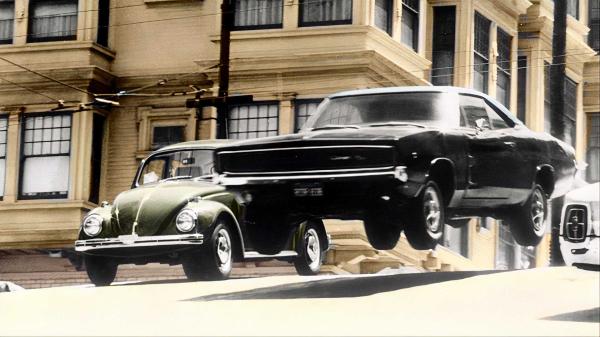
The black ’68 R/T villain car in the Steve McQueen classic Bullitt put the second-gen Charger on the map, while the ’69 General Lee from the Dukes of Hazzard classic TV show kept it relevant, but Dominic Torretto’s supercharged ’70 R/T of the Fast & Furious franchise made it a superstar. Pop culture penetration is important for a car, as it can literally make it an icon. The otherwise unremarkable DeLorean DMC-12 time machine from Back to the Future is legendary, while the seriously cool Mercury Cougar, which hasn’t been in anything, is largely anonymous.
The ’70 Duster 340 got a chance to shine in the 2025 HBO Max streaming series Duster, with major screen time in every single episode. Despite being a spectacular show with amazing acting, top-notch action sequences, and a compelling story, the show was canceled, with a major cliffhanger to boot. Regardless, enough people enjoyed the series, and the Duster 340 got a chance to shine, which continues this car’s upward trajectory as a blue-chip collectible.
Sources: Hagerty, Mecum

Related posts




Latest Post


No Comments