
The Forgotten Japanese Bike That Changed Sportbikes Forever
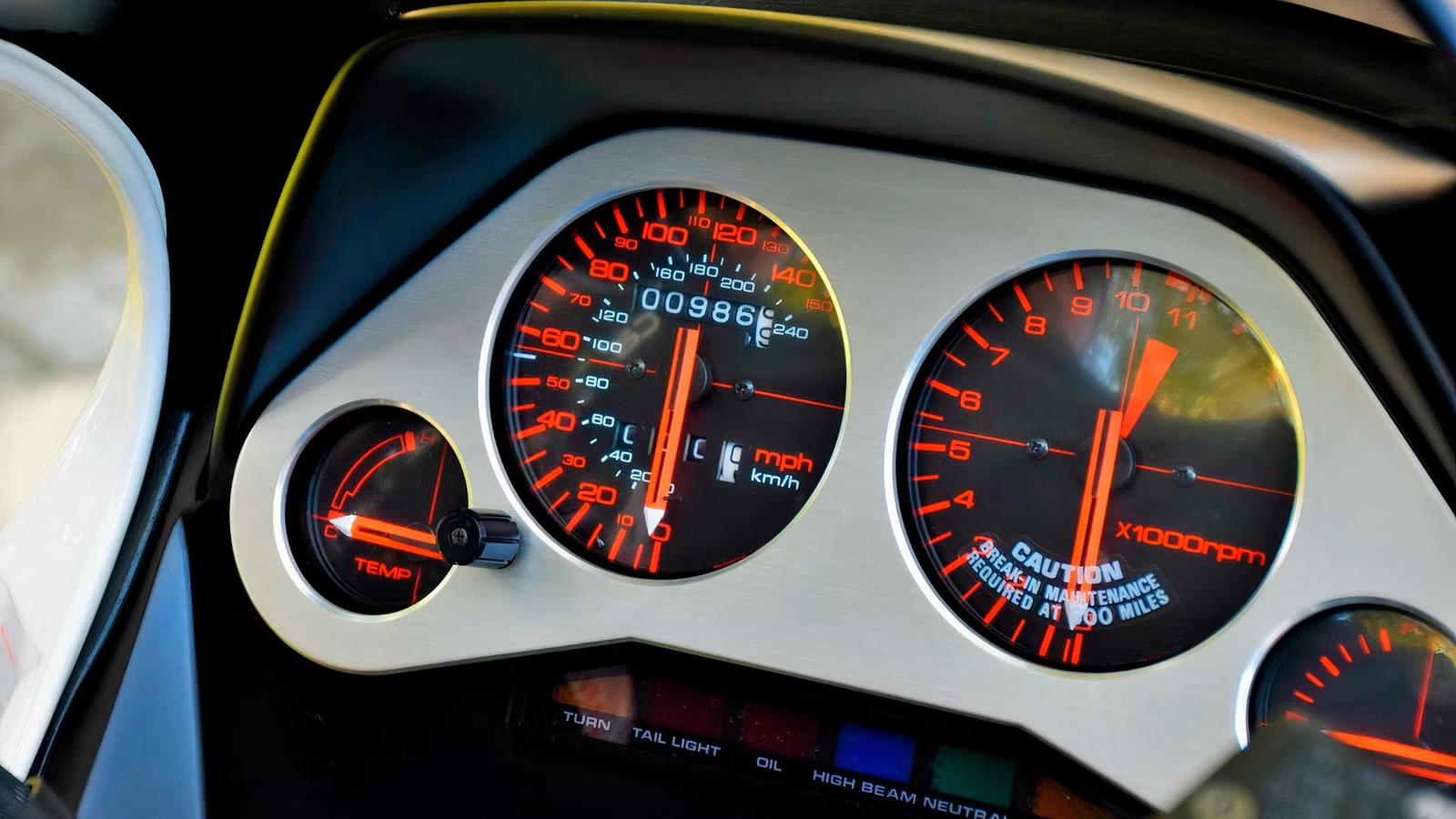
If you were around in the early ’80s, you’d have witnessed the fact that Japanese motorcycles had become spectacularly fast, and yet outright speed was beginning to expose everything around the engine. In essence, horsepower had moved on faster than chassis design.

Then one bike arrived in America that essentially flipped the script altogether, like something the racing department had accidentally given turn signals.
Japan’s motorcycle industry entered the ’80s in full attack mode. Double-overhead-cams were becoming more common, electronic ignition was spreading, and all four major Japanese manufacturers had production turbocharged motorcycles by 1983. The numbers were getting serious. The only problem was that much of the thinking underneath those motorcycles still belonged to the previous decade.

American performance buyers had also been trained to judge fast motorcycles by the simplest numbers available: quarter-mile acceleration and top speed. That made sense when the big Japanese machines of the ’70s were essentially enormous engines asking their frames to keep up. Racing, however, made the weakness harder to ignore, because turning those street bikes into competitive superbikes required extensive chassis work before anyone could confidently throw slick tires at them.
Honda already had part of the answer sitting in its parts bin. Its 90-degree V4 had appeared for 1982 in the shaft-driven Magna and Sabre, but installing a clever engine in another conventional road motorcycle wasn’t going to redefine the sportbike. What mattered next was building the entire motorcycle around performance rather than treating handling as an afterthought once the horsepower department had finished its work.
A New Superbike Rule Forced Honda To Start Over

The push came from AMA Superbike racing. For 1983, the class displacement ceiling dropped from 1,000cc to 750cc, and the race motorcycles had to be production-based. Honda suddenly needed a street bike whose basic architecture was already suitable for serious competition. Trying to persuade another heavyweight road bike to behave on a racetrack wasn’t going to cut it anymore.
You can see the issue facing Honda here. It effectively worked backward from racing. The road bike existed because the race bike needed to be legal, making the project an early example of the homologation-special mentality that would become enormously important to performance motorcycles.
Proving The Concept

Honda had been testing an all-black development mule at Daytona before the production machine appeared, with AMA personnel involved to make sure it would qualify. Even the bodywork became part of the argument. Worth noting is that the chin spoiler fitted to the street bike wasn’t permitted for Superbike competition because officials considered it too much streamlining.
All said and done, the approach worked immediately. Honda riders swept the first three positions at the Daytona Superbike race, and the new machine ultimately won eight Superbike races during its debut season. Wayne Rainey and Kawasaki still took the championship, but Honda had proved the concept. A production motorcycle designed with racing in mind could arrive competitive without first being transformed beyond recognition.
The 1983 Honda VF750F Put Racing At The Center Of Everything

This all leads to the 1983 Honda VF750F V45 Interceptor, and this is where the modern sportbike starts looking pretty familiar. Its 45.8ci liquid-cooled V4 produced a claimed 86 horsepower at 10,000 rpm and 46.3 lb-ft of torque. Honda mounted it inside a rectangular-section steel perimeter frame rather than relying on the more traditional chassis thinking surrounding many big Japanese performance bikes.
The chassis hardware showed how far Honda was willing to go. There was a 16-inch front wheel intended to sharpen steering, while the rear used a single Showa shock instead of twin units. The fork incorporated brake-actuated anti-dive, and triple disc brakes handled stopping duties. At 487 pounds dry, the Interceptor was hardly a modern featherweight, but the important change was where Honda had put its engineering effort.
The VF750F used a one-way overrun arrangement that functioned as an early slipper clutch, which was the first such application on a street motorcycle. Riders today expect slipper clutches on performance bikes because they help manage engine braking during aggressive downshifts. Honda was putting the idea into American showrooms more than four decades ago.
This was pretty impressive, but perhaps the bigger breakthrough was less tangible. Honda had stopped treating the engine, chassis, and rider as separate problems. The Interceptor was developed as one performance package, which sounds plainly obvious in 2026 because practically every serious sportbike now follows that logic. In 1983 though, it was sufficiently novel that Honda itself reportedly hadn’t expected huge sales. American riders had other ideas, however, and the Interceptor became a massive hit.
Its V4 Made Serious Speed Feel Almost Too Easy

For all the clever hardware, the Interceptor still had to be fast enough to make the argument stick, and it was. Testing at the time recorded an 11.9-second quarter-mile at 112 mph, while top speed was roughly 134 mph. But once you set the numbers aside, what was more revealing was how the V4 delivered its performance. Its useful power spread meant riders didn’t need to keep the engine constantly pinned near redline to make progress.
That broad delivery mixed with light, precise steering to get you a motorcycle that could gather speed with virtually no effort. Testers at the time found that the Interceptor felt slower than it actually was because the engine pulled strongly from low in the rev range. Two testers even attracted police attention during one evaluation. Apparently, Honda had developed serious performance and an unofficial roadside interaction program at the same time.
Imperfect Legacy

This is not to say that the Interceptor was without its issues, though. The crouched riding position wasn’t especially pleasant at lower speeds, and the bike didn’t enjoy the tiny throttle openings required for sedate riding. More damaging were engine problems that began surfacing by 1984 and were eventually associated with the camshafts, souring the reputation of Honda’s early V4. The Interceptor could’ve had a cleaner legacy without that baggage, but engineering history rarely bothers with neat endings.
The Formula Won Even After The Interceptor Was Forgotten

The original VF750F Interceptor survived only three model years before the VFR750F replaced it. Honda’s next generation improved the formula with an aluminum spar frame and gear-driven cams, while sportbikes from Suzuki, Kawasaki, and Yamaha were rapidly raising the stakes. The first Interceptor had barely finished introducing the idea before the industry began developing it rapidly.
As far as influence goes, there’s some strong evidence. The Suzuki GSX-R750 would push much harder on low weight, but the basic market had already changed. American riders had discovered that accurate, responsive handling could sell motorcycles every bit as effectively as a heroic quarter-mile rocket. Honda had built the VF750F primarily to satisfy racing requirements and discovered a customer base waiting for exactly that sort of road bike.
Dirt Cheap Valuations

Racing continued to validate the V4 concept as well. Although Honda missed the 1983 AMA Superbike riders’ championship, Honda V4s went on to win the next five titles. The original Interceptor’s legacy therefore runs deeper than its short production life suggests. It helped establish the idea that lessons from the racetrack should shape the production sportbike from the beginning, rather than being applied later with a welder and considerable optimism.
As for how the market values it today, the result is something of a letdown. Current values put a 1983 Honda VF750F V45 Interceptor in impeccable condition at about $8,600, and those are quite hard to come by, so it’s more likely that you’ll get one for far less. For a Japanese motorcycle that helped redraw the sportbike blueprint in America, that’s pretty attainable. Odd, isn’t it? The VF750F changed what riders expected from a fast motorcycle, then watched its descendants sweep up all the glory.
Sources: National Motorcycle Museum, Hagerty, Motorcycle Specs, Cycle News, TopSpeed.

Related posts

Latest Post


No Comments