
The Motorcycle That Makes Practicality Feel Exciting
Riding a high-strung sportbike from Honda or Kawasaki to and from work every day sounds really cool until you hit your third red light in five minutes. Your wrists get tired, your back can start to hurt, and every expansion joint on the highway feels like a personal insult. The alternative isn’t a lot better. Hauling a 550-pound adventure rig through rush hour means wrestling a tall, top-heavy barge through traffic just to squeeze into a tight parking spot at work.

Riders have put up with this nonsense forever. Some of us are lucky enough to have more than one motorcycle to choose from to shake it up a bit, but not everyone has that kind of space or money. Showrooms force a bad choice between sterile commuters that sip gas but feel like electric appliances, or massive touring bikes that cost $25,000 and weigh a ton. Yamaha saw that gap and built an oddball. By dropping a rowdy three-cylinder engine into an upright street frame, it turned out a bike that handles daily work without feeling completely soulless.
Why Most Practical Motorcycles Feel So Boring
Accountants have a great way of ruining practical motorcycles (or just about anything, really). When engineers build a middleweight commuter, budget caps and low insurance ratings take priority over chassis dynamics and engine soul. What you get is a boatload of predictable parallel-twins. They get you to work five days a week without breaking down, but they don’t really give you a reason to take the long way home on Friday afternoon.


Under the body panels or fairings, you can see where accounting saved a dollar. Most middleweight commuters run budget suspension with non-adjustable valving that wallows in fast corners and slams over potholes. The motors are, of course, tuned for clean tailpipe emissions and fuel economy rather than fun. In the end, you get an exhaust note like a sewing machine that runs out of breath the second you merge onto a 75-mph highway.
The Yamaha Tracer 9 Makes Practicality Feel Exciting

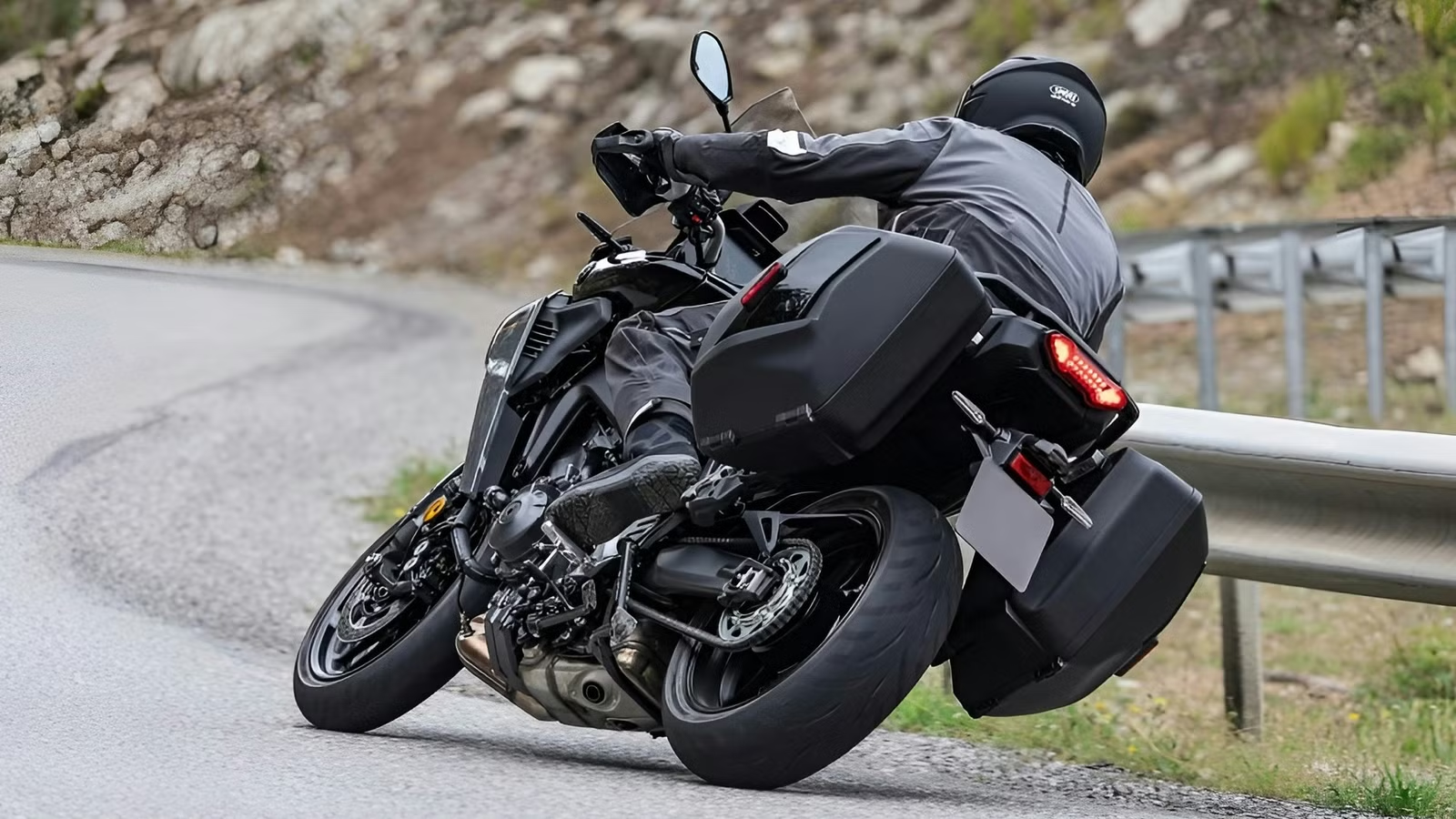
The Tracer 9 breaks out of that commuter box by keeping the punchy personality of a naked streetfighter. Tipping the scales at a manageable 483 pounds wet, this bike stretches out over a 59.1-inch wheelbase that keeps the frame settled when you’re hauling down the interstate. It trims off the unnecessary bulk of traditional heavyweight tourers while preserving the natural seating position you need to stay comfortable all day long.
The Tracer is essentially an MT-09 that hit adulthood but still lifts weights on weekends. You sit completely upright with zero weight on your wrists. Sitting tall like this also gives you a commanding view over low-speed traffic and plenty of legroom to avoid knee cramps. By shaving unnecessary metal off the main aluminum frame, Yamaha built a motorcycle that feels light in tight urban parking lots while remaining rock-solid when semi-trucks blow past you on the highway. But a bike can have great ergonomics and still bore you to tears on Tuesday morning. What keeps the Tracer 9 from becoming just another appliance is what’s underneath the tank.
At $12,599, It Undercuts Big Tourers By Thousands — With The Same Electronics

The price of this motorcycle is where it stops looking like a compromise and starts to look like a solution. The Tracer 9 comes in at $12,599, a price that undercuts big-bore touring rigs by thousands of dollars while still giving you a full electronic suite anchored by a six-axis Inertial Measurement Unit. That brings lean-sensitive traction control, slide control, and front-wheel lift management straight off the factory floor.
The standard gear list also includes an up-and-down quickshifter, electronic cruise control, and a hand-adjustable windscreen. You don’t have to blow another $2,000 in an aftermarket catalog just to get the bike ready for a weekend trip. Factor in reasonable maintenance intervals on a proven mechanical platform, and long-term ownership stays surprisingly affordable.
Yamaha’s 890cc Triple Brings The Firepower

Underneath the plastics lives Yamaha’s 890cc CP3 liquid-cooled inline-three motor, sending 117 horsepower and 69 pound-feet of torque straight to the rear tire. Standard twins feel coarse at high revs. An inline-four forces you to wring its neck to find real power. This crossplane triple just hits like a hammer right off idle. Crack the gas open out of a second-gear corner and the front tire immediately wants to float off the asphalt. That is, if you turn down the electronic babysitters.
The best trick here is how fast the engine changes personalities based on your right wrist. Like most inline-three engines, the power delivery stays smooth and predictable under 5,000 RPM, letting you trickle through gridlock with control and ease. Above 7,000 RPM, the bike really wakes up: the intake under the tank gets a bit louder, and the bike transforms into a howling sport engine that pulls hard all the way to redline.
How The Tracer 9’s Sensor Suite Handles What Your Reflexes Can’t

The onboard computer uses real-time data from sensors to keep the chassis planted when pavement conditions change. That six-axis IMU checks pitch, roll, and yaw over a hundred times a second. It feeds that data to onboard computers to manage rear-wheel spin and ABS pressure without chopping power abruptly. You can ride over wet utility covers or cold asphalt with confidence. The bike handles traction losses before your brain even registers the slip.
Still, Yamaha’s obsession with parts-bin sharing leaves a couple of clear black marks on the machine. The front brake system relies on cheap rubber lines between the master cylinder and calipers, giving the lever a squishy, underwhelming feel when you grab a big handful of stop. The dash has been upgraded from its dual-screen setup that had most riders divided. The fuel gauge has also been improved over the previous generation, which was notably imprecise.
Fully Adjustable KYB Forks That Handle Mountain Twisties And Potholed Commutes Equally Well

Suspension hardware consists of a fully adjustable 41mm KYB inverted front fork paired to a link-type KYB rear shock. The factory valving leans toward the firmer side of sport-touring. It gives you sharp feedback through the bars without punishing your joints over small road seams. Tip the bike hard into a sweeping bend and the front end tracks true. It holds its line without the flighty, twitchy feel of a short-wheelbase naked bike.
When you take the long way home through mountain twisties, the KYB gear holds up to heavy trail-braking without diving through all its travel. The low center of gravity makes side-to-side direction changes feel easy, letting you flick through back-to-back corners without wrestling the handlebars. Even when the road surface turns into patched-up asphalt, the shock valving absorbs heavy hits cleanly, so the rear tire stays hooked up under power.
XSR900 Geometry And A Reinforced Subframe That Carries Full Luggage Without Chassis Weave

The engineers kept the chassis light by using an aluminum frame with geometry shared with the retro XSR900. The Tracer 9 runs a 24.4-degree rake angle and a longer swingarm, creating a stable footprint that stops the bike from doing unwanted power wheelies when loaded down with gear. That extra length keeps the machine tracking dead straight down interstate lanes. It completely cures the skittish front-end feel that plagues lighter naked bikes on open highways.
Despite dropping weight off the main frame, the rear subframe is built extra tough to carry real loads. It is rated to handle full hard luggage and a passenger without flexing or setting off high-speed chassis weave. What you get is a mid-sized machine that handles like a light street bike on Monday morning, yet carries a full load of gear across three state lines on Friday without sweating it.

Daily comfort is where this machine has a huge advantage over a dedicated supersport. The neutral seating position places your spine in a natural alignment and keeps your arms and wrists comfortable. Combined with effective wind deflection from the front fairing and standard cruise control, you can take it on a long-distance commute or trip without feeling beat up at the end of the day.
Engine heat management is another plus, with the cooling system directing hot air away from the rider’s legs, enhancing comfort during summer traffic. However, high-frequency vibrations from the triple-cylinder engine can be felt through the handlebars at highway speeds, so shifting to higher gears can help reduce hand fatigue.
Structural Pannier Mounts That Keep The Bike Looking Clean — With Or Without Bags

Carrying gear is straightforward thanks to hard pannier mounts engineered directly into the rear subframe. Because the mounting points are structural parts of the bike, you don’t have to bolt on a web of heavy steel tubing to hang saddlebags. Take the hard cases off, and the back end of the bike looks clean, narrow, and clutter-free.
Having lockable side cases ready to go changes how you use a motorcycle every day. You can throw your rain gear, a laptop, or groceries into the hard bags and lock them up tight. When you get to your destination, simply stash your helmet inside the case, lock the latch, and walk away without dragging heavy riding gear around with you all afternoon.
Why The Tracer 9 Defines The Modern Daily Rider

The Yamaha Tracer 9 works because, while it may be a compromise, it isn’t a boring one. It takes the fast and fun engine from the MT-09 naked bike and sticks it inside a chassis that makes sense for real-world commuting and long-distance travel. You get the upright comfort, weather protection, and utility of a big touring rig, and you still get that raw mechanical soul that made you want to ride in the first place.
At the end of the day, this bike succeeds because it makes a dull commute feel like a blast. It has a few minor flaws, but those complaints vanish the second you roll on the gas and hear that triple howl. If you want one machine in your garage that handles Monday morning traffic and Sunday canyon runs with equal ease, the Tracer 9 remains one of the best tools on the road today.
Source: Yamaha, Edmunds, JD Power

Related posts

Latest Post


No Comments